Toggle light / dark theme

What Are the Absolute Worst Cities to Work in Right Now?

My new story for TechCrunch on why a new generation of kids might “really” love robots. What would Freud say?


Robots intrigue us. We all like them. But most of us don’t love them. That may dramatically change over the next 10 years as the “robot nanny” makes its way into our households.

In as little time as a decade, affordable robots that can bottle-feed babies, change diapers and put a child to sleep might be here. The human-machine bond that a new generation of kids grows up with may be unbreakable. We may end up literally loving our machines almost like we do our mothers and fathers.

I’ve already seen some of this bonding in action. I have a four-foot interactive Meccanoid robot aboard my Immortality Bus, which I’ve occasionally used for my presidential campaign. The robot can do about 1,000 functions, including basic interaction with people, like talking, answering questions and making wisecracks. When my five-year-old rides with me on the bus, she adores it. After being introduced to it, she obsessively wanted to watch Inspector Gadget videos and read books on robots.

My two daughters (the other one is two years old) have always been near technology, and both were able to successfully navigate YouTube watching videos on iPhones by the time they were 12 months old. Yet, while my kids love the iPhone, and they want to use it regularly, it doesn’t bond them to technology in a maternal sense like the Meccanoid robot does. More importantly, the smartphone doesn’t bond them to technology in an anthropomorphic sense — where one gives technology human attributes, like personalities.

Researchers shed light on repair mechanism for severe corneal injuries

More progress in repairing damage to the cornea which could have implications for aging research as well as for injury.


Media Contacts: Suzanne Day Media Relations, Mass. Eye and Ear 617−573−3897 [email protected]

New findings may pave the way for the development of pharmaceutical therapies to reverse corneal scarring

Boston, Mass. — In cases of severe ocular trauma involving the cornea, wound healing occurs following intervention, but at the cost of opaque scar tissue formation and damaged vision. Recent research has shown that mesenchymal stem cells (MSCs) — which can differentiate into a variety of cells, including bone, cartilage, muscle and fat cells — are capable of returning clarity to scarred corneas; however, the mechanisms by which this happens remained a mystery — until now. In a study published online today in Stem Cell Reports, researchers from Schepens Eye Research Institute of Massachusetts Eye and Ear have identified hepatocyte growth factor (HGF), secreted by MSCs, as the key factor responsible for promoting wound healing and reducing inflammation in preclinical models of corneal injury. Their findings suggest that HGF-based treatments may be effective in restoring vision in patients with severely scarred corneas.

Acne sufferers live longer, research suggests

Interesting article that suggests Acne sufferers may live longer.


Spotty teenagers may have the last laugh over their peers with perfect skin after research found that those who suffer from acne are likely to live longer.

Their cells have a built-in protection against ageing which is likely to make them look better in later life, a study has found.

By the time she reaches middle age, the spotty girl who could never find a boyfriend could be attracting envious glances from her grey and wrinkly peers.

CRISPR Cas9: Will it Cure Aging? — Talk

How we can use CRISPR/Cas9 to treat the processes of aging.


Oliver Medvedik, Cofounder of the Life Extension Advocacy Foundation and the Lifespan.io Crowdfunding platform, discusses the CRISPR/Cas9 gene editing system in depth and highlights how it may be used to help overcome the diseases and disabilities of aging. He also gives an overview of other promising areas in aging research, such as senescent cell-clearing drugs, or “senolytics”, and “augmentive” compounds that may help restore the body to youthful functionality.

Support our campaigns: https://www.lifespan.io/

Fund Medical Research to End Age-Related Disease

Please sign this petition to the NIH to help get more funding for aging research.


Every year about two million Americans die of illnesses doctors cannot cure. Cancer afflicts 50% of men and 30% of women. Five hundred and ninety five thousand Americans will die of cancer this year. Millions get heart diseases, strokes, etc. Every year 1,612,552 Americans die of the top 8 illnesses that doctors are unable to cure. Over a 30-year period, 48,376,560 United States citizens will die of the top 8 illnesses. Let us not forget other disabling and potentially curable illnesses. How much is it worth to save them? We have the resources and opportunity to cure age-related disease.

History has shown that medical research actually saves money. We now spend three trillion two hundred billion dollars yearly for health care. The health care expenditures will increase as our population grows with more senior citizens.

Every year we also spend hundreds of billions of dollars for services such as Social Security Disability, welfare, food stamps, special transportation, etc. Medical research will help cut down on the need for these services. It will also extend our lives.

A sickeningly bad idea indeed

A strong rebuttle to the sick article in the Telegraph which attempts to discredit Zuckerberg and Chan and their commitment to curing diseases.


Science and progress hardly ever stop just because a few cuckoos think we’re going too far. That’s what I tell myself most of the times when I bump into depressingly ill-informed articles about ageing and the diseases of old age. I tell myself that the best thing to do is to just let such articles disappear into oblivion and not give them any extra visibility. However, if instead of a few cuckoos we’re faced with an army of cuckoos, then we’re in for troubles.

At the time of this writing, people who are in favour of or oppose rejuvenation aren’t many, and neither are those who know about it but don’t care. Quite likely, most people in the world haven’t even heard about it yet. What I fear is that, when the advent of rejuvenation biotechnologies will be close, people who oppose rejuvenation will do their best to persuade undecided ones that disease is better than health, and ultimately, provoke an us-vs-them conflict that could jeopardise the cause of rejuvenation. The best way to avoid that conflict is to convince as many people as possible to support rejuvenation biotechnologies before they even arrive, so that when they do, those who oppose them will only be a few cuckoos indeed and not an army. Exposing the intellectual misery of deathist arguments is indubitably a good way of reaching this goal; that’s why I chose to respond to this spectacularly stupid article, instead of just ignoring it.

Lewis doesn’t want to live in a world without diseases. She prefers living in one where diseases are invented.

The Next Step for Veganism Is Ditching Our Bodies and Digitizing Our Minds

Connecting the dots between transhumanism, veganism, and caring for animals. My new story for Vice Motherboard:


The answer is bewildering—and it probably won’t be satisfying to plant-loving people. Nonetheless, it will inevitably eliminate most human-caused animal deaths. The answer is transhumanism—the movement that aims to replace human biology with synthetic and machine parts.

You see, the most important goal of transhumanism is to try to overcome death with science and technology. Most cellular degeneration—otherwise known as aging and sickness—comes from the failing of cells. That failure is at least partially caused by the daily act of eating and drinking—of putting foreign objects into our bodies which cells have to consume or discard to try to create energy. Paraxdocially, it’s stressful and hard work for cells to endlessly do this just to live. A simple way to eliminate this Sisyphean task—all the steaks, chocolate donuts, bacon breakfasts, and even my favorite, scotch—is to get rid of human reliance on food and drink entirely.

Transhumanists, like myself, want to get rid of it all. We want to strip you of your stomach, your guts, and even your anus—and replace it all with machine parts and bionics. In the future, there will be no eating, drinking, or defecation.

The obvious question: Where will we get energy from if we don’t eat?

Generation Cryo: Fighting Death in the Frozen Unknown

Fascinating article, and a mostly fair one at that!

“Cryonicists are often dismissed as wasteful, selfish, and narcissistic, and the practice itself is often viewed as an eccentric indulgence for wealthy people with a profound fear of death. And genuine concern exists about the feasibility and viability of cryonics. But as more and more families take the leap into the frozen unknown, there are practical concerns—legal rights, money, consent. And lurking beneath the surface, there is a different fear—that cryonics might just actually work and that signing up for cryonics might be the most insanely rational decision you will ever make.”


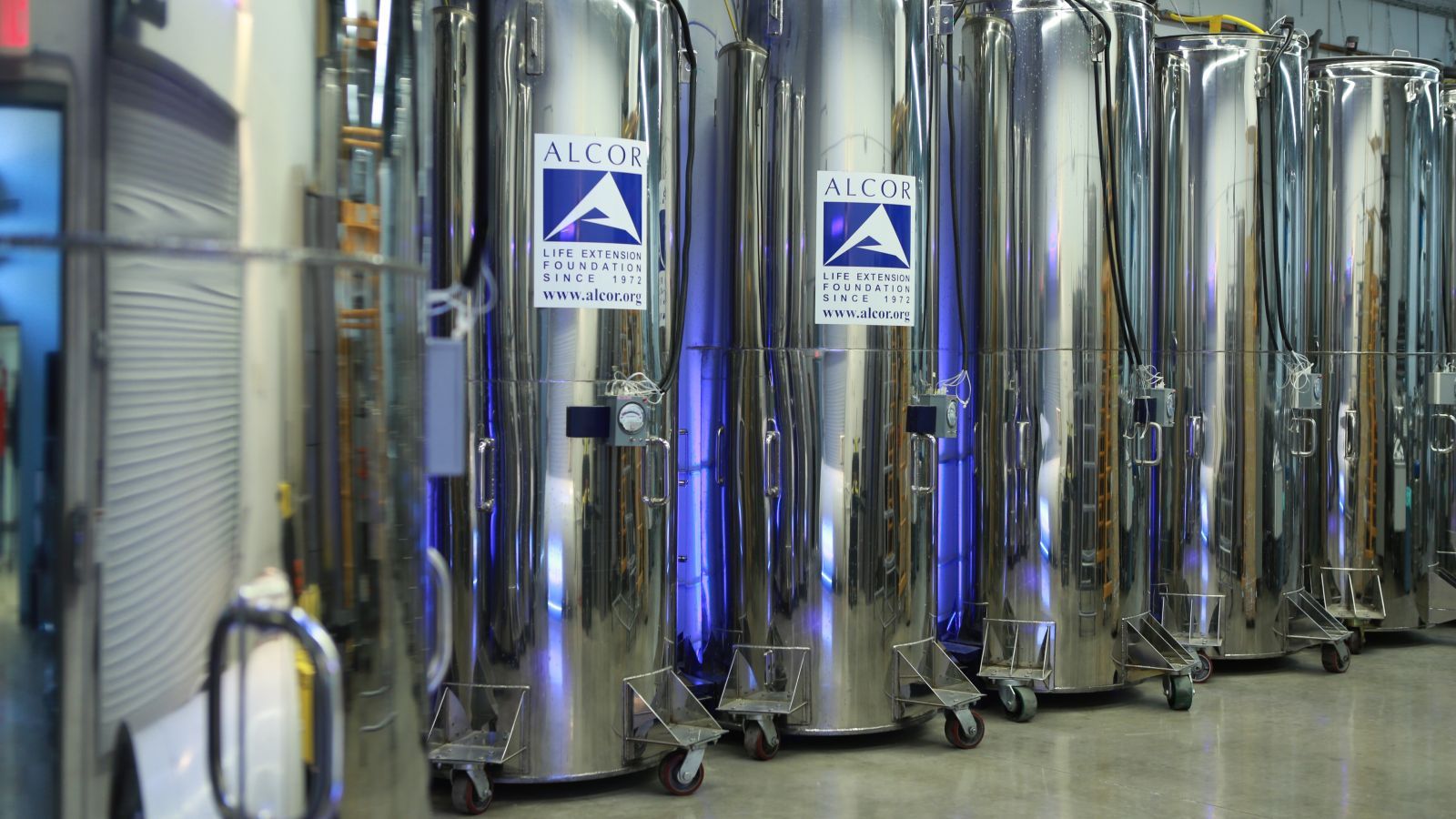
In a vat of liquid nitrogen on storage platform 17, the youngest person ever to be put into cryogenic storage has been waiting for the future for one year and eight months.

/* */