
OpenAI, the leading artificial intelligence research lab, had an eventful week with major announcements that give insight into its future plans and direction. This was covered in the recent All-In Podcast:
Category: futurism – Page 605
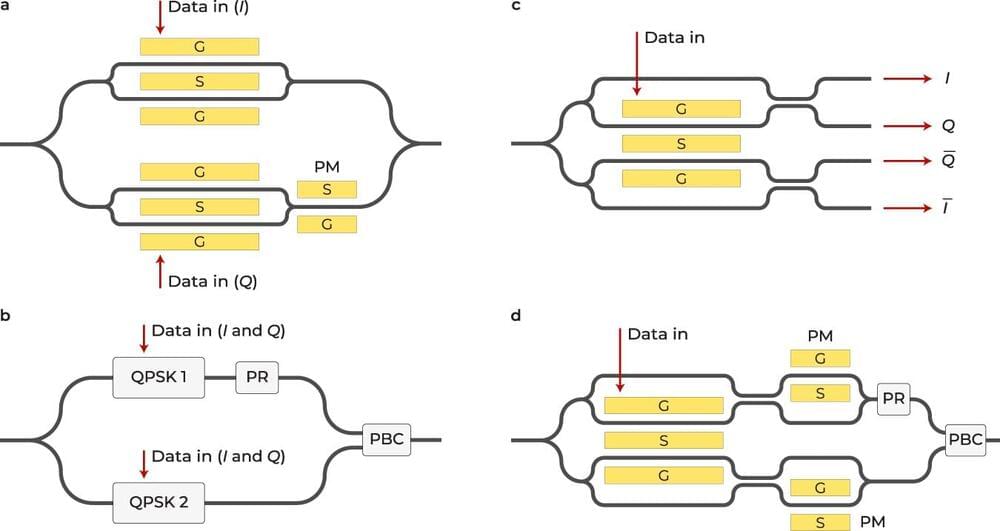
New technology could reduce lag, improve reliability of online gaming, meetings
Whether you’re battling foes in a virtual arena or collaborating with colleagues across the globe, lag-induced disruptions can be a major hindrance to seamless communication and immersive experiences.
That’s why researchers with the University of Central Florida’s College of Optics and Photonics (CREOL) and the University of California, Los Angeles, have developed new technology to make data transfer over optical fiber communication faster and more efficient.
Their new development, a novel class of optical modulators, is detailed in a new study published recently in the journal Nature Communications. Modulators can be thought of as like a light switch that controls certain properties of data-carrying light in an optical communication system.
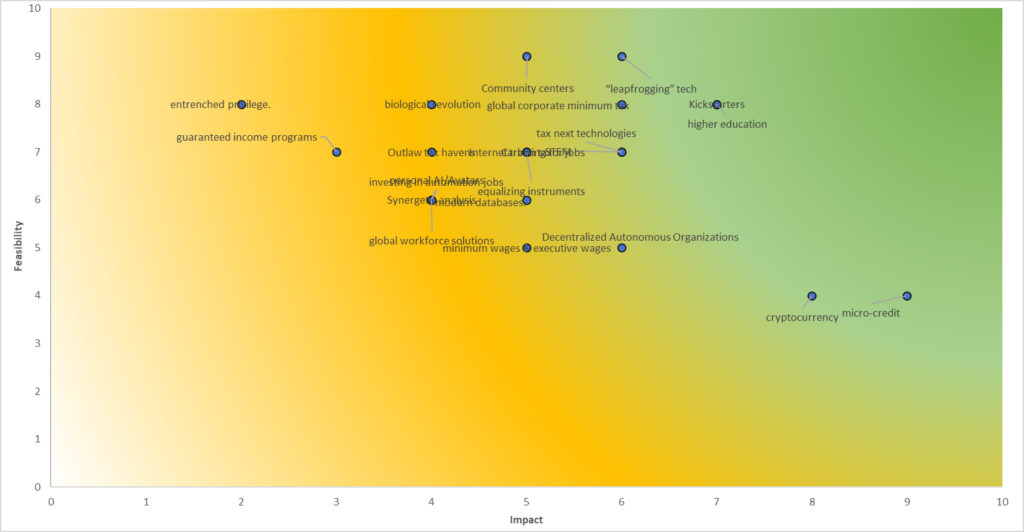
Actions for Wealth Inequality by the Millenium Project, Ranked
When working at the Millenium Project, a global think tank that publishes reports surrounding global problems, I decided to improve the way reports were presented by ranking the actions provided by the organization to adress the problem. I focused on the 23 actions in global challenge 7 (Rich-poor gap) and created a system focusing on two aspects: feasibility and impact.
Assigning scores from 1–10 for each of these aspects made sense as an action needs to be both implemented and impactful for it to adress the problem. By researching to assign these scores and multiplying them, I could get an overall idea of where an action would compare to another one. Below is a graph summarizing my results, followed by the details behind each ranking.
1. Make higher education more easily available to all.
Feasibility: 7

Reshaping Work: Adapting To The Future With Generative AI
Today’s generative AI revolution poses similar challenges and opportunities as the Industrial Revolution.

Google doesn’t play fair with Bing, says Microsoft CEO Satya Nadella
Google’s search engine dominance in the market share is causing a competitive disadvantage to other competitors like Bing, as it uses its power to improve its algorithm, ultimately placing it further.

The Smartest Man Who Ever Lived
A novelist transforms the physicist John von Neumann into a scientific demon.

Patch Confusion for Critical Exim Bug Puts Email Servers at Risk — Again
The good news is, so far, no exploits appear to have been released for the latest vulnerabilities, says Dustin Childs, head of threat awareness for Trend Micro’s Zero Day Initiative.
“We have no indication regarding the potential exploitability of these bugs,” he says. “We are not aware of any active exploits using these bugs.”
Exim is the most popular mail transfer agent on the Internet, accounting for 59% — or 253,000 — of identifiable mail servers on the Internet, according to a March 1 scan of MX servers. Postfix, another open source mail transfer agent, is the second most popular, with 149,000 detectable installations.

50 Years Ago, Scientists Dreamed of Lasers That Could Kick Off Nuclear Fusion
In the 1970s, lasers that could initiate nuclear fusion were a distant dream. Now, scientists are using such lasers to achieve fusion “ignition.”

Microsoft says it spent $100 Billion on Bing and is stopping Google from having a monopoly
He also touched upon the news of Google paying Apple to keep Google Search as the default search on iOS devices. Nadella questioned if Google would continue paying if it were the only player in the market. He also said that Apple was using Microsoft to “bid up the price” it received from Google.
Do you think Google would continue to pay Apple if there was no search competition? Why would they do that?
Satya Nadella also talked about Google’s dominance in the market saying, “You get up in the morning, you brush your teeth and you search on Google”. He also told the Google lawyer that Microsoft is “competing against someone who has a 97% share”.

The world’s first artificial energy island just got the go-ahead
The world’s first artificial energy island has secured its environmental permit, so it’s now all systems go in Belgium.
Princess Elisabeth Island is a pioneering electricity grid at sea that’s going to connect offshore wind farms to the Belgian mainland and also serve as a hub for future interconnectors with the UK and Denmark.
Belgian electricity transmission system operator Elia is the project’s developer, and obtaining the permit, which Elia applied for in January 2023, is a key milestone. Construction will take over two years, from March 2024 to August 2026.