Click on photo to start video.

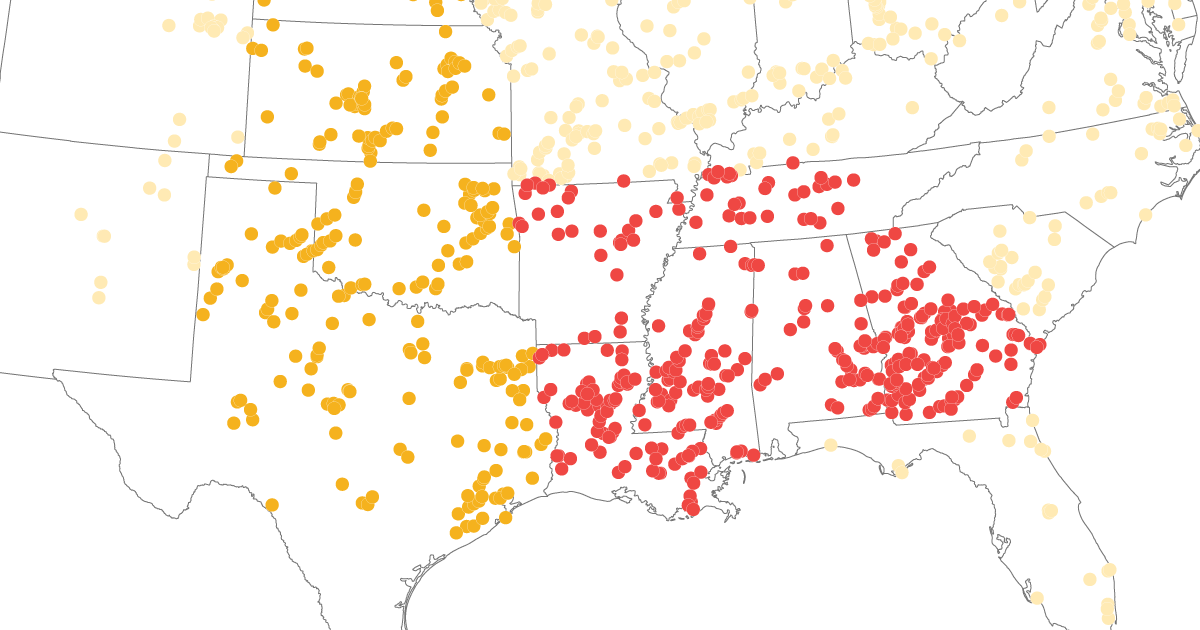
It’s no mystery why the stretch of America’s heartland from Iowa to Texas became known as Tornado Alley. Every spring, twisters up to two-and-a-half miles wide—wider than Manhattan—churn across flat fields, open roads and, typically, sparsely populated towns, causing hundreds of millions of dollars of property damage each year.
In terms of the number of twisters, Tornado Alley is still dominant. But in recent decades, the bulk of the destruction inflicted by these storms has shifted to the southeast U.S., a swath of states from Louisiana to Georgia meteorologists have dubbed Dixie Alley.
Since 1997, on average, tornadoes in Dixie Alley have caused more than $600 million in property damage annually (accounting for inflation) and killed more than 40 people a year, compared with $470 million in damage and 13 deaths a year in Tornado Alley. And that’s despite almost 3,000 more twisters touching down in Tornado Alley during that time.
In the 3rd millennium BCE, Mesopotamian kings recorded and interpreted their dreams on wax tablets. A thousand years later, Ancient Egyptians wrote a dream book listing over a hundred common dreams and their meanings. And in the years since, we haven’t paused in our quest to understand why we dream. So, after a great deal of scientific research, technological advancement, and persistence, we still don’t have any definitive answers, but we have some interesting theories. Here are seven reasons we might dream.
1. WE DREAM TO FULFILL OUR WISHES In the early 1900’s, Sigmund Freud proposed that while all of our dreams, including our nightmares, are a collection of images from our daily conscious lives. They also have symbolic meanings which relate to the fulfillment of our subconscious wishes. Freud theorized that everything we remember when we wake up from a dream is a symbolic representation of our unconscious, primitive thoughts, urges and desires. Freud believed that by analyzing those remembered elements, the unconscious content would be revealed to our conscious mind, and psychological issues stemming from its repression could be addressed and resolved.
A team of scientists unearthed a volcanic region previously hidden under ice sheets, with the geologist who led the team warning of destabilising consequences.
Edinburgh University researchers uncovered almost 100 volcanoes – with the highest almost as tall as Switzerland’s 3,970-metre Eiger.
Geologists think the region, which sits two kilometers below ice in west Antarctica, will dwarf east Africa’s volcanic ridge, which is rated as the world’s densest concentration of volcanoes.

“Tracing the next generation of farms, restaurants and kitchens in the Bay Area and beyond”

“If, as The Wall Street Journal suggests, we think of AI as a technology that predicts, it’s much easier to map its impact. We must push ourselves to do that and understand the future of work.”