The rise of artificial intelligence and impending end of Moore’s law means silicon chips are nearing the end of the line. Here are some alternatives.
Category: computing – Page 1,055
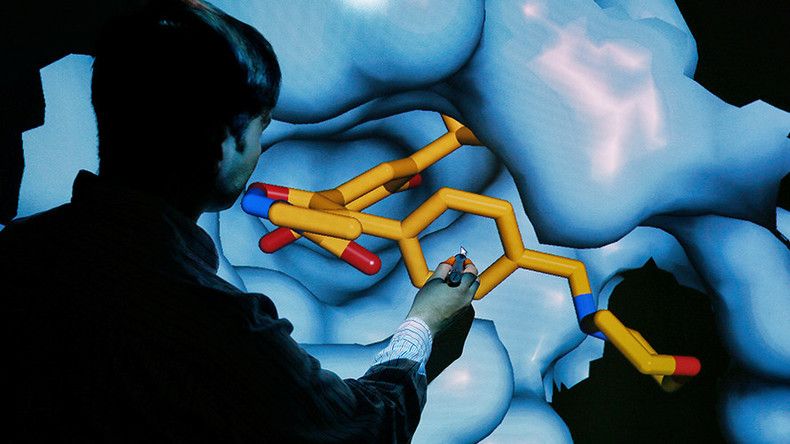
250Gbps: Russian scientists aim to revolutionize computing with plasma-driven antennas
A team of Russian physicists has found a way to tune silicon nanoparticles so they can process optical data at previously unattainable speed, paving the way for the creation of “ultracompact and ultrafast” processing devices.
The findings of the experiment-based survey conducted by scientists from Moscow Institute of Physics and Technology (MIPT) and ITMO University were published in the ACS Photonics journal in late July.
How AI Will Redefine Love
Artificial intelligence is beginning to disrupt entire industries from finance to medicine. Yet the most revolutionary application has yet to arrive—and it’s an existential one.
As thinking machines become more integrated into our lives, we must expect a transformation in how we define what it means to be conscious; what it means to live and to die; and ultimately, what it means to love a non-human being.
These questions are artfully explored in the plot of the 2013 sci-fi film, Her, which tells the story of a man who falls deeply in love with an intelligent operating system. This OS, Samantha, is designed to evolve and adapt her personality to appeal to Theodore. She has a very human voice and provides constant empathetic support. As Samantha’s psychological and intellectual capacities grow, so does Theodore and Samantha’s love for each other.
The Cyborgs Are Coming: Mankind Is On The Cusp Of Human Brain Augmentation With BrainGate Technology
BrainGate technology is no longer the stuff of science fiction. The science of interfacing human brains and other biological neurons with computers has been developing for well over a decade and now, the progress is amazing. While the human mind is an amazing organ, that surpasses any computer ever made. Many fantasize about improving on natural skills and abilities using technology in the form of some sort of brain implant. That dream is about to become a reality. In some ways, it already has according to the BrainGate website.
“BrainGate Company’s current and planned intellectual property (the technology) is based on technology that can sense, transmit, analyze and apply the language of neurons. BrainGate consists of a sensor that is implanted on the motor cortex of the brain and a device that analyzes brain signals.”
Cyborg and biohacking research history started in 1998 with Dr. Kevin Warwick and what he called Project Cyborg according to Digital Trends. Warwick began by implanting a simple radio-frequency identification chip or RFID in his own shoulder. He planned to use this chip to adjust lighting in his office and opening doors locked to others. The experiment was successful, and so Warwick went a bit further, experimenting on himself yet again. In 2002, Warwick had a surgeon implant a BrainGate technology device.
A First: Israeli Scientists “Have Used the Human Mind to Control Nano Robots Inside a Living Creature”
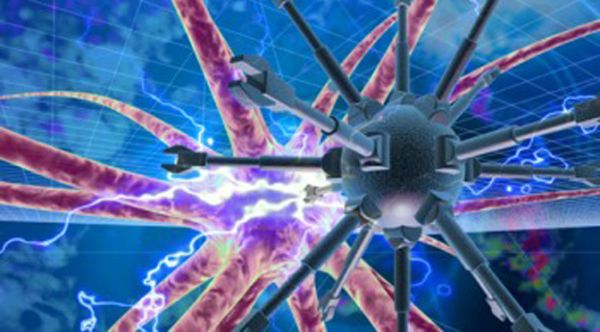
Researchers at Bar Ilan University and the Interdisciplinary Center in Herzliya, both in Israel, have developed new technology that allows tiny bots to release drugs into the body controlled by human thought alone. The test involved a man using his thoughts to activate nano robots inside a cockroach.
The bots have been built using a DNA origami structure with hollow shell-like components, and they come with a “gate” that can be opened and shut with the help of iron oxide nanoparticles that act as a “lock” – which can be prized open using electromagnetic energy.
The Israeli team believe the bots could help in controlled release of drugs over time. Led by Dr Ido Bachelet of Bar Ilan University, scientists demonstrated how to control this process with human brainwaves. Using a computer algorithm, they trained the system to detect when a person’s brain was under strain from doing mental arithmetic. The team then placed a fluorescent drug in the bots and injected them into various cockroaches that were placed inside an electromagnetic coil.
Ray Kurzweil Explores How Self-Driving Cars Will Choose Between Life or Death
Driving a motor vehicle requires making tough choices in the heat of the moment. Whether slamming on the brakes in traffic or speeding up before a light turns red, split-second decisions are often a choice between the lesser of two evils. Sometimes, a choice could lead to bodily injury or even a loss of life.
As more self-driving cars reach the road, life-and-death decisions once made by humans alone will increasingly shift to machines. Yet the idea of giving that responsibility over to a computer may be unsettling to some.
Self-driving cars have the potential to significantly reduce the tens of thousands of auto fatalities occurring yearly—but a reduction isn’t the same as elimination. In fact, some deaths will inevitably happen at the hands of computer algorithms once they make those decisions for us.

Inside the killer robot ‘arms race’ where the world’s five leading superpowers are secretly preparing for an all-out futuristic war
GAME OF DRONES
WORLD superpowers are engaged in a feverish “arms race” to develop the first killer robots completely removed from human control, the Sun Online can reveal.
These machines will mark a dramatic escalation in computer AI from the drones and robots currently in use, all of which still require a human to press the “kill button”.
CIA reveals Spacenet ‘AI in the sky’ that could constantly monitor activity on Earth
CIA reveals Spacenet ‘AI in the sky’ that could constantly monitor activity on Earth via high resolution satellites…
It sounds like something out of a sci-fi film — an AI that constantly monitors the Earth, looks for unusual activity.
However, CosmiQ Works, a division of the CIA’s venture arm, has revealed SpaceNet, a project with Amazon, satellite mapping firm DigitalGlobe and chip firm Nvidia to train algorithms to work out what’s happening on our planet.
The project will create a giant online database of hi-res images that AIs will be able to use to teach themselves — and started with images of Rio during the Olympics.
World’s Scientists: “Human Consciousness Will Remain a Mystery”
More insights on human conscientious in relation to its state after we die.
Personally, (this is only my own opinion) I believe much of the human conscientious will remain a mystery even in the living as it relates to the re-creation of the human brain and its thinking and decision making patterns on current technology. Namely because any doctor will tell you that a person’s own decisions (namely emotional decision making/ thinking) can be impacted by a whole multitude of factors beyond logical information such as the brain’s chemical balance, physical illness or even injury, etc. which inherently feeds into conscientious state. In order to try to replicate this model means predominantly development of a machine that is predominantly built with synthetic biology; and even then we will need to evolve this model to finally understand human conscientious more than we do today.
Sir Roger Penrose, a mathematical physicist at Oxford University, has asked “what right do we have to claim, as some might, that human beings are the only inhabitants of our planet blessed with an actual ability to be “aware”? It is hard to see how one could begin to develop a quantum-theoretical description of brain action when one might well have to regard the brain as “observing itself” all the time! Beneath all this technicality is the feeling that it is indeed “obvious” that the conscious mind cannot work like a computer, even though much of what is involved in mental activity might do so.