The AI tools were complemented by quantum biology and bioengineering approaches.
Philip Gray/ORNL, U.S. Dept. of Energy.
Combining several advances.
It can take years of focused laboratory work to determine how to make the highest quality materials for use in electronic and photonic devices. Researchers have now developed an autonomous system that can identify how to synthesize “best-in-class” materials for specific applications in hours or days.
The new system, called SmartDope, was developed to address a longstanding challenge regarding enhancing properties of materials called perovskite quantum dots via “doping.”
“These doped quantum dots are semiconductor nanocrystals that you have introduced specific impurities to in a targeted way, which alters their optical and physicochemical properties,” explains Milad Abolhasani, an associate professor of chemical engineering at North Carolina State University and corresponding author of the paper “Smart Dope: A Self-Driving Fluidic Lab for Accelerated Development of Doped Perovskite Quantum Dots,” published open access in the journal Advanced Energy Materials.
How precious metals were brought to Earth and preserved in a magma ocean #preciousmetals metals.
#earth.
#magma.
#giantimpacts.
#kilonova.
#neutronstars.
#cosmicexploration.
#earthformation.
#planetaryexploration.
#planetaryscience.
#geochemistry.
#mineralogy.
#geophysics.
#usa.
#china.
#southafrica.
#brazil
Imagine a skin cream that heals damage occurring throughout the day when your skin is exposed to sunlight or environmental toxins. That’s the potential of a synthetic, biomimetic melanin developed by scientists at Northwestern University.
In a new study, the scientists show that their synthetic melanin, mimicking the natural melanin in human skin, can be applied topically to injured skin, where it accelerates wound healing. These effects occur both in the skin itself and systemically in the body.
When applied in a cream, the synthetic melanin can protect skin from sun exposure and heals skin injured by sun damage or chemical burns, the scientists said. The technology works by scavenging free radicals, which are produced by injured skin such as a sunburn. Left unchecked, free radical activity damages cells and ultimately may result in skin aging and skin cancer.
Oak Ridge National Laboratory’s research in quantum biology and AI has significantly improved the efficiency of CRISPR Cas9 genome editing in microbes, aiding in renewable energy development.
Scientists at Oak Ridge National Laboratory (ORNL) used their expertise in quantum biology, artificial intelligence, and bioengineering to improve how CRISPR Cas9 genome editing tools work on organisms like microbes that can be modified to produce renewable fuels and chemicals.
CRISPR is a powerful tool for bioengineering, used to modify genetic code to improve an organism’s performance or to correct mutations. The CRISPR Cas9 tool relies on a single, unique guide RNA.
“Plastic recycling has been touted as a solution to the plastics pollution crisis, but toxic chemicals in plastics complicate their reuse and disposal and hinder recycling.”
As such, plastic recycling today is an essential part of waste management and environmental preservation initiatives. Recycling plastics minimizes the environmental impact of plastic manufacturing, conserves energy, and helps lower the need for new raw materials.
A crucial sustainable process
However, a new study is putting a damper on this crucial sustainable process. Researchers from the University of Gothenburg investigated recycled plastic pellets gathered from 13 different nations and discovered they contained hundreds of hazardous substances, including pharmaceuticals and pesticides.
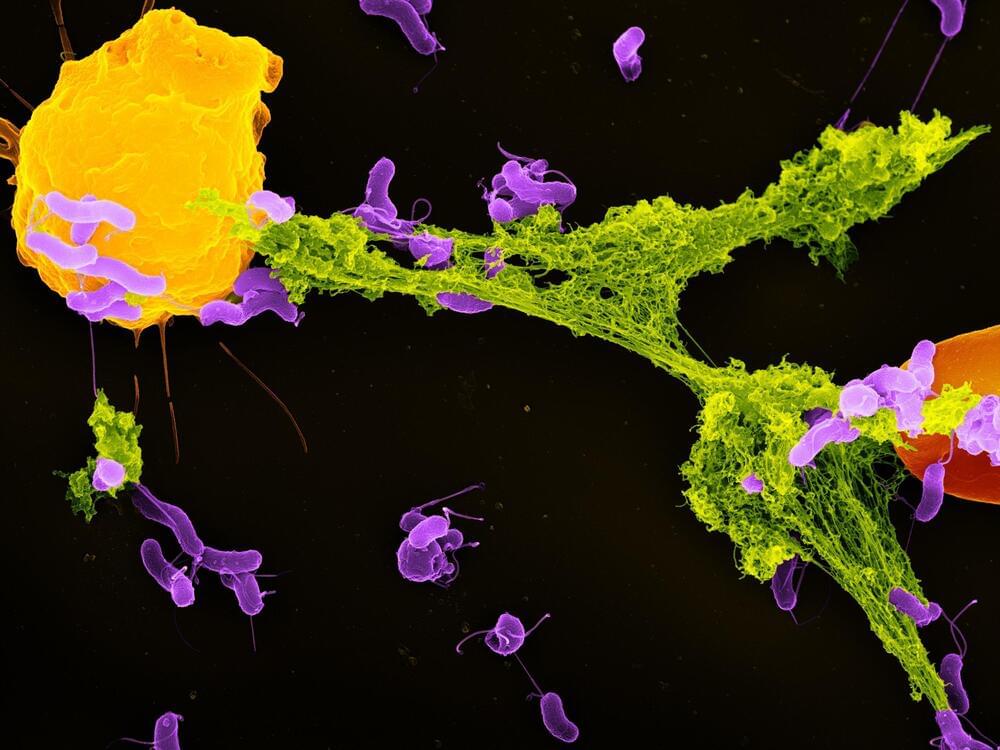
Researchers at the University of São Paulo (USP) in Brazil, partnering with colleagues in Australia, have identified a novel bacterial protein that can keep human cells healthy even when the cells have a heavy bacterial burden. The discovery could lead to new treatments for a wide array of diseases relating to mitochondrial dysfunction, such as cancer and auto-immune disorders. Mitochondria are organelles that supply most of the chemical energy needed to power cells’ biochemical reactions.
The study is published in the journal PNAS. The researchers analyzed more than 130 proteins released by Coxiella burnetii when this bacterium invades host cells, and found at least one to be capable of prolonging cell longevity by acting directly on mitochondria.
After invading host cells, C. burnetii releases a hitherto unknown protein, which the authors call mitochondrial coxiella effector F (MceF). MceF interacts with glutathione peroxidase 4 (GPX4), an anti-oxidant enzyme located in the mitochondria, to improve mitochondrial function by promoting an anti-oxidizing effect that averts cell damage and death, which may occur when pathogens replicate inside mammalian cells.
Lasers are essential tools for observing, detecting, and measuring things in the natural world that we can’t see with the naked eye. But the ability to perform these tasks is often restricted by the need to use expensive and large instruments.
In a newly published cover-story paper in the journal Science, researcher Qiushi Guo demonstrates a novel approach for creating high-performance ultrafast lasers on nanophotonic chips. His work centers on miniaturizing mode-lock lasers—a unique laser that emits a train of ultrashort, coherent light pulses in femtosecond intervals, which is an astonishing quadrillionth of a second.
Ultrafast mode-locked lasers are indispensable to unlocking the secrets of the fastest timescales in nature, such as the making or breaking of molecular bonds during chemical reactions, or light propagation in a turbulent medium. The high-speed, pulse-peak intensity and broad-spectrum coverage of mode-locked lasers have also enabled numerous photonics technologies, including optical atomic clocks, biological imaging, and computers that use light to calculate and process data.
The system shows potential for drug development in delicate environments such as coral reefs.
ACS
To better comprehend this, researchers have presented a proof-of-concept device that “sniffs” seawater, capturing dissolved chemicals for analysis. The underwater device “catches and concentrates dissolved substances generated by sponges or other marine animals while causing no damage to the source or the environment,” said a statement.