The US Army Research Laboratory (ARL) are at an advanced stage of with their synthetic biology research. The work could see bacteria being used to send signals and sense in a way similar to computers, the advantage being that it could potentially provide a more intuitive sensory experience to a piece of tech, and bypass some of the pitfalls unique to electrical structures. The research also has application for new 3D printing materials.
Category: bioengineering – Page 233
The Neuroscientist Who’s Building a Better Memory for Humans
In an epidsode of the dystopian near-future series, Black Mirror, a small, implantable device behind the ear grants the ability to remember, access, and replay every moment of your life in perfect detail, like a movie right before your eyes.
Theodore Berger, a biomedical engineer at the University of Southern California, can’t promise that level of perfect recall—perhaps for the better—but he is working on a memory prosthesis. The device, surgically implanted directly into the brain, mimics the function of a structure called the hippocampus by electrically stimulating the brain in a particular way to form memories—at least in rats and monkeys. And now, he’s testing one that could work in humans.
Berger’s device hinges on a theory about how the hippocampus transforms short-term memories, like where you deposited your keys, into long-term memories—so you can find them later. In his early experiments, he played a tone and then puffed air in a rabbit’s face, causing it to blink. Eventually, just playing the tone would make the rabbit blink, just like Pavlov’s famous salivating dogs. Berger recorded the hippocampus’ activity with electrodes, and as the rabbits learned to associate the tone with the air puff, patterns in those signals changed in a predictable way.
Building “genetic circuits” in cells could kill tumors
More on the cell circuited technology that will deprive cancer cells of oxygen.
Imagine having cells in your body that can actively repel cancer in a way that makes it theoretically impossible for you to suffer from it.
Researchers at the U.K.’s University of Southampton…have engineered cells with a so-called “built-in genetic circuit” capable of producing a molecule for inhibiting the ability of tumors to grow and survive in the body.
“There are various defense mechanisms built into human cells, such as proteins that spot DNA damage, but there are also gaps in this defense system that are exploited by disease,” Professor Ali Tavassoli, one of the lead authors of the paper …“We were wondering if it is possible to equip human cells with the ability to sense and respond to a disease marker…”
Brain Implants that Augment the Human Brain Using AI
BMI implant leveraging AI.
You probably clicked on this article because the idea of using brain implants to allow artificial intelligence (AI) to read your brain sounds futuristic and fascinating. It is fascinating, but it’s not as futuristic as you might think. Before we start talking about brain implants and how to augment the human brain using AI, we need to put some context around human intelligence and why we might want to tinker with it.
We floated the idea before that gene editing techniques could allow us to promote genetic intelligence by performing gene editing at the germline. That’s one approach. As controversial as it might be, some solid scientific research shows that genetics does play a role in intelligence. For those of us who are already alive and well, this sort of intelligence enhancement won’t work. This is where we might look towards augmented intelligence. This sort of augmentation of the brain will firstly be preventative in that it will look to assist those who have age associated brain disorders as an example. In order for augmented intelligence to be feasible though, we need a read/write interface to the human brain. One company called Kernel might be looking to address this with a technology that takes a page out of science fiction.
Human cells with ‘built-in circuit’ can kill cancer cells
I have been evangelizing this for a while and glad to see others chiming in.
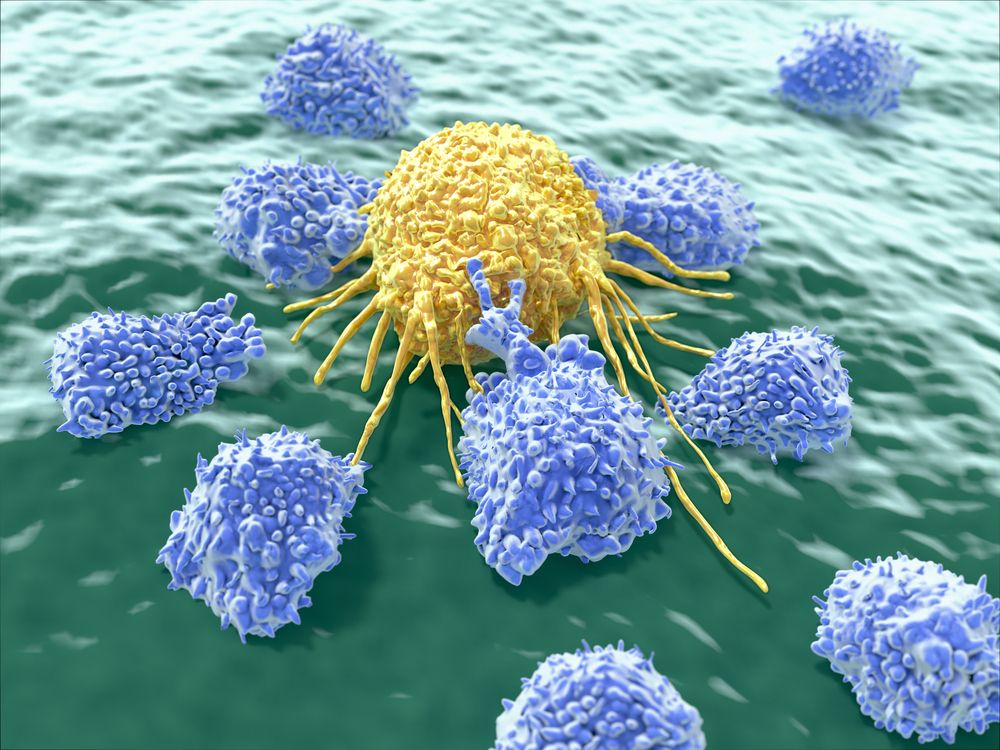
London, Nov 26 (IANS) Researchers have engineered cells with a “built-in genetic circuit” that produces a molecule that impairs the ability of cancer cells to survive and grow in their low oxygen environment.
The genetic circuit produces the machinery necessary for the production of a compound that inhibits a protein which has a significant and critical role in the growth and survival of tumours.
This results in the cancer cells being unable to survive in the low oxygen, low nutrient tumour micro-environment.
Biologist discusses a synthetic metabolic pathway that fixes carbon dioxide and synthetic biology
A synthetic metabolic pathway developed by Tobias Erb and his colleagues at the Max Planck Institute for Terrestrial Microbiology in Marburg converts CO2 from the atmosphere into organic matter more efficiently than plants are able to through photosynthesis. We asked the researcher what significance this process could have for climate protection, discussed the hurdles the research team had to overcome to achieve their goal, and looked at the new perspectives that synthetic biology opens up.
Does the synthetic metabolic pathway that fixes CO2 now represent an effective means of curbing climate change?
Firstly, we are aiming to understand the fundamental biological and chemical principles of how CO2 in gaseous form can be converted into organic molecules. Our primary motivation is not stopping climate change. We are seeking to develop atmospheric CO2 as a source of carbon for the future using biological methods. Producing a CO2-neutral process or even one that removes CO2 from the atmosphere and has a positive impact on the climate would be a fantastic secondary effect.
Genetic engineering: Who cleans up the mess?
WASHINGTON – Scientists believe genetic engineering experiments have the potential to wipe out malaria and other illnesses that kill millions of people every year.
But they also acknowledge they could have unintended consequences that could be catastrophic.
So, over the next four years, the Pentagon’s Defense Advanced Research Projects Agency, dubbed DARPA, plans to develop a cleanup crew for engineered genes deemed harmful to the eco-system.
SynBio is gearing up
We’re only starting in this space.
Synthetic Biology (SynBio) includes a large field of applications. Within this area biochemists combine engineering concepts and techniques with biology to design new genes that produce a specific protein. When this protein is an enzyme, bacteria and yeast in which such a gene is implanted can produce specific chemicals through a fermentation process. A large and growing number of businesses is active in this field. This became apparent once again at the EFIB-conference in Glasgow, last October. The workshop was chaired by John Cumbers, founder of the American SynBioBeta, an internet-site dedicated to sharing information and news on synthetic biology.