The future of intelligence is rapidly evolving with AI advancements, poised to transform numerous aspects of life, work, and existence, with exponential growth and sweeping changes expected in the near future.
## Questions to inspire discussion.
Strategic Investment & Career Focus.
🎯 Q: Which companies should I prioritize for investment or career opportunities in the AI era?
A: Focus on companies with the strongest AI models and those advancing energy abundance, as these will have the largest marginal impact on enabling the innermost loop of robots building fabs, chips, and AI data centers to accelerate exponentially.
For the first time in Earth’s history, one species can rewrite its own genome, rebuild its own brain, and design entirely new forms of intelligence. That combination makes Homo sapiens look less like evolution’s end point and more like a transitional form: an ancestral species whose descendants may be biological, mechanical, or something in between. The way future humans remember us may depend on how seriously our generation takes its role as the first conscious ancestor.
Imagine a descendant civilization, thousands or millions of years from now, trying to reconstruct its origins. Its members might not have bones or blood. They might be born in free-fall habitats orbiting other stars, or instantiated as software in computational substrates that current engineers can barely imagine. Their analysts would comb through archives from a small blue planet called Earth and conclude that the strange, warlike primates who built the first rockets and the first neural networks were not the culmination of evolution, but an ancestral phase.
That premise — the idea that present-day humans are an ancestral species for future humans and other intelligent beings — is beginning to migrate from science fiction into serious scientific and philosophical discussion. Advances in gene editing, synthetic biology, space medicine, brain–computer interfaces and artificial intelligence all point toward a future in which “intelligent beings” no longer form a single species, or even share a single kind of body. The more that picture comes into focus, the more it forces a rethinking of what “being human” means.
“Old systems of the past are collapsing, and new systems of the future are still to be born. I call this moment the great progression.”
Up next, We are living through a slowdown in human progress | Jason Crawford ► • We are living through a slowdown in human…
We are at a tipping point. In the next 25 years, technologies like AI, clean energy, and bioengineering are poised to reshape society on a scale few can imagine.
Peter Leyden draws on decades of observing technological revolutions and historical patterns to show how old systems collapse, new ones rise, and humanity faces both extraordinary risk and unprecedented opportunity.
Dr. Michael Levin is a professor in the Department of Biology at Tufts University and an associate faculty member at the Wyss Institute at Harvard. He directs the Allen Discovery Center at Tufts, where his team integrates biophysics, computational modeling, and behavioral science to study how cellular collectives make decisions during embryogenesis, regeneration, and cancer.
Levin’s research centers on diverse forms of intelligence and unconventional embodied minds, bridging conceptual theory, experimental biology, and translational work aimed at regenerative medicine. His lab also pioneers efforts in artificial intelligence and the bioengineering of novel living machines.
📖 Let’s take our stories back. Check out our latest book in the Tales for Now and Ever series, Rapunzel and the Evil Witch: https://rapunzelbook.com/
Join Fr. Stephen De Young in his Jubilees and the Nephilim course, now streaming live on The Symbolic World: https://www.thesymbolicworld.com/cour… 00:00 — Coming up 01:14 — Intro music 01:40 — Introduction 02:23 — What Michael does 06:19 — Example experiments 07:51 — Memories outside the brain 12:46 — Terminology: memory 13:59 — Communicate to biological cells 15:54 — Limitations? 17:39 — Platonic patterns 34:06 — Incarnation and constraints 39:26 — Causes 49:28 — New beings in new spaces 52:25 — What the Enlightenment dismissed 55:32 — Molecular medicine 57:36 — Subtle bodies 01:00:45 — Ethics 01:03:37 — Medical and meaning applications 01:11:42 — Frightening 01:14:31 — Against the status quo 01:19:03 — Should we dabble in this technology? 💻 Website and blog: http://www.thesymbolicworld.com 🔗 Linktree: https://linktr.ee/jonathanpageau 🔒 BECOME A PATRON: https://thesymbolicworld.com/subscribe Our website designers: https://www.resonancehq.io/ My intro was arranged and recorded by Matthew Wilkinson: https://matthewwilkinson.net/
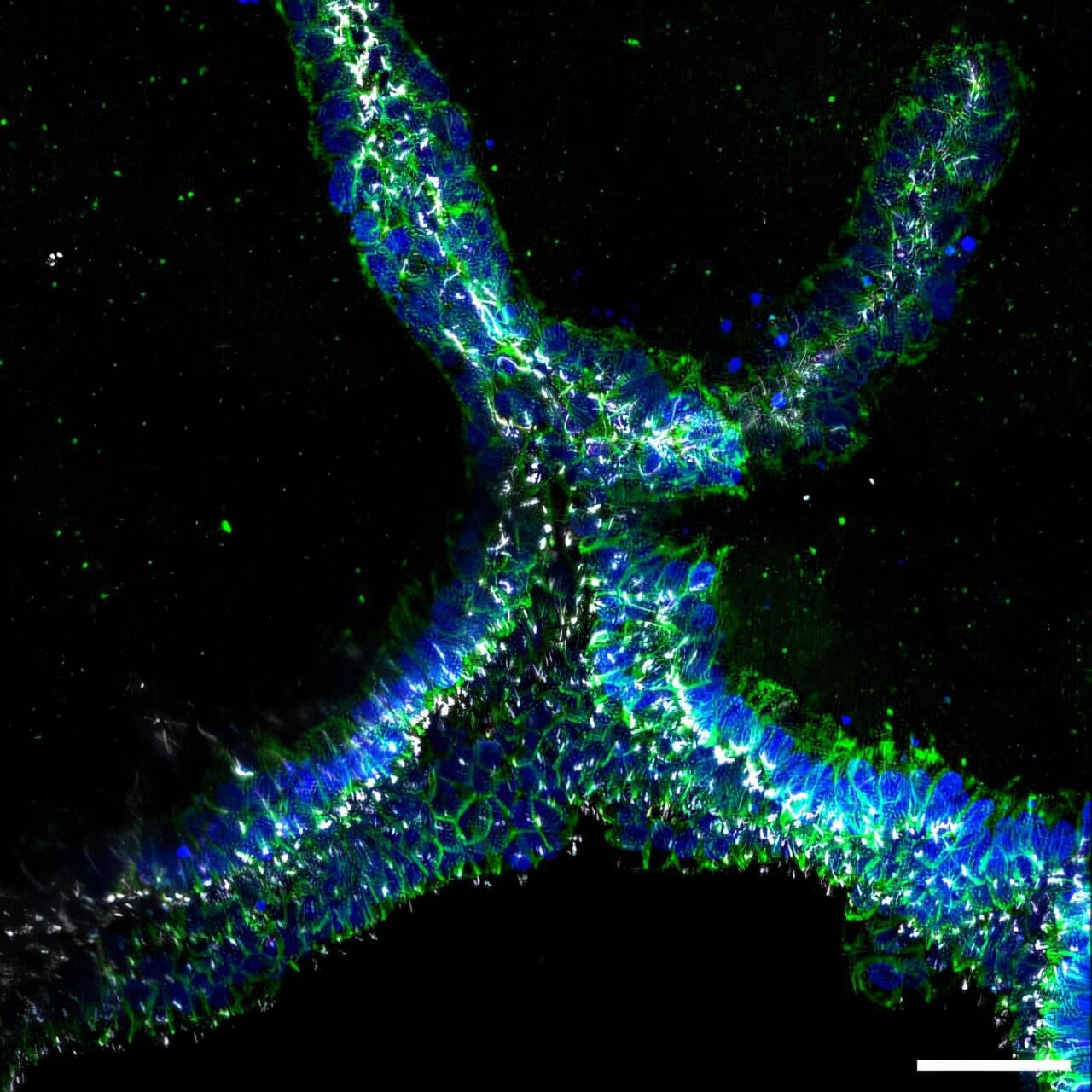
The human kidney filters about a cup of blood every minute, removing waste, excess fluid, and toxins from it, while also regulating blood pressure, balancing important electrolytes, activating Vitamin D, and helping the body produce red blood cells. This broad range of functions is achieved in part via the kidney’s complex organization. In its outer region, more than a million microscopic units, known as nephrons, filter blood, reabsorb necessary nutrients, and secrete waste in the form of urine.
To direct urine produced by this enormous number of blood-filtering units to a single ureter, the kidney establishes a highly branched three-dimensional, tree-like system of “collecting ducts” during its development. In addition to directing urine flow to the ureter and ultimately out of the kidney, collecting ducts reabsorb water that the body needs to retain, and maintain, the body’s balance of salts and acidity at healthy levels.
Finding ways to recreate this system of collecting ducts is the focus of researchers and bioengineers who are interested in understanding how duct defects cause certain kidney diseases, underdeveloped kidneys, or even the complete absence of a kidney. Being able to fabricate the kidney’s plumbing system from the bottom up would be a giant step toward tissue replacement therapies for many patients waiting for a kidney donation: In the U.S. alone, 90,000 patients are on the kidney transplant waiting list. However, rebuilding this highly branched fluid-transporting ductal system is a formidable challenge and not possible yet.
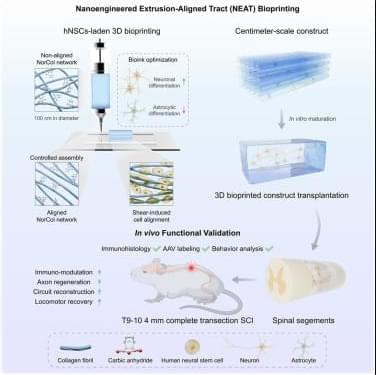
Gu et al. present NEAT, a nanoengineered extrusion-aligned tract bioprinting strategy that fabricates aligned, human neural stem cell-laden collagen hydrogel constructs through shear-induced fibrillar organization. In a rat model of complete spinal cord transection, NEAT enables axonal reconnection and functional locomotor recovery, demonstrating its translational potential for spinal cord repair and neural tissue engineering.
What does it take to turn bold ideas into life-saving medicine?
In this episode of The Big Question, we sit down with @MIT’s Dr. Robert Langer, one of the founding figures of bioengineering and among the most cited scientists in the world, to explore how engineering has reshaped modern healthcare. From early failures and rejected grants to breakthroughs that changed medicine, Langer reflects on a career built around persistence and problem-solving. His work helped lay the foundation for technologies that deliver large biological molecules, like proteins and RNA, into the body, a challenge once thought impossible. Those advances now underpin everything from targeted cancer therapies to the mRNA vaccines that transformed the COVID-19 response.
The conversation looks forward as well as back, diving into the future of medicine through engineered solutions such as artificial skin for burn victims, FDA-approved synthetic blood vessels, and organs-on-chips that mimic human biology to speed up drug testing while reducing reliance on animal models. Langer explains how nanoparticles safely carry genetic instructions into cells, how mRNA vaccines train the immune system without altering DNA, and why engineering delivery, getting the right treatment to the right place in the body, remains one of medicine’s biggest challenges. From personalized cancer vaccines to tissue engineering and rapid drug development, this episode reveals how science, persistence, and engineering come together to push the boundaries of what medicine can do next.
Chapters: 00:00 Engineering the Future of Medicine. 01:55 Failure, Persistence, and Scientific Breakthroughs. 05:30 From Chemical Engineering to Patient Care. 08:40 Solving the Drug Delivery Problem. 11:20 Delivering Proteins, RNA, and DNA 14:10 The Origins of mRNA Technology. 17:30 How mRNA Vaccines Work. 20:40 Speed and Scale in Vaccine Development. 23:30 What mRNA Makes Possible Next. 26:10 Trust, Misinformation, and Vaccine Science. 28:50 Engineering Tissues and Organs. 31:20 Artificial Skin and Synthetic Blood Vessels. 33:40 Organs on Chips and Drug Testing. 36:10 Why Science Always Moves Forward.
How Elon plans to launch a terawatt of GPUs into space.
## Elon Musk plans to launch a massive computing power of 1 terawatt of GPUs into space to advance AI, robotics, and make humanity multi-planetary, while ensuring responsible use and production. ## ## Questions to inspire discussion.
Space-Based AI Infrastructure.
Q: When will space-based data centers become economically superior to Earth-based ones? A: Space data centers will be the most economically compelling option in 30–36 months due to 5x more effective solar power (no batteries needed) and regulatory advantages in scaling compared to Earth.
☀️ Q: How much cheaper is space solar compared to ground solar? A: Space solar is 10x cheaper than ground solar because it requires no batteries and is 5x more effective, while Earth scaling faces tariffs and land/permit issues.
Q: What solar production capacity are SpaceX and Tesla planning? A: SpaceX and Tesla plan to produce 100 GW/year of solar cells for space, manufacturing from raw materials to finished cells in-house.