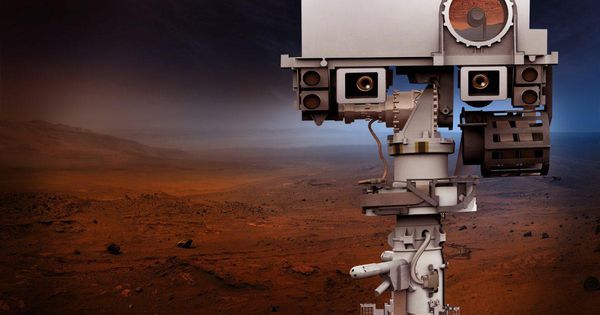
See the face of the new rover.
Many people believe we aren’t the only intelligent forms of life in the Universe. So why haven’t we found any yet?
We explore some of the ramifications arising from superflares on the evolutionary history of Earth, other planets in the solar system, and exoplanets. We propose that the most powerful superflares can serve as plausible drivers of extinction events, and that their periodicity corresponds to certain patterns in the terrestrial fossil diversity record. On the other hand, weaker superflares may play a positive role in enabling the origin of life through the formation of key organic compounds. Superflares could also prove to be quite detrimental to the evolution of complex life on present-day Mars and exoplanets in the habitable zone of M- and K-dwarfs. We conclude that the risk posed by superflares has not been sufficiently appreciated, and that humanity might potentially witness a superflare event in the next $\sim {10}^{3}$ years, leading to devastating economic and technological losses. In light of the many uncertainties and assumptions associated with our analysis, we recommend that these results should be viewed with due caution.

Giorgio Tsoukalos is in Manila for History Con 2018.
Giorgio Tsoukalos, of “Ancient Aliens,” one of History channel’s most popular and longest-running shows, believes that all ancient civilizations were visited by extraterrestrial beings at some point.
And yes, that includes ancient Philippines.
According to him, the country has some bizarre folktales that could prove his theories that humans aren’t alone in the universe.
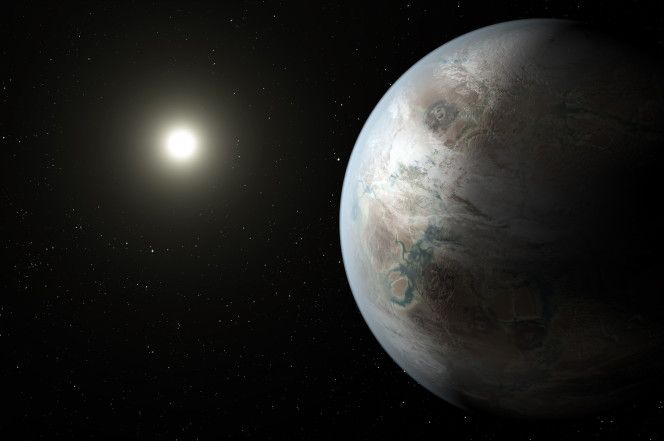
One of the biggest challenges for astronomers searching for habitable exoplanets is trying to match up newly discovered worlds with the increasingly long list of criteria that we believe are required for life to take root. A planet may be at a reasonable distance from its host star, but if that star is too young or too old, or just the wrong type, life as we know it would have a hard time there. Now, researchers are reporting the existence of several new planets that appear to meet all the requirements.
The research, which was conducted by scientists from the University of Cambridge and the Medical Research Council Laboratory of Molecular Biology, focuses on planets that are at a safe distance from their host star, but that are also getting enough UV light to trigger the chemical reactions that serve as the foundation for life to exist.
The researchers involved with the study used data from previous experiments that demonstrated the conditions under which the building blocks of life may have formed. Chemicals produced as a result of carbon-rich meteorites slamming into the early Earth are thought to have been a precursor for life, but the scientists still needed to account for the role that the sun played.
Extraterrestrial life in the universe might be rarer than scientists thought; here’s why.
Follow Elements for more!
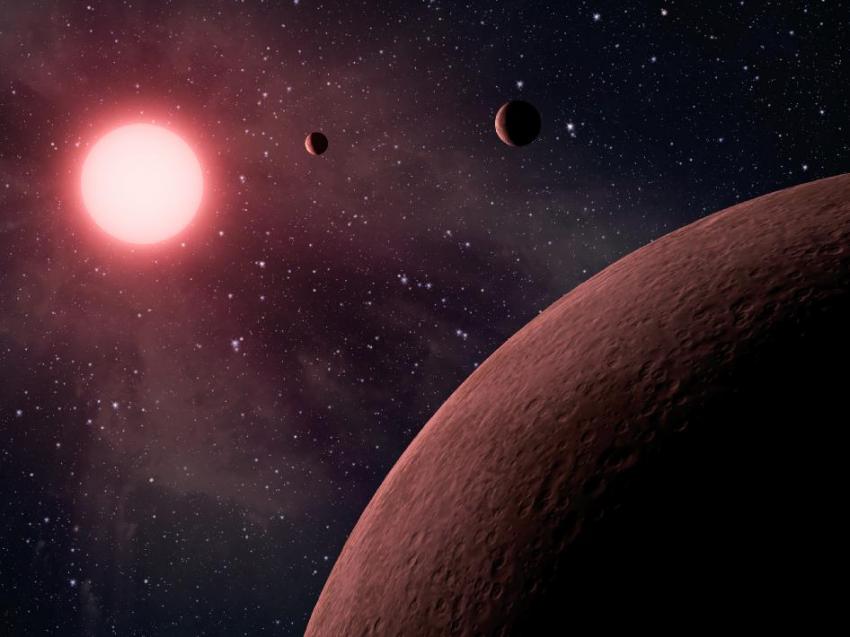
Scientists have identified a group of planets outside our solar system where the same chemical conditions that may have led to life on Earth exist.
The researchers, from the University of Cambridge and the Medical Research Council Laboratory of Molecular Biology (MRC LMB), found that the chances for life to develop on the surface of a rocky planet like Earth are connected to the type and strength of light given off by its host star.
Their study, published in the journal Science Advances, proposes that stars which give off sufficient ultraviolet (UV) light could kick-start life on their orbiting planets in the same way it likely developed on Earth, where the UV light powers a series of chemical reactions that produce the building blocks of life.
Scientists say they’ve found a huge lake of salty water buried deep beneath Mars’s surface.
Could there be life on Mars?
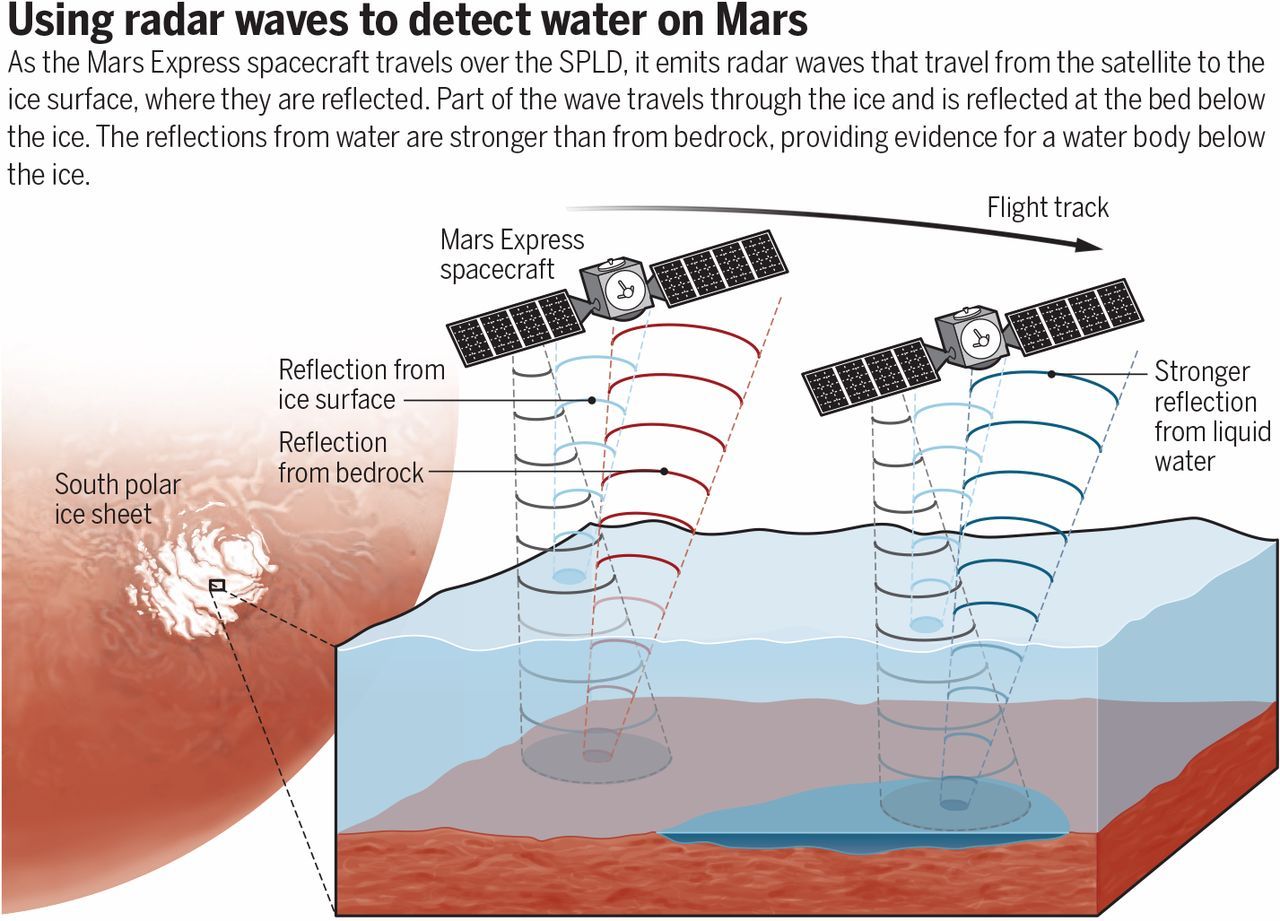
A water body exists below the Martian south polar ice cap.
Without water, no form of life as we know it could exist. There is therefore great interest in detecting liquid water on other planets of our Solar System. Landforms such as dry river valleys and lakes show that liquid water must have been present on Mars in the past (1). Nowadays, small amounts of gaseous water exist in the Martian atmosphere, and some water ice is found on the planet’s surface. Water droplets were seen condensing onto the Phoenix lander (2), and there may be reoccurring water activity on slopes during the Martian summer (3). However, stable bodies of liquid water have not been found on Mars. Published in Science’s First Release this week, Orosei et al. (4) report an analysis of radar data from the Mars Express mission that shows the existence of stable liquid water below 1.5 km of ice, close to the Martian south pole.
Ice caps similar to those on Earth exist at the Martian north and south poles, known as the North and South Polar Layered Deposits (NPLD and SPLD, respectively). More than 30 years ago, Clifford hypothesized that liquid water might be present below the Martian polar ice caps (5). Despite mean annual air temperatures of around −60°C, lakes exist below Earth’s Antarctic ice sheet (6). Glacier ice insulates the bed from the cold surface. Thus, temperatures at the base of the Antarctic ice sheet, which may be as thick as 4.8 km, can reach the pressure melting point of water; the melting point is reduced owing to the pressure of the ice layer above. Water at the ice base reduces basal friction, leading to increased flow speeds. Finding liquid water below the Martian ice caps might solve ongoing debates about whether the NPLD ice flow is due to ice deformation, deformation of the bed, or gliding over the bed or whether it is not flowing at all (7).
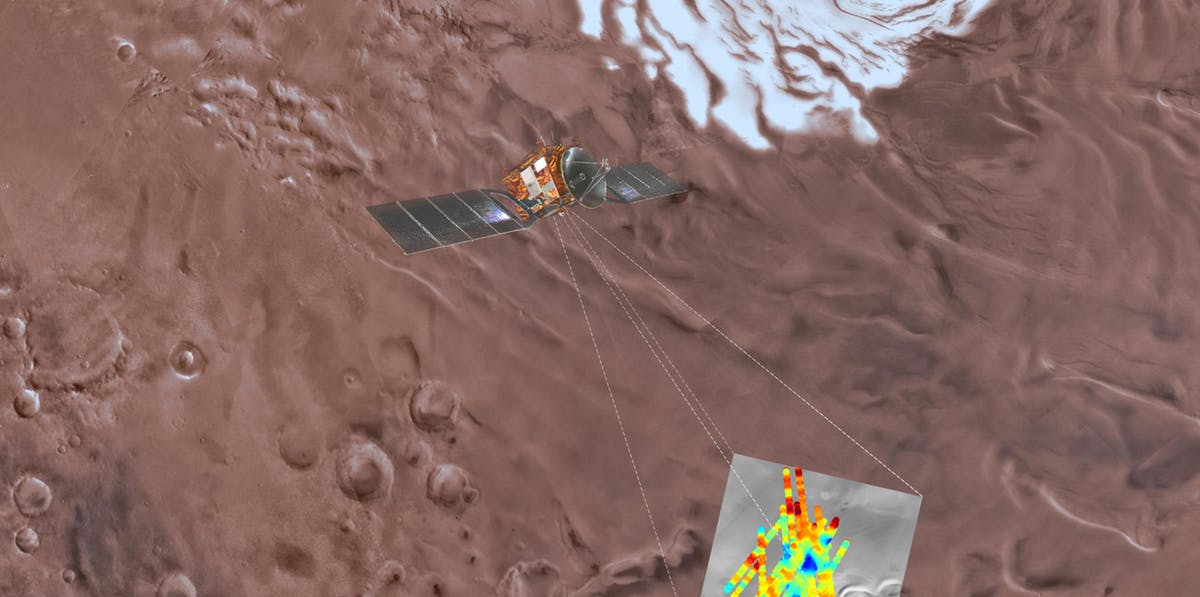
Scientists announced Wednesday that they’ve found evidence of a large body of water beneath the surface of Mars. It may not be little green men, but it’s pretty darn cool.
The announcement, which comes less than two months after the Curiosity Rover found evidence of organic molecules on Mars, adds one more piece to the puzzle for scientists searching the planet for signs that it could support life — or at least could have in the past. And while scientists have long known that Mars used to have liquid water billions of years ago, the fact that it could still have water is a big deal since there’s a possibility that this water may host living organisms.
The researchers involved in the discovery, a team of Italian astronomers and physicists, published their findings in a paper in the journal Science. In the paper, the team presents evidence collected from May 2012 to December 2015 by the MARSIS (Mars Advanced Radar for Subsurface and Ionosphere Sounding) experiment aboard the Mars Express spacecraft that shows evidence of a large body of liquid water.