SUGGESTED BOOK: Abundance: The Future Is Better Than You Think by Peter H. Diamandis and Steven Kotler ISBN-13: 978–1451614213
QUOTATION: “…Again, yesterday holds tomorrow hostage .… Memory is past. It is finite. Vision is future. It is infinite. Vision is greater than history…”
SUGGESTED BOOK: Abundance: The Future Is Better Than You Think by Peter H. Diamandis and Steven Kotler. ISBN-13: 978–1451614213 Regards,
QUOTATION: “…Digital code is what drives rapid speed growth today. It allows mergers like AOL Time Warner … It drives the Internet, TV, music, finance, IT, news coverage, research, manufacturing. A few countries and companies understood the change. That is how poor countries like Finland, Singapore, and Taiwan got so wealthy … So quickly … But a lot of folks just did not learn to read and write a new language … And even though they produced more and more goods, particularly commodities … And even though they restructured companies and governments … Cut budgets, raised taxes, built large factories and buildings … They got a lot poorer. (In 1938 the richest country per person in Asia was … the Philippines. In 1954, according to the World Bank, the most promising Asian economy was … Burma. Both remain commodity economies … Both are sidelined from the digital revolution … And you probably would not like to live in either country). Your world changed when you went ‘On Line.’ One day you used a fax or e-mail … And it soon became hard to conceive of living with only snail mail. If you understood this change early … And invested or worked in some of the companies driving the digital revolution … You are probably quite well off … (as a country and/or as an individual). If you came late, as a speculator, without understanding what a digital language does, or does not do … You probably lost a lot of money during the year 2000. Your world … and your language … are about to change again. The two nucleotide base pairs that code all life …A-T, C-G … Have already led some of the world’s largest companies … Monsanto … DuPont … Novartis … IBM … Hoechst … Compaq … GlaxoSmithKline … To declare that their future lies in life science. They have abandoned, sold, spun off core business divisions … And launched themselves into selling completely new products … Which is why so many chemical, seed, cosmetic, food, pharmaceutical companies … Are partnering, Merging, Growing. Some life-science companies will crash spectacularly … Others will get larger than Microsoft and Cisco … (Companies that are already larger than the economies of most of the world’s countries.). The world’s mega-mergers are going to be driven by digital and genetic code. Consider what is about to happen to medicine. You currently spend about nine times as much for doctors and medical interventions … As you do on medicines and prevention. In the measure that we understand how viruses, bacteria, and our bodies are programmed … And how they can be reprogrammed … Treatment will shift from emergency interventions … Toward deliberate and personalized prevention … (Just as dentistry did.). And we may end up spending just as much on pharmaceuticals as we do on doctors. These medicines do not have to be pills or injections … They could be a part of the food you eat every day, your soap or cosmetics … Perhaps you will inhale them or simply put various patches on your skin. (This is why Procter & Gamble is thinking of merging with a pharmaceutical company, why L’Oreal is hiring molecular biologists, and why Campbell’s is selling soups designed for hospital patients with specific diseases.)…”
RECOMMENDED BOOK: Revolutionary Wealth: How it will be created and how it will change our lives by Alvin Toffler and Heidi Toffler ISBN-13: 978–0385522076
DAILY QUOTE: By Michael Anissimov utters, “…One of the biggest flaws in the common conception of the future is that the future is something that happens to us, not something we create…”
RECOMMENDED BOOK:
Radical Evolution: The Promise and Peril of Enhancing Our Minds, Our Bodies — and What It Means to Be Human by Joel Garreau ISBN-13: 978–0767915038
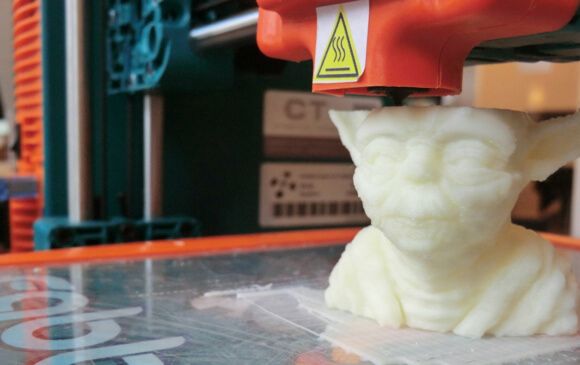
We here at Digital Trends are big fans of 3D printing. Like so many others, we see it as one of the most potentially disruptive technologies currently on the market – something that could substantially change the way we shop, work, and create. Problem is, at the moment, consumer-level 3D printers are mostly an expensive way to make cheap plastic trinkets.
Of course, that will soon change – perhaps sooner than you think. This week, newly launched startup MarkForged announced the world’s first 3D printer capable of printing objects in carbon fiber, the super-strong and lightweight material. Dubbed the Mark One, the 3D printer also prints in fiberglass, nylon, and PLA (the common plastic filament used by many 3D printers).
NEWCASTLE, ENGLAND — General Electric’s oil and gas division will start pilot production of 3D printed metal fuel nozzles for its gas turbines in the second half of this year, a major step towards using the technology for mass-manufactured parts in the industry.
The phrase “we want to lower the barrier of entry for brain-computer interfaces” may be the strongest indicator yet that you are, indeed, living in the future. In order to achieve that futuristic dream, Conor Russomanno and Joel Murphy have launched what’s become the infomercial of the 21st Century, a Kickstarter campaign. It’s called OpenBCI and it’s an open-source, 3D printable brain scanner.
OpenBCI is built around a 24-bit analog-to-digital converter called the ADS1299, from Texas Instruments, which measures EEG, as well as EMG (skeletal muscle) and ECG (heart) signals. It’s Arduino compatible, with designs and software all available on GitHub. After printing out the Spider Claw 3000 headset, you can connect the OpenBCI board from the campaign, along with electrodes to attach to your scalp, and begin measuring brain waves for a variety of uses. The software from OpenBCI is compatible with a number of different open source platforms, such as Processing, so that you can take the data and apply it to your own projects. 3D printing makes the OpenBCI even more accessible as it allows users with a variety of head shapes and sizes to print a headset tailored to their own head. Watch the Kickstarter video for a more detailed idea of how the OpenBCI project works:
At The University of Southern California, Professor Behrokh Khoshnevis has built a colossal 3D printer that can build a house in 24 hours. Khoshnevis’s robot comes equipped with a nozzle that spews out concrete and can build a home based on a set computer pattern.
We first saw this on MSN.com. The technology, known as Contour Crafting, could completely revolutionize the construction industry. Discover Magazine’s Brad Lemley explains that workers would lay down two rails for the robot to operate on.
Two-thousand-and-fourteen is already looking like a great year for 3D creativity. Assembled 3D printers are coming out priced at under 500 euros, new low-cost high-quality 3D scanners are launching and, if that weren’t enough, the first SpaceGlasses are going to be delivered in July.
3D printing is attractive to a lot of different people for a lot of different reasons, but in general its supporters talk about the economic and efficiency benefits; it can build things faster and easier than competing methods, bring down manufacturing costs and remove the need for large amounts of international shipping. That’s usually what you hear in defense of 3D printing — but now, Italian food corporation Barilla is looking to 3D print their art.