Toggle light / dark theme

What Does Amazon’s 3D Printing Store Say About Consumer 3D Printing In General?

— Singularity Hub

Consumer 3D printing has been creeping into mainstream awareness. Last year, office supply chain Staples announced they’d sell 3D Systems Cube 3D printers in stores, and UPS began offering 3D printing services at select locations.

Not to be outdone, massive online retailer Amazon dedicated an online storefront to 3D printers and supplies. And most recently, the firm added another storefront selling 3D printed products—bobbleheads, jewelry, smartphone cases.

Read more

Tiny 3D-Printed Bio-Bots Are Propelled by Muscle Cells

Written By: — Singularity Hub

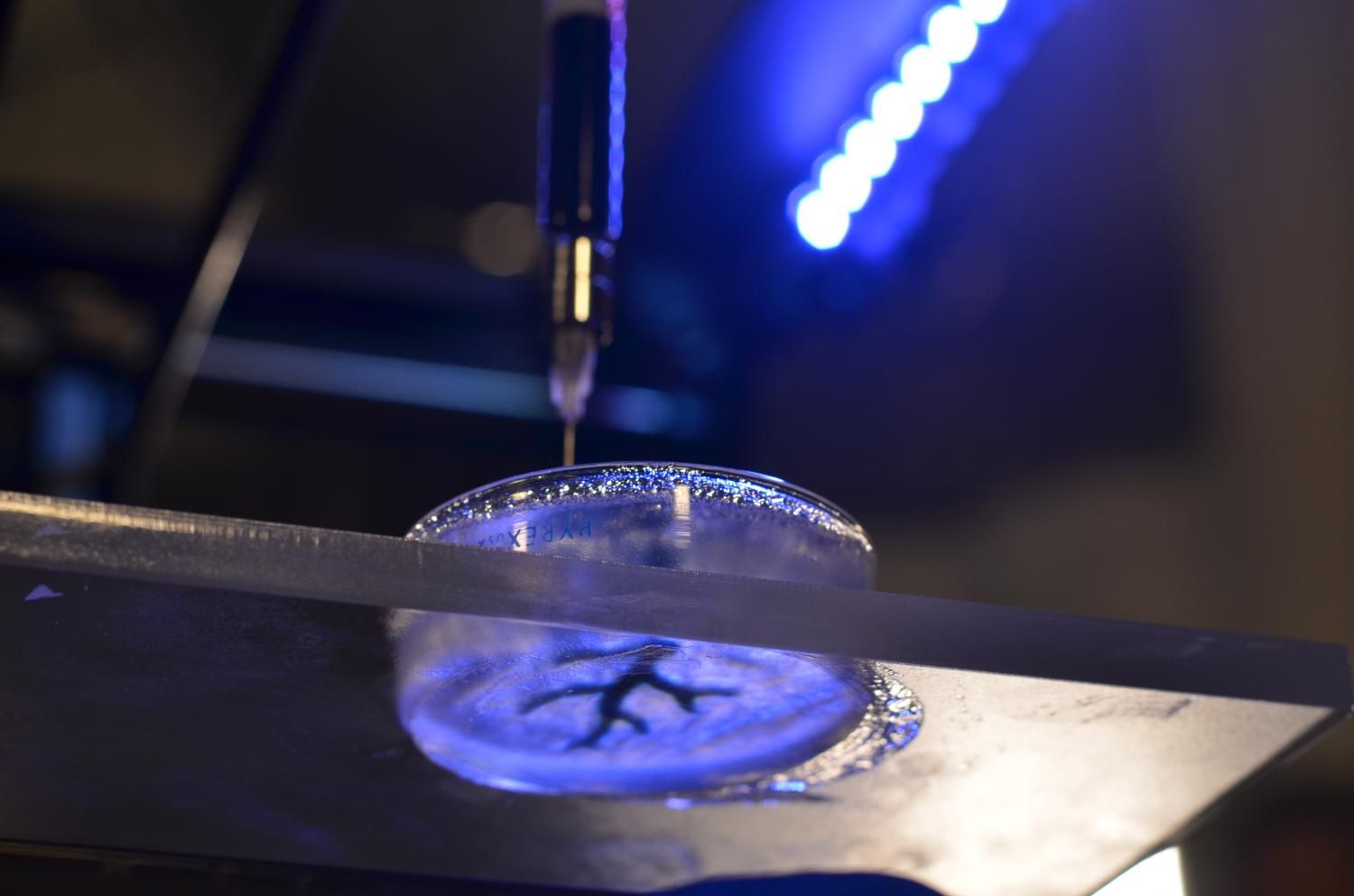
Robots come in all shapes and sizes—some are mechanical, and some aren’t. Last year, a team of scientists from the University of Illinois at Urbana-Champaign made a seven-millimeter-long 3D printed robot powered by the heart cells of a rat.

The device, made of 3D printed hydrogel—a water-based, biologically compatible gel—had two feet, one bigger than the other. The smaller, longer foot was coated in heart cells. Each time the cells contracted, the robot would crawl forward a few millimeters.

Read more

Super Size Me: Now You Can 3D Print a Life-sized Model of Yourself

— Inside 3DP

http://www.inside3dp.com/wp-content/uploads/2014/07/human-skeleton-163715_640.jpg

Forget those eight-inch mini-me models you can get for £60 if you happen to live near an Asda in Manchester, offering the service. Now, thanks to a firm in China, you can actually own a fully life-sized replica of yourself.

The company is called Qingdao Unique Products Develop Co. Ltd, and in order to print a life-size model, they have developed the world’s largest 3D printer. The Chinese company revealed their life-size 3D printed model and their 3D Wax Statue Printer at the World 3D printing technology Industry Conference and Exposition held in Qingdao in June.

Read more

‘In the Year 2054: Rifles will 3D print their own bullets’ – At Least According to Call of Duty Developer

by 3DPrint.com

It’s always fun predicting the future. People do it all the time because it is entertaining to imagine a world that we or our children will one day have the chance to experience. We’ve seen fictitious movies do this from time to time since the beginning of film. There was the hoverboard in ‘Back to the Future’, the jet packs in ‘The Rocketeer’, teleportation in Star Trek, and the list goes on. Some of these inventions have already become a reality, while we are still awaiting the arrival of others.

Another Star Trek prediction, was that of the Replicator, which was used to basically 3D print objects, especially food. These have already begun to take shape in current times, in the form of 3D printers. MakerBot even calls their consumer level 3D printer the ‘Replicator’. Sure it may not work the exact same way, but its close enough.

Now, one video game development company, Sledgehammer Games, is trying to predict the future in their upcoming video game. We’re sure that most of you are well aware of the Call of Duty video game series. ‘Call of Duty: Advanced Warfare’ is currently scheduled for release this coming Novembmer. In the game, which takes place in the year 2054, Sledgehammer Games will try their hands at predicting the future themselves. One of the more notable futuristic ideas in the game, is that of the 3D-Printer Rifle.

Read more

Forget the 3D Printer: 4D Printing Could Change Everything

By Randy Rieland — Smithsonian.com

These days, 3D printing seems to be at the core of most new new research ventures, whether it’s developing ways to print entire meals or recreating facial features to repair a patient’s face.

But Skylar Tibbits wants to up the ante: He’s hoping 4D printing will be the thing of the not-so-far future.

The name for his concept, Tibbits admits, was a bit lighthearted at first. At the Massachusetts Institute of Technology, Tibbits and researchers from the firms Stratasys and Autodesk Inc were trying to come up with a way of describing the objects they were creating on 3D printers—objects that not only could be printed, but thanks to geometric code, could also later change shape and transform on their own.

The name stuck, and now the process they developed—which turns code into “smart objects” that can self-assemble or change shape when confronted with a change in its environment—could very well pop up in a number of industries, from construction to athletic wear.

Read more

NASA is considering recycling plastic for 3D printing on the International Space Station

By — GigOm

When NASA sends a 3D printer to the International Space Station, it will dramatically improve the crew’s ability to fix unforeseen problems like broken parts and supply shortages. It will also reduce how much mass needs to be carried into space; instead of having a spare copy of everything, astronauts can just print parts as they are needed.

NASA is considering taking that reduction in material one step further by putting a plastic recycler on the ISS. The Made in Space printer that will board the ISS later this year prints in ABS plastic, which is the same type used in Legos and other common items. A recycler would allow the ISS crew to turn broken parts and other unneeded items back into the raw material on which the printer relies.

Read more

What to make of the film ‘Transcendence’? Show it in classrooms.


I recently saw the film Transcendence with a close friend. If you can get beyond Johnny Depp’s siliconised mugging of Marlon Brando and Rebecca Hall’s waddling through corridors of quantum computers, Transcendence provides much to think about. Even though Christopher Nolan of Inception fame was involved in the film’s production, the pyrotechnics are relatively subdued – at least by today’s standards. While this fact alone seems to have disappointed some viewers, it nevertheless enables you to focus on the dialogue and plot. The film is never boring, even though nothing about it is particularly brilliant. However, the film stays with you, and that’s a good sign. Mark Kermode at the Guardian was one of the few reviewers who did the film justice.

The main character, played by Depp, is ‘Will Caster’ (aka Ray Kurzweil, but perhaps also an allusion to Hans Castorp in Thomas Mann’s The Magic Mountain). Caster is an artificial intelligence researcher based at Berkeley who, with his wife Evelyn Caster (played by Hall), are trying to devise an algorithm capable of integrating all of earth’s knowledge to solve all of its its problems. (Caster calls this ‘transcendence’ but admits in the film that he means ‘singularity’.) They are part of a network of researchers doing similar things. Although British actors like Hall and the key colleague Paul Bettany (sporting a strange Euro-English accent) are main players in this film, the film itself appears to transpire entirely within the borders of the United States. This is a bit curious, since a running assumption of the film is that if you suspect a malevolent consciousness uploaded to the internet, then you should shut the whole thing down. But in this film at least, ‘the whole thing’ is limited to American cyberspace.

Before turning to two more general issues concerning the film, which I believe may have led both critics and viewers to leave unsatisfied, let me draw attention to a couple of nice touches. First, the leader of the ‘Revolutionary Independence from Technology’ (RIFT), whose actions propel the film’s plot, explains that she used to be an advanced AI researcher who defected upon witnessing the endless screams of a Rhesus monkey while its entire brain was being digitally uploaded. Once I suspended my disbelief in the occurrence of such an event, I appreciate it as a clever plot device for showing how one might quickly convert from being radically pro- to anti-AI, perhaps presaging future real-world targets for animal rights activists. Second, I liked the way in which quantum computing was highlighted and represented in the film. Again, what we see is entirely speculative, yet it highlights the promise that one day it may be possible to read nature as pure information that can be assembled according to need to produce what one wants, thereby rendering our nanotechnology capacities virtually limitless. 3D printing may be seen as a toy version of this dream.

Now on to the two more general issues, which viewers might find as faults, but I think are better treated as what the Greeks called aporias (i.e. open questions):

(1) I think this film is best understood as taking place in an alternative future projected from when, say, Ray Kurzweil first proposed ‘the age of spiritual machines’ (i.e. 1999). This is not the future as projected in, say, Spielberg’s Minority Report, in which the world has become so ‘Jobs-ified’, that everything is touch screen-based. In fact, the one moment where a screen is very openly touched proves inconclusive (i.e. when, just after the upload, Evelyn impulsively responds to Will being on the other side of the interface). This is still a world very much governed by keyboards (hence the symbolic opening shot where a keyboard is used as a doorstop in the cyber-meltdown world). Even the World Wide Web doesn’t seem to have the prominence one might expect in a film where computer screens are featured so heavily. Why is this the case? Perhaps because the script had been kicking around for a while (which is true). This may also explain why in Evelyn’s pep talk to funders includes a line about Einstein saying something ‘nearly fifty years ago’. (Einstein died in 1955.) Or, for that matter, why the FBI agent (played by Irish actor Cillian Murphy) looks like something out of a 1970s TV detective series, the on-site military commander looks like George C. Scott and the great quantum computing mecca is located in a town that looks frozen in the 1950s. Perhaps we are seeing here the dawn of ‘steampunk’ for the late 20th century.

(2) The film contains heavy Christian motifs, mainly surrounding Paul Bettany’s character, Max Waters, who turns out to be the only survivor of the core research team involved in uploading consciousness. He wears a cross around his neck, which pops up at several points in the film. Moreover, once Max is abducted by RIFT, he learns that his writings querying whether digital uploading enhances or obliterates humanity have been unwittingly inspirational. Max and Will can be contrasted in terms of where they stand in relation to the classic Faustian bargain: Max refuses what Will accepts (quite explicitly, in response to the person who turns out to be his assassin). At stake is whether our biblically privileged status as creatures entitles us to take the next step to outright deification, which in this case means merging with the source of all knowledge on the internet. To underscore the biblical dimension of dilemma, toward the end of the film, Max confronts Evelyn (Eve?) with the realization that she was the one who nudged Will toward this crisis. Yet, the film’s overall verdict on his Faustian fall is decidedly mixed. Once uploaded, Will does no permanent damage, despite the viewer’s expectations. On the contrary, like Jesus, he manages to cure the ill, and even when battling with the amassed powers of the US government and RIFT, he ends up not killing anyone. However, the viewer is led to think that Will 2.0 may have overstepped the line when he revealed his ability to monitor Evelyn’s thoughts. So the real transgression appears to lie in the violation of privacy. (The Snowdenistas would be pleased!) But the film leaves the future quite open, as what the viewer sees in the opening and final scenes looks more like the result of an extended blackout (and hints are given that some places have already begun the restore their ICT infrastructure) than anything resembling irreversible damage to life as we know it. One can read this as either a warning shot to greater damage ahead if we go down the ‘transcendence’ route, or that such a route might be worth pursuing if we get manage to sort out the ‘people issues’. Given that Max ends the film by eulogising Will and Evelyn’s attempts to benefit humanity, I read the film as cautiously optimistic about the prospects for ‘transcendence’, where the film’s plot is taken as offering a simulated trial run.

My own final judgement is that this film would be very good for classroom use to raise the entire range of issues surrounding what I have called ‘Humanity 2.0’.

3D Printed Cast With Ultrasonic Vibrations Helps Speed Up Recovery


So we’ve seen how 3D printers can be used to print medical-related gadgets, such as a portion of a skull, and while those are great and serve as viable alternatives compared to current implants and whatnot, wouldn’t it be better if those 3D printed medical gadgets/accessories could actively help your healing process as well?Well perhaps now it can, thanks to a prototype cast which not only acts as a regular cast, but at the same time uses ultrasonic vibrations that will help speed up the bone healing time. This design was put together by Turkish student, Denis Karasahin, who managed to win the 2014 Golden A’Design Award for his idea.

Read more

/* */