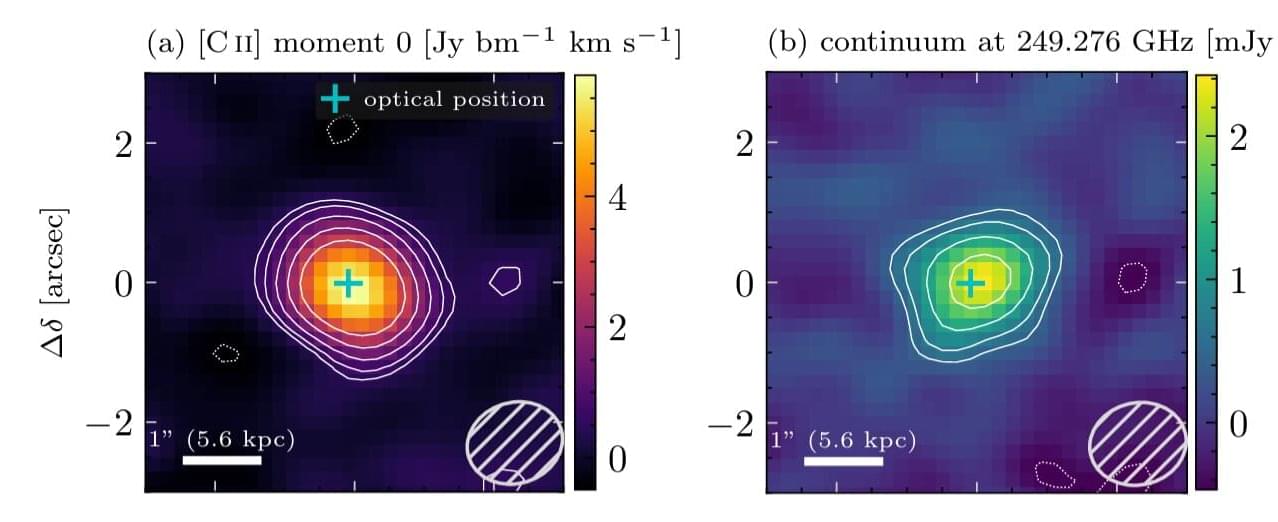
A new study reveals a dust-reddened quasar from a time when the universe was less than a billion years old. Located at a redshift of 6.5488, the object J1440+0019 contains a rapidly accreting supermassive black hole with a mass of about 1.1 billion suns. The paper was posted to the arXiv preprint server on Oct. 9.
Cosmic reionization is estimated to have happened roughly between 600 million and a billion years (redshifts 6 to 8) after the Big Bang. This epoch is when ionizing UV radiation from early stars and galaxies converted the universe’s neutral hydrogen gas into the ionized state seen today. Studying quasars and galaxies from this era can put a limit on the redshift at which it occurred.
Most quasars from this period are identified by their bright rest-frame ultraviolet light. This method may fail for quasars with even modest dust reddening—their UV emission may be heavily blocked by the surrounding dust envelope. Previous studies suggest that a large fraction of early active galactic nuclei (AGN) are obscured. Only a handful of reddened quasars are known at redshifts around and beyond 6, and they were found by different methods.