Toggle light / dark theme

Get the latest international news and world events from around the world.

Log in for authorized contributors

How Memories Form in the Brain: “Pulse Generators” Grow and Shrink

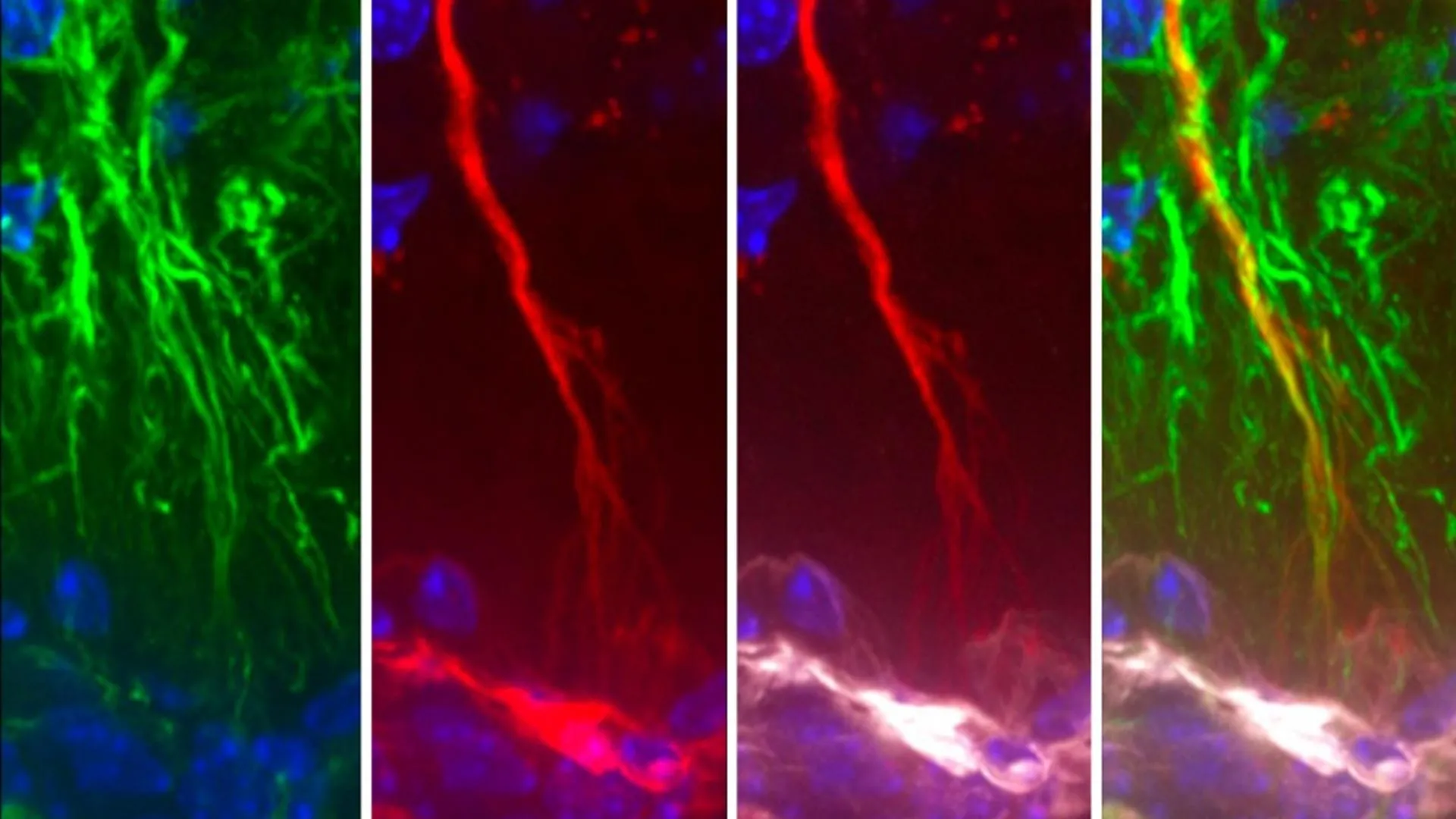
Memories and learning processes are based on changes in the brain’s neuronal connections and, as a result, in signal transmission between neurons. For the first time, DZNE researchers have observed an associated phenomenon in living brains – specifically in mice. This mechanism concerns the cellular pulse generator for neuronal signals (the “axonal initial segment”) and had previously only been documented in cell cultures and in brain samples. A team led by neuroscientist Jan Gründemann reports on this in the journal Nature Neuroscience, alongside experts from Switzerland, Italy, and Austria. Their study sheds light on the brain’s ability to adapt. Next, the researchers intend to investigate the significance of these findings in Alzheimer’s disease.

In the brain, neurons branch out and connect with each other to form a network through which electrical signals are actively exchanged. This network structure is an essential component of the brain’s “hardware” and is therefore fundamental to its function, especially with regard to learning processes and memory formation. However, this complex architecture and signal transmission across this network are not fixed; they can change as a result of experiences and events. This flexibility, also known as neuroplasticity, is the basis for the brain’s ability to adapt.


As memories are formed, the brain changes in measurable ways: synaptic “pulse generators” grow and shrink, revealing surprising insights from brain research.

‘Mini-Brains’ Reveal Hidden Signals of Schizophrenia And Bipolar Disorder

‘Mini-brains’ grown in the lab allow scientists to study brain wiring without interfering with brains in living people, and now a new study has used these scaled-down models to identify neural signatures associated with schizophrenia and bipolar disorder.

Toward high entropy material discovery for energy applications using computational and machine learning methods

npj Computational Materials, Article number: (2025) Cite this article

We are providing an unedited version of this manuscript to give early access to its findings. Before final publication, the manuscript will undergo further editing. Please note there may be errors present which affect the content, and all legal disclaimers apply.

ARK Robotics Research

Automation and robotics, particularly with the integration of AI, are transforming industries and poised to significantly impact the workforce, but are likely to lead to a reduction in work hours and increased productivity rather than total job destruction.

## Questions to inspire discussion.

Investment & Market Opportunity.

🤖 Q: What is the revenue potential for robotics by 2025? A: ARK Invest projects a $26 trillion global revenue opportunity across household and manufacturing robotics by 2025, driven by convergence of humanoid robots, AI, and computer vision technologies.

💰 Q: How should companies evaluate robot ROI for deployment? A: Robots are worth paying for based on task-specific capabilities delivering 2–10% productivity gains, unlike autonomous vehicles requiring full job performance—Roomba succeeded despite early limitations by being novel and time-saving for specific tasks.

Implementation Strategy.

Most sensitive radio observations to date find no evidence of technosignature from 3I/ATLAS

Since the interstellar object (ISO) 3I/ATLAS was first discovered on July 1, 2025, it has garnered much attention, including speculation, hopes and fears that it may somehow contain evidence of technologically advanced civilizations outside of our solar system.

Now, a new paper published on the arXiv preprint server details the findings from radio observations made at the 100-meter Green Bank Telescope as a part of the Breakthrough Listen program, designed to look for signs of alien life. The data were taken on December 18, 2025—the day before the object’s closest approach to Earth, and those hoping for evidence of advanced alien civilizations may not like the results.

ASKAP discovers a spectacular outflow in a nearby galaxy

Using the Australian Square Kilometer Array Pathfinder (ASKAP), an international team of astronomers has discovered a spectacular bipolar outflow from the disk of a nearby galaxy known as ESO 130-G012. The finding was reported in a paper published December 17 on the pre-print server arXiv.

ESO 130-G012 is an edge-on galaxy at a distance of some 55 million light years, with an estimated stellar mass of about 11 billion solar masses. The galaxy has a star-formation rate at a level of 0.2 solar masses per year and hosts a black hole approximately 50 million times more massive than the sun.

Hunting for dark matter axions with a quantum-powered haloscope

Axions are hypothetical light particles that could solve two different physics problems, as they could explain why some nuclear interactions don’t violate time symmetry and are also promising dark matter candidates. Dark matter is a type of matter that does not emit, reflect or absorb light, and has never been directly observed before.

Axions are very light particles theorized to have been produced in the early universe but that would still be present today. These particles are expected to interact very weakly with ordinary matter and sometimes convert into photons (i.e., light particles), particularly in the presence of a strong magnetic field.

The QUAX (Quest for Axions/QUaerere AXion) collaboration is a large group of researchers based at different institutes in Italy, which was established to search for axions using two haloscopes located in Italy at Laboratori Nazionali di Legnaro (LNL) and Laboratori Nazionali di Frascati (LNF), respectively.

AI model uses social media posts to predict unemployment rates ahead of official data

Social media posts about unemployment can predict official jobless claims up to two weeks before government data is released, according to a study. Unemployment can be tough, and people often post about it online.

Researcher Sam Fraiberger and colleagues recently developed an artificial intelligence model that identifies unemployment disclosures on social media. The work is published in the journal PNAS Nexus.

Data from 31.5 million Twitter users posting between 2020 and 2022 was used to train a transformer-based classifier called JoblessBERT to detect unemployment-related posts, even those that featured slang or misspellings, such as “I needa job!” The authors used demographic adjustments to account for Twitter’s non-representative user base, then forecast US unemployment insurance claims at national, state, and city levels.

Simple wipe test reveals hidden PFAS contamination on firefighter protective gear

The flames die down. The sirens fade. Firefighters peel off their gear, thinking the danger has passed. But in the quiet aftermath, another enemy lingers, an invisible film of “forever chemicals” clinging to jackets, pants and masks.

Researchers at Sylvester Comprehensive Cancer Center, part of the University of Miami Miller School of Medicine, have developed a way to see what the eye cannot.

A simple wipe test detected invisible cancer-linked “forever chemicals” on every set of firefighter gear examined, including breathing masks, according to new research from Sylvester Comprehensive Cancer Center, part of the University of Miami Miller School of Medicine. The non-destructive method offers fire departments a practical way to identify and reduce exposure to per-and polyfluoroalkyl substances (PFAS), chemicals tied to increased cancer risk that can linger on gear long after a fire is out.

/* */