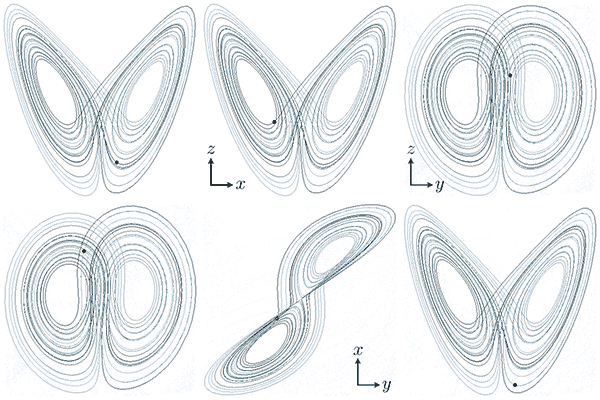
The Lorenz system is a three-dimensional classical dynamic system represented by three ordinary differential equations. It was first developed by the meteorologist Edward Lorenz and describes chaotic behavior of fluid movement when subjected to heating.
Although the Lorenz system is deterministic, its dynamics depend on the choice of initial parameters. For some ranges of parameters, the system is predictable as trajectories settle into fixed points or simple periodic orbits. In contrast, for other parameter ranges, the system becomes chaotic and the solutions never settle down but instead trace out the butterfly-shaped Lorenz attractor, popularly known as butterfly effect. In this regime, small differences in initial conditions grows exponentially making long-term prediction practically impossible.