Describing matter under extreme conditions, such as those found inside neutron stars, remains an unsolved problem. The density of such matter is equivalent to compressing around 100,000 Eiffel Towers into a single cubic centimeter. In particular, the properties of so-called quark matter—which consists of the universe’s fundamental building blocks, the quarks, and may exist in extremely dense regions—play a central role.
Researchers from TU Darmstadt and Goethe University Frankfurt have studied this matter and its thermodynamic properties. Their findings are published in the journal Physical Review Letters.
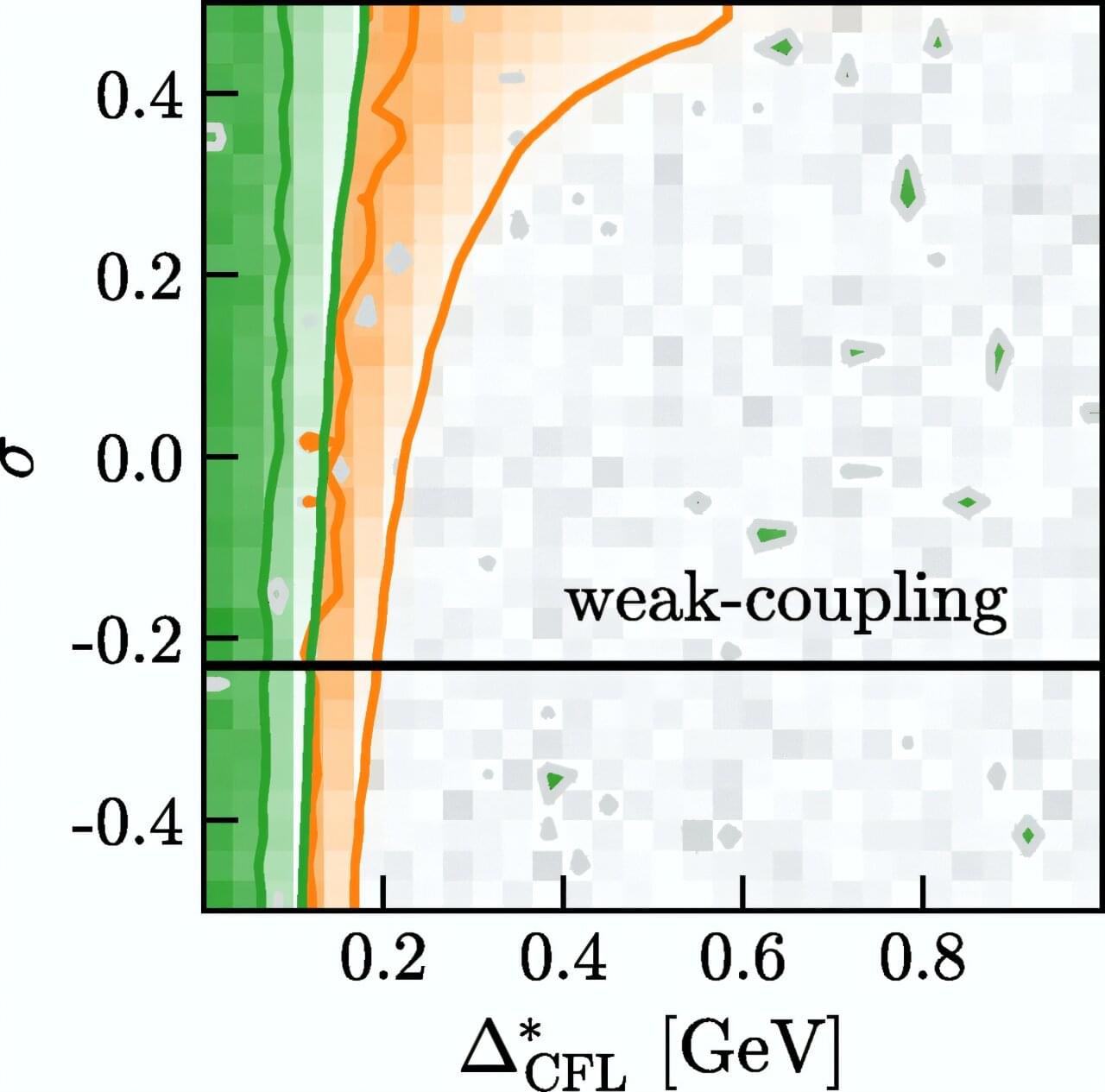
Theoretical studies suggest that quarks at very low temperatures enter a so-called color-superconducting state, which fundamentally alters the nature of matter. This state is analogous to the transition of an electron gas into an electrical superconductor—except that, instead of electrons, quarks pair up and create an energy gap in their excitation spectrum.