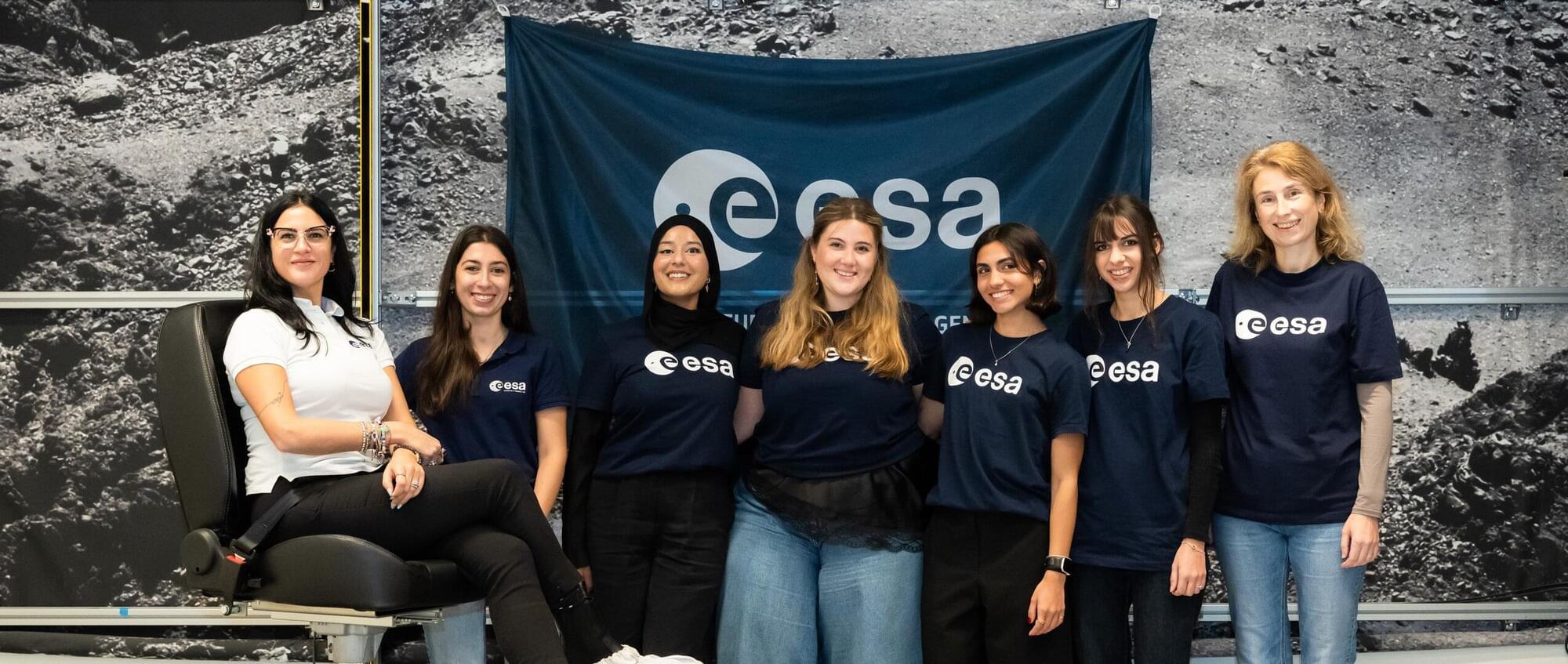
As part of the ESA Academy Experiments Programme, Team V-STARS carried out the first experiment with human participants in the Orbital Robotics Lab, investigating how microgravity affects the perception of verticality.
The V-STARS team, a collaboration between Birkbeck, University of London, and the University of Kent (UK), was selected to join the ESA Academy Experiments Programme in February 2025. After obtaining ethical approval from the United Kingdom and authorisation from the ESA Medical Board, the team was permitted to carry out their experiment in the Orbital Robotics Lab (ORL), located at ESTEC, the ESA site in the Netherlands.
The campaign involved test subjects seated on the ORL’s floating platform, wearing VR headsets while performing gravity-related perceptual tasks. The project investigates the use of Vestibular Stochastic Resonance — a phenomenon in which controlled noise enhances the sensitivity of a sensory system — to improve perception and potentially accelerate adaptation to microgravity. Over two weeks, the team tested more than 20 participants and has now returned to their universities to analyse the results.