“A strong magnetic field is very important for life on a planet,” said Dr. Miki Nakajima.
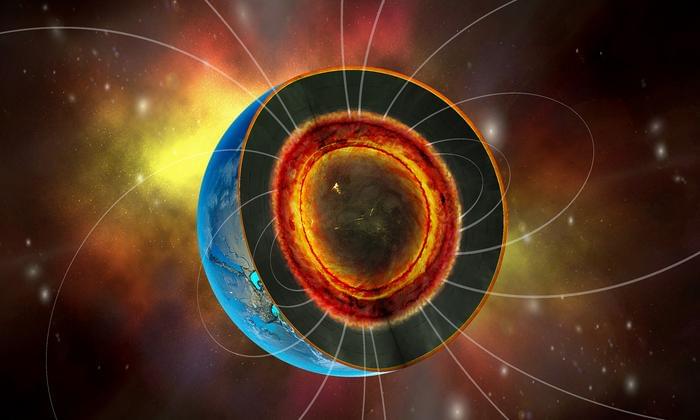
How can magnetic fields help determine the habitability of exoplanets? This is what a recent study published in Nature Astronomy hopes to address as a team of researchers from the University of Rochester and the University of California, Los Angeles investigated the formation processes that create magnetic fields on Earth and exoplanets slightly larger than Earth called super-Earths. This study has the potential to help scientists better understand planetary formation processes and the planetary conditions to search for life as we know it.
For the study, the researchers used a combination of laboratory experiments and computer models to simulate the formation processes of exoplanets, specifically focusing on the formation of the interior magma ocean responsible for generating the planet’s magnetic field like on Earth. The goal of the study was to estimate the long-term evolution of super-Earths, which are estimated to be between 1–10 Earth masses and 2–3 Earth radii. In the end, the researchers found that super-Earths between 3–6 Earth masses can produce magnetic fields that are stronger than Earths for up to several billion years.
“A strong magnetic field is very important for life on a planet,” said Dr. Miki Nakajima, who is an associate professor of Earth and Environmental Sciences at the University of Rochester and lead author of the study. “But most of the terrestrial planets in the solar system, such as Venus and Mars, do not have them because their cores don’t have the right physical conditions to generate a magnetic field. However, super-earths can produce dynamos in their core and/or magma, which can increase their planetary habitability.”