Passwd is a Google Workspace–only password manager using zero-knowledge AES-256 encryption, Google SSO, audit logs, and scalable team pricing.
Get the latest international news and world events from around the world.

Italy fines Apple $116 million over App Store privacy policy issues
Italy’s competition authority (AGCM) has fined Apple €98.6 million ($116 million) for using the App Tracking Transparency (ATT) privacy framework to abuse its dominant market position in mobile app advertising.
ATT requires developers to request consent to collect their data for targeted advertising before tracking them across websites, apps, and services owned by other companies. Apple introduced ATT in June 2020 and began enforcing it in April 2021 with the release of iOS 14.5 and iPadOS 14.5.
As the AGCM said in a Monday press release following a two-year investigation, Apple’s ATT policy requires third-party apps to display a standardized prompt requesting user permission to track activity across other companies’ apps and websites.
Microsoft rolls out hardware-accelerated BitLocker in Windows 11
Microsoft is rolling out hardware-accelerated BitLocker in Windows 11 to address growing performance and security concerns by leveraging the capabilities of system-on-a-chip and CPU.
BitLocker is the native full-disk encryption feature in Windows that protects data from being readable without proper authentication. During normal device boot, it relies on the Trusted Platform Module (TPM) to securely manage encryption keys and automatically unlock the drive.
Microsoft states that as non-volatile memory express (NVMe) storage has become more performant, BitLocker’s cryptographic operations have a more noticeable performance impact for gaming and video editing activities.

WebRAT malware spread via fake vulnerability exploits on GitHub
The WebRAT malware is now being distributed through GitHub repositories that claim to host proof-of-concept exploits for recently disclosed vulnerabilities.
Previously spread through pirated software and cheats for games like Roblox, Counter Strike, and Rust, WebRAT is a backdoor with info-stealing capabilities that emerged at the beginning of the year.
According to a report from Solar 4RAYS in May, WebRAT can steal credentials for Steam, Discord, and Telegram accounts, as well as cryptocurrency wallet data. It can also spy on victims through webcams and capture screenshots.

Malicious extensions in Chrome Web store steal user credentials
Two Chrome extensions in the Web Store named ‘Phantom Shuttle’ are posing as plugins for a proxy service to hijack user traffic and steal sensitive data.
Both extensions are still present in Chrome’s official marketplace at the time of writing and have been active since at least 2017, according to a report from researchers at the Socket supply-chain security platform.
Phantom Shuttle’s target audience is users in China, including foreign trade workers who need to test connectivity from various locations in the country.
Alzheimer’s Paper Retracted; Lipoic Acid and MS; Botched Autism Drug Rollout
Science Signaling retracted a 2017 paper that linked a specific amyloid form (amyloid-beta 56) to tau pathology after an investigation into allegations of data manipulation. Author Sylvain Lesné, PhD, who resigned from the University of Minnesota earlier this year, objected to the retraction.
Older adults who were awake more during the night performed worse on cognitive tests no matter how long they slept, data from the Einstein Aging Study showed. (Sleep Health)
Human herpesvirus 7 could be a contributing factor in multiple sclerosis (MS) etiology, a case-control study in Sweden suggested. (Brain Communications)
— News and commentary from the world of neurology and neuroscience.

Professor of Medicine Says Death Appears to Be Reversible
A near-death experience expert insists that one’s heart stopping doesn’t have to be the end, with current medical interventions that can help patients cheat death.
In an interview with The Telegraph, associate professor of medicine at New York University’s Langone Medical Center Sam Parnia insisted that by and large, the medical industry is still very behind on the concepts of death and dying.
According to Parnia, studies from the last five years — including some undertaken by his own eponymous lab at NYU — have suggested that our brains remain “salvageable for not only hours, but possibly days” after death.
Back from the brink: programmed cell revival for regeneration
Yay:3 death can be reversed at a cellular level and then regenerate it back to health.
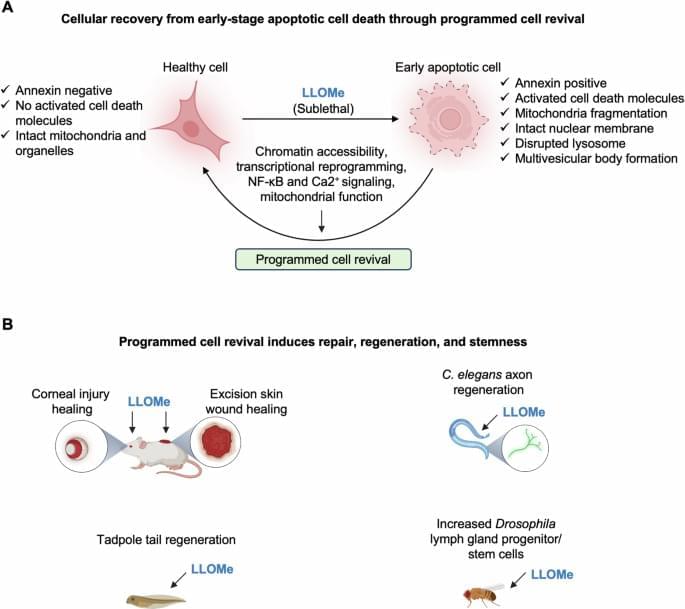
Therefore, in this issue of The EMBO Journal, Dhar et al sought to improve our understanding of the key molecular mechanisms that regulate the reversal of cell death and apply this knowledge to tissue repair (Dhar et al, 2025). In their study, the authors used a sublethal dose of the lysosomotropic agent L-Leucyl-L-leucine methyl ester (LLOMe) to induce apoptotic cell death (Johansson et al, 2010) in mouse embryonic fibroblasts (MEFs) and characterize the cell revival process. At the initial stage following LLOMe treatment, cells detach from the growth surface and display an apoptotic phenotype, suggesting they are undergoing cell death. However, at later stages, most of the floating cells reattach and regain their typical morphology, with a reduction in the activation of cell death molecules (Fig. 1A). These results indicate that cells can recover from the brink of cell death in response to LLOMe. This phenomenon occurs in multiple non-immune cell types, including primary MEFs and cardiac fibroblasts, as well as several cell lines from hamsters, mice, and humans (Dhar et al, 2025).
At the organellar level, shortly after treatment with LLOMe, microtubules, mitochondria, Golgi, and the endoplasmic reticulum are fragmented; however, these structures progressively recover within 2–3 h and return to near-normal morphology by 16 h post-treatment. Additionally, reviving cells display dramatic changes in endosomes, autophagosomes, and lysosomes, including the formation of abnormally large EEA1-positive early endosomes, LC3-positive autophagosomes, and Rab7/lysotracker-positive acidic vacuoles resembling multivesicular bodies. These large acidic compartments are enzymatically active and frequently surrounded by mitochondrial networks during revival, suggesting a role for metabolic support in driving the recovery.
Advancing Computers to Think Like Humans: Neuromorphic Meshing Explained
#neuromorphic #computing #futuretech
By Chuck Brooks, Skytop Contributor / December 3, 2025
Chuck Brooks serves as President and Consultant of Brooks Consulting International. Chuck also serves as an Adjunct Professor at Georgetown University in the Cyber Risk Management Program, where he teaches graduate courses on risk management, homeland security, and cybersecurity.
Chuck has received numerous global accolades for his work and promotion of cybersecurity. Recently, he was named the top cybersecurity expert to follow on social media, and also as one top cybersecurity leaders for 2024. He has also been named “Cybersecurity Person of the Year” by Cyber Express, Cybersecurity Marketer of the Year, and a “Top 5 Tech Person to Follow” by LinkedIn” where he has 120,000 followers on his profile.
As a thought leader, blogger, and event speaker, he has briefed the G20 on energy cybersecurity, The US Embassy to the Holy See, and the Vatican on global cybersecurity cooperation. He has served on two National Academy of Science Advisory groups, including one on digitalizing the USAF, and another on securing BioTech. He has also addressed USTRANSCOM on cybersecurity and serves on an industry/government Working group for DHS CISA focused on security space systems.