The new breed of electric hot rodders.
As anyone who has purchased jewelry can attest, platinum is expensive. That’s tough for consumers but also a serious hurdle for a promising source of electricity for vehicles: the hydrogen fuel cell, which relies on platinum.
Now a research team led by Bruce E. Koel, a professor of biological and chemical engineering at Princeton University, has opened a door to finding far cheaper alternatives. In a paper published April 4 in the journal Nature Communications, the researchers reported that a chemical compound based on hafnium worked about 60 percent as effectively as platinum-related materials but at about one-fifth the cost.
“We hope to find something that is more abundant and cheaper to catalyze reactions,” said Xiaofang Yang, principal scientist at HiT Nano Inc. and visiting collaborator at Princeton who is working with Koel on the project.
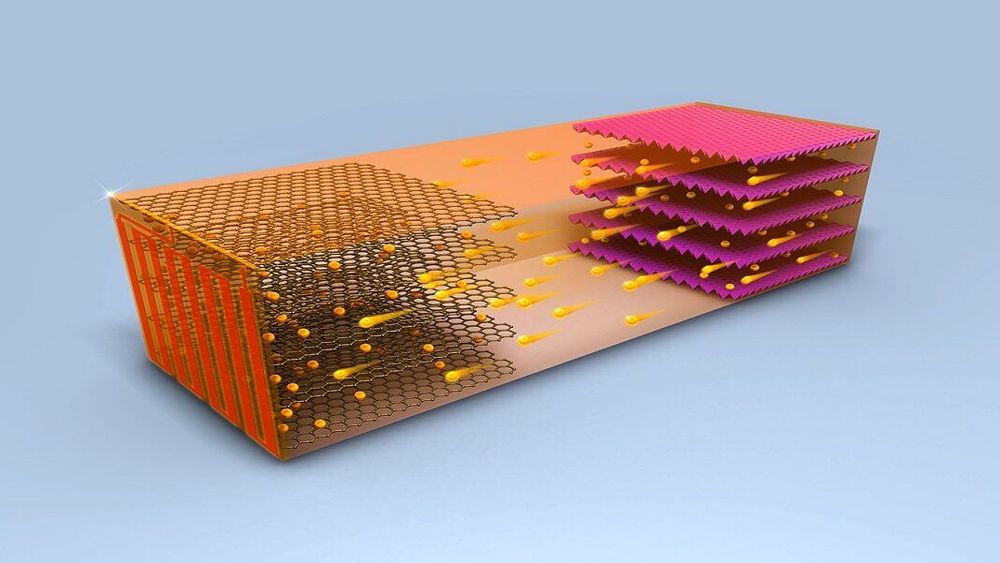
Researchers at Oregon State University have found that a chemical mechanism first described more than two centuries ago holds the potential to revolutionize energy storage for high-power applications like vehicles or electrical grids.
The research team led by Xiulei (David) Ji of OSU’s College of Science, along with collaborators at the Argonne National Laboratory, the University of California Riverside, and the Oak Ridge National Laboratory, are the first to demonstrate that diffusion may not be necessary to transport ionic charges inside a hydrated solid-state structure of a battery electrode.
“This discovery potentially will shift the whole paradigm of high-power electrochemical energy storage with new design principles for electrodes,” said Xianyong Wu, a postdoctoral scholar at OSU and the first author of the article.
A group of researchers at Sandia National Laboratories have developed a tool that can cross-train standard convolutional neural networks (CNN) to a spiking neural model that can be used on neuromorphic processors. The researchers claim that the conversion will enable deep learning applications to take advantage of the much better energy efficiency of neuromorphic hardware, which are designed to mimic the way the biological neurons work.
The tool, known as Whetstone, works by adjusting artificial neuron behavior during the training phase to only activate when it reaches an appropriate threshold. As a result, neuron activation become a binary choice – either it spikes or it doesn’t. By doing so, Whetstone converts an artificial neural network into a spiking neural network. The tool does this by using an incremental “sharpening process” (hence Whetstone) through each network layer until the activation becomes discrete.
According to Whetstone researcher Brad Aimone, this discrete activation greatly minimizes communication costs between the layers, and thus energy consumption, but with only minimal loss of accuracy. “We continue to be impressed that without dramatically changing what the networks look like, we can get very close to a standard neural net [in accuracy],” he says. “We’re usually within a percent or so on performance.”
There is a new battery type being hyped, with terms such as “Quantum Glass” battery or even “The Jesus Battery” and a claim that “It Will Ignite the Global $3 Trillion Electric Car Revolution.” Go and see it for yourself at investorplace.com (video transcript available from me), Forbes, and other financial information services.
This touted breakthrough in battery technology is the latest in a slew of innovative ideas that include “batteries made with sand,” “stretchable batteries,” “foam batteries,” “pee powered batteries,” “laser-made micro-super-capacitors” and more (13 Amazing Battery Innovations That Could Change The World).
TOKYO — Toyota is ramping up electric vehicle deployment plans, pulling forward its goal of selling 5.5 million electrified vehicles by five years and aiming to develop a solid-state battery by next summer as it races to meet a “sudden surge” of EV popularization.
Toyota now aims to sell some 5.5 million traditional gasoline-electric hybrids, plug-in hybrids, EVs and hydrogen fuel cell vehicles by 2025. Nearly 1 million of them could be pure EVs.
Executive Vice President Shigeki Terashi, Toyota’s r&d chief, outlined the new roadmap in a June 7 briefing about the company’s EV plans. In December 2017, the company had said it wanted to sell that many electrified vehicles by 2030, five years later than the revised outlook.
Michelin and General Motors have teamed up to literally reinvent the wheel with a new generation of high-tech airless tires.
The automotive companies’ Uptis (Unique Puncture-proof Tire System) prototype grabbed headlines after it was presented at the Movin’On Summit on sustainable mobility in Montreal this week.
It doesn’t have a traditional sidewall and carries a load by the top via a resin-embedded fiberglass material that Michelin already has 50 patents for, according to Car and Driver.