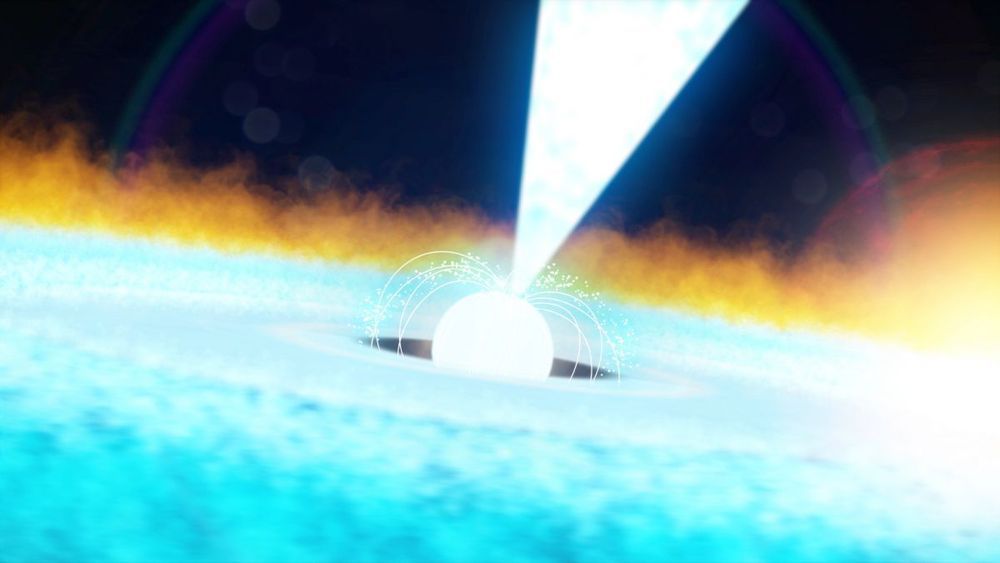
Scientists from Moscow Institute for Physics and Technology, Space Research Institute of the Russian Academy of Sciences (IKI), and Pulkovo Observatory discovered a unique neutron star, the magnetic field of which is apparent only when the star is seen under a certain angle relative to the observer. Previously, all neutron stars could be grouped into two big families: the first one included objects where the magnetic field manifests itself during the whole spin cycle, and the other one included objects where the magnetic field is not measured at all. The neutron star GRO J2058+42 studied by the researchers offers an insight into the internal structure of neutron star’s magnetic field only at a certain phase of its rotational period. The work was published in the Astrophysical Journal Letters and supported by the Russian Science Foundation.
The neutron star in the GRO J2058+42 system was discovered almost quarter of a century ago with the Compton Gamma-Ray Observatory (CGRO), USA. It belongs to the class of so-called transient X-ray pulsars. This object was studied using different instruments and nothing set it apart from other objects of its class. Only recent observations with the NuSTAR space observatory that has an outstanding combination of the high energy resolution (400 eV) and extremely wide energy range (3–79 keV), enabled the scientists to detect a peculiar feature in the pulsars emission, potentially making it the first object of its own family.
A cyclotron absorption line[1] was registered in the source energy spectrum[2] that allows estimating the magnetic field strength of the neutron star. Such an observational phenomenon (cyclotron line) is not new and is currently observed in approximately 30 X-ray pulsars. The uniqueness of the Russian scientists’ discovery is that this line manifests itself only when the neutron star is seen under a certain angle to the observer. This discovery became possible due to a detailed “tomographic” analysis of the system. X-ray spectra of the neutron star GROJ2058+42 were measured from ten different directions and only in one of them a significant depression in the emission intensity around 10 keV was found. This energy corresponds approximately to the magnetic field strength of 1012 G at the surface of the neutron star.