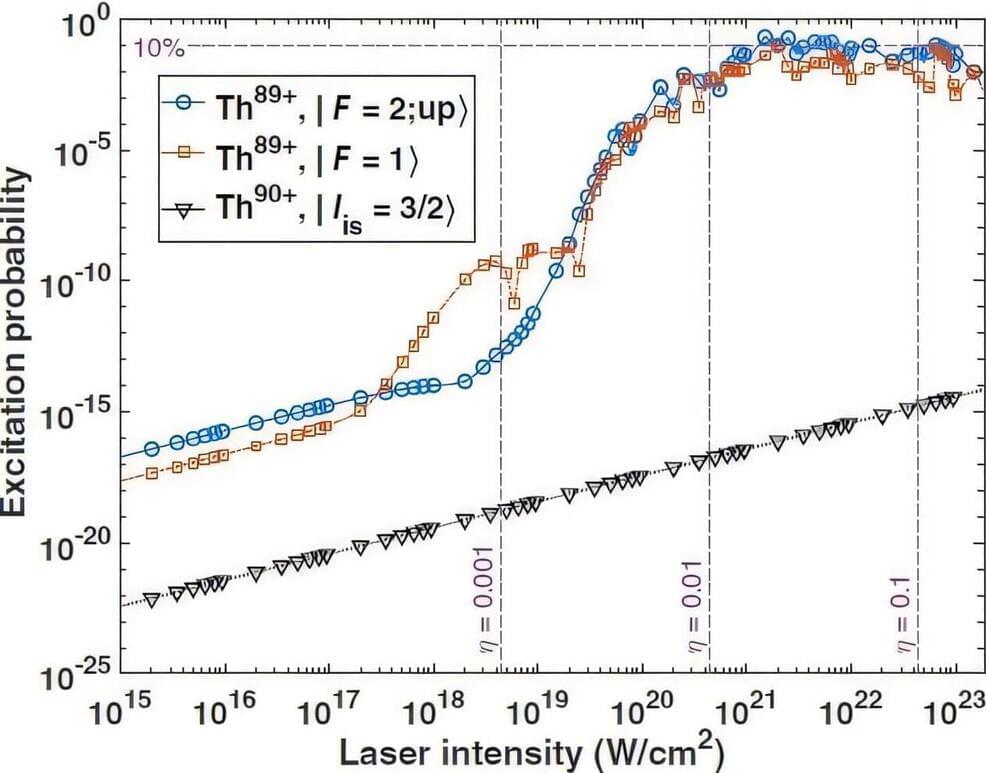
Why are there atomic clocks but no nuclear clocks? After all, an atom’s nucleus is typically surrounded by many electrons, so in principle it should be less susceptible to outside noise (in the form of light). A nucleus, for high-atomic number atoms, contains more particles than does the element’s electrons. It holds nearly the entire mass of the atom while taking up only about 1/100,000th of the atom’s space. While the first atomic clock was invented in 1949, no nuclear clock has yet been feasible.
Category: space – Page 258
How Earth’s Magnetic Field Influences Flows in the Planet’s Core
A “Little Earth Experiment” inside a giant magnet sheds light on so-far-unexplained flow patterns in Earth’s interior.
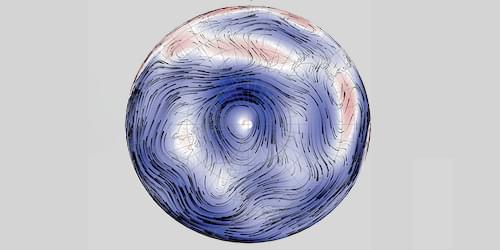
Earth’s inner core is a hot, solid ball—about 20% of Earth’s radius—made of an iron alloy. The planet’s outer core, beneath the rocky mantle, is a colder, liquid metal. Geophysics models explain that, since the movement of a liquid metal induces electrical currents, and currents induce a magnetic field, convection and rotation produce our planet’s magnetic fields. But these models typically neglect an important contribution: how Earth’s magnetic field influences the very flows that generate it. Alban Pothérat of Coventry University, UK, and collaborators have now developed a theory that accounts for such feedback and vetted it using a lab-based “Little Earth Experiment” [1]. Their results inform a model pinpointing processes that might explain the discrepancies between theoretical predictions and satellite observations of Earth, opening new perspectives on the study of geophysical flows.
Understanding flows in planetary interiors is a long-standing challenge. “If you don’t account for the fact that the magnetic field itself changes the flow, then you won’t get the right flow,” says Pothérat. Indeed, both satellite data from the European Space Agency’s Swarm mission and state-of-the-art numerical simulations indicate certain circulating core flows where liquid produced at the boundary of the inner core is fed into the outer core, moves upward toward the poles, and from there finally flows back inward (Fig. 1).

At 2.2 Billion Years Old, This Is The Oldest Impact Crater On Earth
Around 2.2 billion years ago, a massive space rock collided against our planet, leaving a massive scar.
Around 200 million years older than any other site like it on the planet’s surface, the so-called Yarrabubba impact structure is located in Australia.
Although the impact site is the oldest found to date, finding it was not easy.
Silent Signals: The Breakthrough Technology Powering Faster Space Data
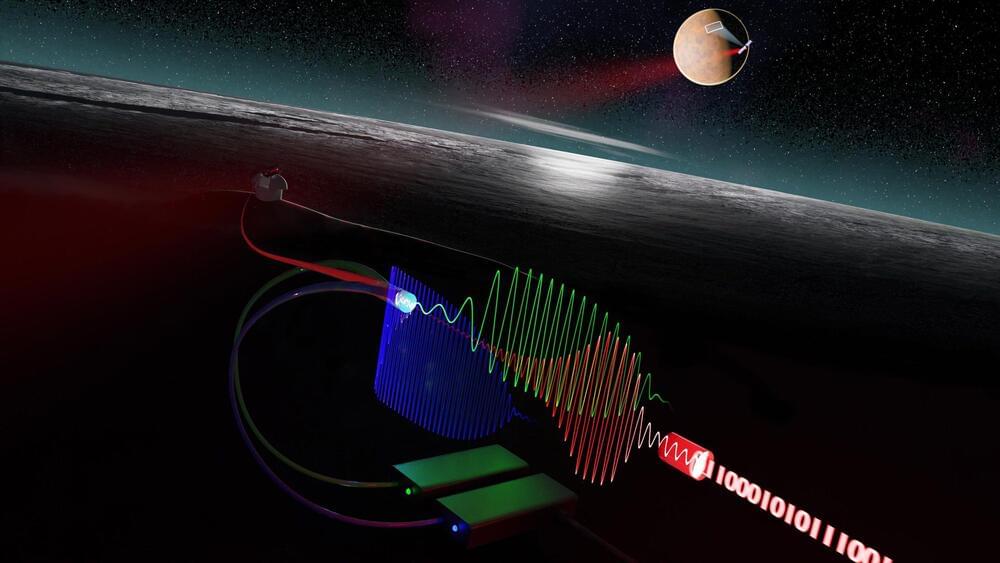
In space exploration, long-distance optical links now enable the transmission of images, videos, and data from space probes to Earth using light.
However, for these signals to travel the entire distance undisturbed, hypersensitive receivers and noise-free amplifiers are essential. Researchers at Chalmers University of Technology in Sweden have now developed a system featuring a silent amplifier and an ultra-sensitive receiver, opening up possibilities for faster and more reliable space communication.
Space communication systems are increasingly relying on optical laser beams instead of traditional radio waves, as light experiences less signal loss over vast distances. However, even light-based signals weaken as they travel, meaning that optical systems need highly sensitive receivers to detect these faint signals by the time they reach Earth. Researchers at Chalmers have developed an innovative approach to optical space communication that could unlock new opportunities—and discoveries—in space.
Successful demonstration of a commercial cryogenic radio frequency power sensor paves way for quantum computing
Radio frequency (RF) and microwave power measurements are widely used to support applications across space, defense, and communication. These precise measurements enable engineers to accurately characterize waveforms, components, circuits, and systems.
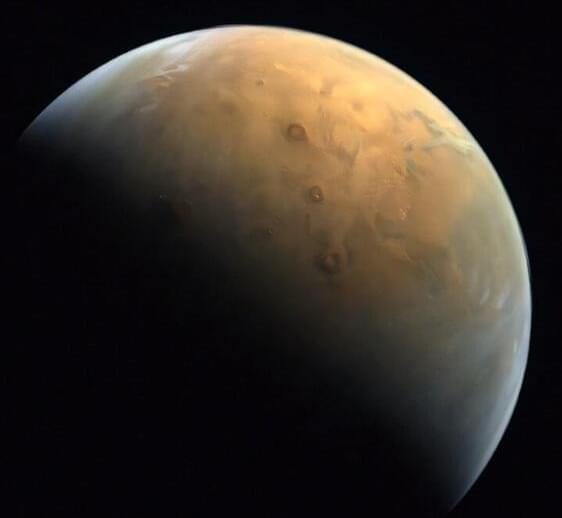
Chinese rover finds evidence of ancient Martian ocean
A Chinese rover has found new evidence to support the theory that Mars was once home to a vast ocean, including tracing some ancient coastline where water may once have lapped, a study said Thursday.
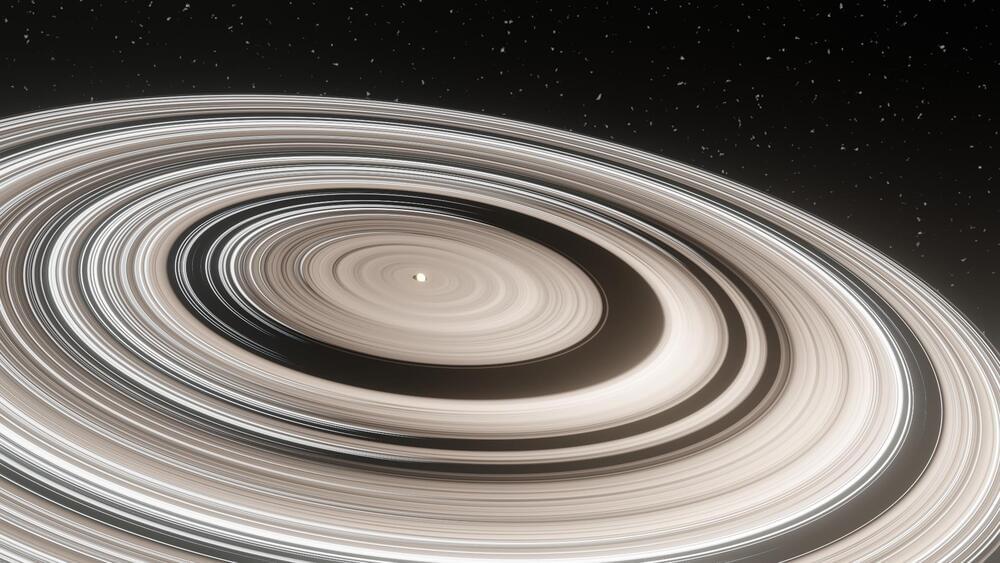
This Planet Has Rings 200 Times Larger Than Saturn
J1407b, has the largest ring system yet seen – around 200 times larger than Jupiter’s (the largest in our solar system). Its host planet is likewise massive: we don’t know whether it’s a gas giant or a brown dwarf. So far, it’s been classified as a super-Jupiter stellar body.
This is an updated (quotes and sources) version of the previous article.

DTU Researchers discover one of the fastest-spinning stars in the Universe
New research in our Milky Way has revealed a neutron star that rotates around its axis at an extremely high speed. It spins 716 times per second, making it one of the fastest-spinning objects ever observed. Photo: NASA.

Newfound dead star spins record-breaking 716 times a second, explodes with thermonuclear blasts
We are dealing with very extreme events.
Lab-made ‘supersolid’ could offer clues to neutron star mysteries
Scientists have finally proven the existence of “supersolids,” a bizarre state of matter that behaves like both a liquid and a solid.