Sperm in space!!!
For the first time (officially), NASA will set loose some human sperm in outer space.
We’re never short of reasons to look up at the night sky — whether it’s the rare second blue moon we were just treated to, or a meteor shower.
But in case you need a little motivation to get out of the house and into the fresh air this month, we have a beautiful one for you: checking out the ever-changing celestial geometry above our heads.
This April, the gas giant Jupiter forms a rare and fleeting triangle with two bright stars in our night sky, and it’ll be visible with the naked eye if you know where to look.
Imagine driving and being warned when you’re too close to the edge of the road.
That’s exactly what space technology developed by German researchers can do, and it could be in Northland trucks in the next year.
Researchers from the German Aerospace Agency have been in Whangarei with the Intelligent Positioning System, which has been designed to navigate the rover on Mars.
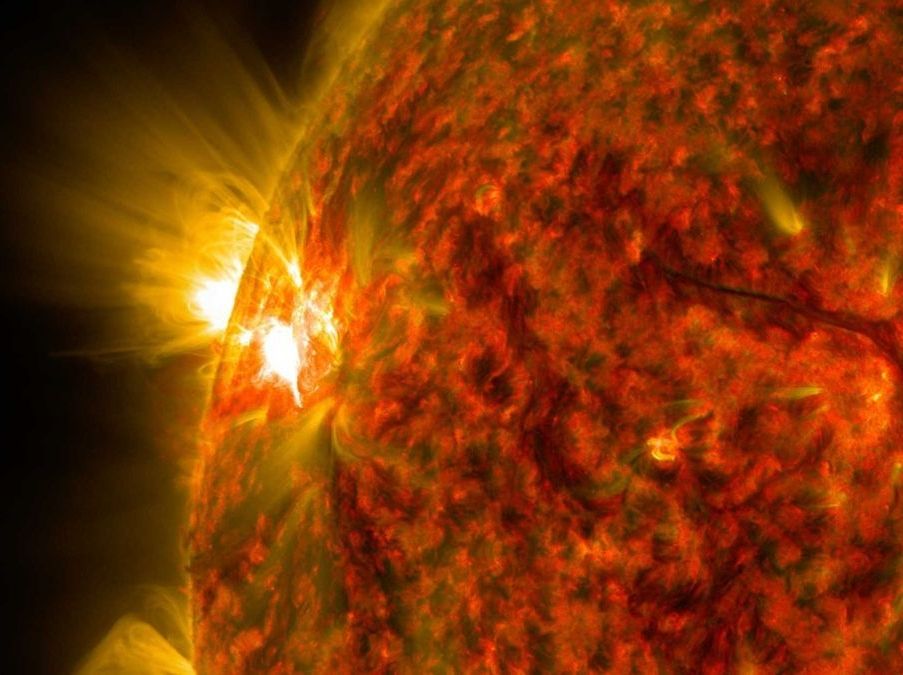
On April 2, 1845, Armand Hippolyte Louis Fizeau and Jean Bernard Léon Foucault manage to make the very first photography of the Sun. Thereby, they both initiate astronomical photography.
From a previous blog post you may remember Léon Foucault’s Pendulum.[4] The instrument was used to proof Earth’s rotation in the 1850s and counts to one of Foucault’s biggest scientific achievements. But let’s start a little bit earlier. Leon Foucault was born on September 18, 1819 as the son of a publisher in Paris. After an education received chiefly at home, he studied medicine, which he abandoned in favour of physics due to a fear of blood.
Meanwhile, astronomical photography started to establish slowly. There were not many experts in the field back then, since the very long exposures needed to capture relatively faint astronomical objects and many technological problems had to be overcome. Completely new telescopes had to be developed that were rigid enough in order to not lose the focus during exposure time. Also the telescopes had to be attached to a rotating mount that would move at a constant rate very accurately. Next to the telescope building itself, the technology of photography needed improvement as well. The daguerreotype was just introduced in 1839 and came into a very widespread use. However, for astronomical photography, the process was too slow and was only able to record very bright objects. Also, the exposure time was very limited using this method due to the wet plate collodion process.
384 sunsets in 12 days.
Looking for a getaway that offers unmatched views of sunrises and sunsets? Specifically, 384 of them in 12 days?
Try outer space.
Houston-based Orion Span hopes to launch the “first luxury hotel in space” — the 35-by-14-foot Aurora Station — by late 2021 and bring guests on board the following year.
For just $80,000, you can reserve a condo in space.
A team of research scientists recently conducted a series of simulations to see how the Orion Launch Abort System would fair in high speed conditions.
Pretty Scientific is a new Gizmodo series where we explore how the best images in science were created and why.
Three pillars of gas and dust sit among stars like towers of billowing smoke. It would take several years for light to cross from the top to the bottom of these dusty columns. This striking image from the Hubble Space Telescope remains, to this day, one of the most well-known astronomical images ever taken.
But if you were to peer at the Pillars of Creation, part of the Eagle Nebula, through your own telescope, you wouldn’t see the same thing. The images you typically see of outer space are colorized and processed in order to bring out the detail and highlight the most relevant parts for scientific study. The popularity of the Pillars of Creation may have forever changed how astronomers present images of space to the public.