Toggle light / dark theme

Tesla Model 3 protects owner from unsafe air even without Bioweapon Defense Mode

Amidst the ongoing threat of the California wildfires, a Tesla Model 3 owner has posted a brief demonstration of the electric sedan’s capability to maintain the air quality inside its cabin, despite the vehicle not being equipped with the Model S and X’s hospital-grade HEPA filter or a dedicated “Bioweapon Defense Mode.”

Elon Musk took to Twitter last week to offer the Model S and Model X as vehicles that can be used to transport people away from the ongoing CA wildfires. The Model S and X are capable of scrubbing the air inside the car, thanks to their large HEPA filters that are fitted with separate acid and alkaline gas neutralization layers. Later social media updates and anecdotes from Model S and X owners driving through the CA area indicate that Bioweapon Defense Mode helped maintain the air quality inside their vehicles.

In a follow-up tweet, Elon Musk noted that the Model 3’s air filtration system is not on the same “hospital-grade” level as that of the Model S and X, since the smaller vehicle does not have enough space to accommodate the HEPA filtration system in Tesla’s two flagship vehicles. This could be seen in the parts catalog for the vehicles, where the Model X HEPA filter was listed as “FILTER, HEPA, MDL X,” while the Model 3’s system was simply listed as “HVAC, CABIN FILTER, M3.”

NASA Image of Merging Galaxy Clusters Looks Suspiciously Like the USS Enterprise

Two possibilities: Either the image captures two massive galactic clusters in the process of colliding, or NASA is covering up the existence of a starship so big it’s several million light years long.


Humanity’s current understanding of physics may suggest faster-than-light travel is impossible, but researchers here on Earth can still observe happening in places much too far away to ever actually visit (and generally only what they looked like in the distant past). One of them is a galactic collision that, at least from our planetary vantage point, looks an awful lot like a craft going where no man has ever gone before.

NASA released the above composite image of the galaxy cluster Abell 1033 some 1.62 billion light years away this week, showing wisps of gas that appear to be arranged in the shape of Star Trek’s USS Enterprise. NASA wrote that the image was captured by the Chandra X-ray Observatory, an X-ray telescope that detects superheated gases, as well as the Low-Frequency Array, which detects radio emissions.

Rocket Science in 60 Seconds: EM-1 and the Power Needed to Get to the Moon and Beyond

Click on photo to start video.

NASA’s Rocket Science in 60 Seconds gives you an inside look at work being done to explore deep space. In the latest episode you can hear Rob Stough, payload utilization manager for our NASA’s Space Launch System, talk about the power we needed to boost the rocket into space and send NASA’s Orion Spacecraft to the Moon. Watch: https://youtu.be/0VB9aI3xVFs

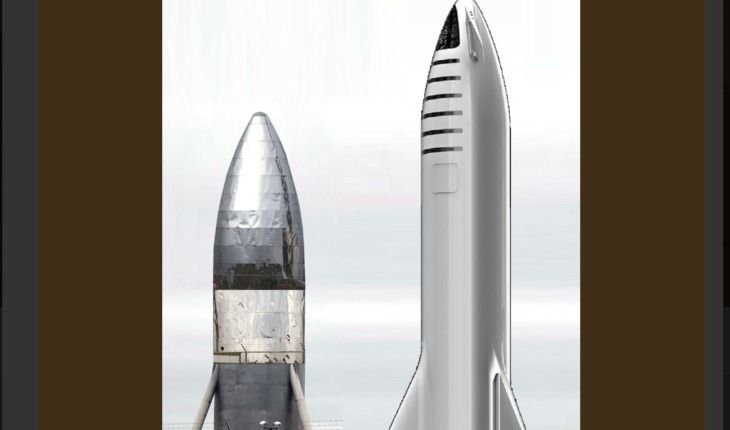
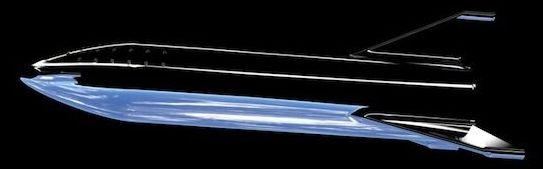
Elon Musk says a ‘radical change’ is coming to SpaceX’s monster Mars rocket design

  • In a tweet, Musk revealed that “radical change” was coming to the design of the Big Falcon Rocket (BFR), which is meant to go to Mars.
  • The tweet appeared to indicate that the second stage of the Falcon 9 will now be used for component tests for the BFR, and that the company is abandoning plans to make the second stage of Falcon 9 reusable.
  • Musk has said that his “aspirational” goal is to launch an unmanned cargo mission to Mars by 2022.

In a tweet, Saturday, SpaceX founder Elon Musk announced that “radical change” was coming to the design of the Big Falcon Rocket (BFR), that is being made in an attempt to go to Mars.

Musk left out any specifics of his plan, simply announcing that “SpaceX is no longer planning to upgrade Falcon 9 second stage for reusability” and would be “Accelerating BFR instead.” Musk called the new design “very exciting” and “delightfully counter-intuitive.”

News: On the evening of Thursday, Nov. 15, NASA’s Kepler space telescope received its final set of commands to disconnect communications with Earth

The “goodnight” commands finalize the spacecraft’s transition into retirement, which began on Oct. 30 with NASA’s announcement that Kepler had run out of fuel and could no longer conduct science.

Coincidentally, Kepler’s “goodnight” falls on the same date as the 388-year anniversary of the death of its namesake, German astronomer Johannes Kepler, who discovered the laws of planetary motion and passed away on Nov. 15, 1630.

The most incredible technology you’ve never seen

There’s money to be made and lives to be saved with the tiny stuff that’s all around us.

Saving the world (or some subset of people in it) is in vogue among the world’s wealthiest.

Jeff Bezos has a rocket company, Blue Origin. Bezos believes our future is extraterrestrial, and his rocket company exists because he thinks the price for getting anything off this rock is too damn high.

‘Unlike us, Elon Musk is using old tech’: Russia shows off reusable NUKE ENGINE for Mars mission

A leading Russian space research center has posted a video of its nuclear-powered rocket, that will be able to land on Mars after seven months, and can be re-launched into space just 48 hours after landing.

“A mission to Mars is possible in the very near future, but that’s not an aim in itself. Our engines can be the foundation for a whole range of space missions that currently seem like science fiction,” Vladimir Koshlakov, who heads Moscow’s Keldysh Research Center told Rossiyskaya Gazeta.

The institute, which is famous for developing the Katyusha rocket launched during World War II, has been working on what it says is a “unique” propulsion system since 2009. From past descriptions, it comprises a gas-cooled fission reactor that powers a generator, which in turn feeds a plasma thruster.

/* */