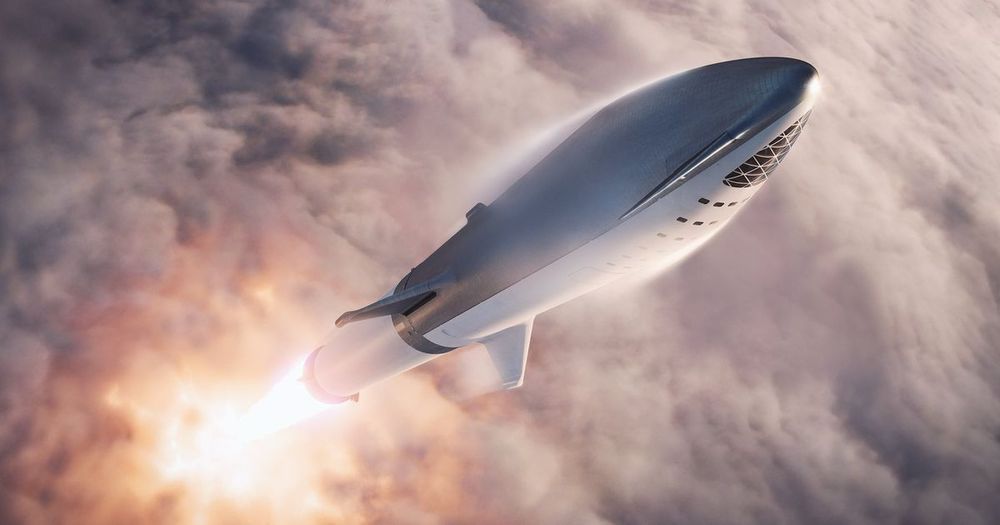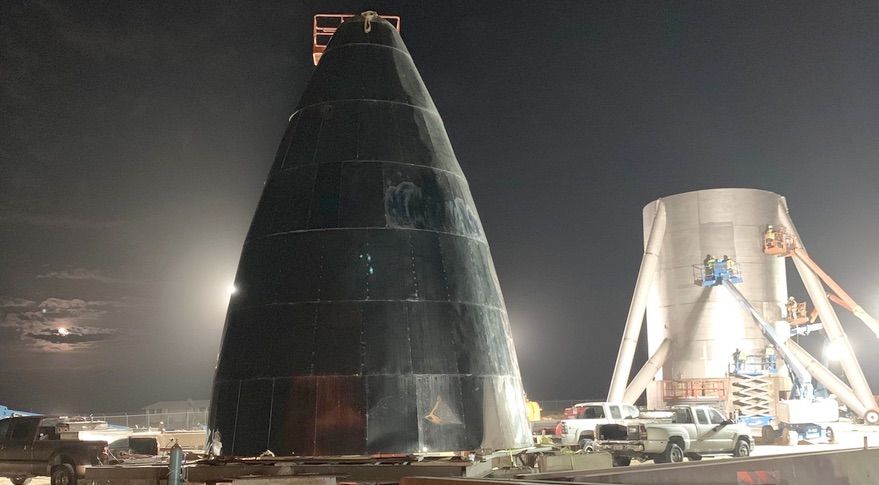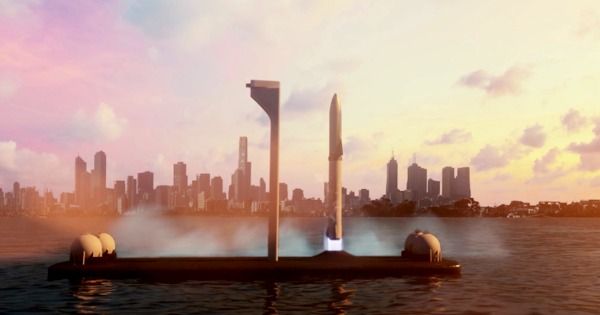
Elon Musk has Tweeted some of the details of the breakthrough changes to the SpaceX Super Heavy Starship.
The overall shape of the SpaceX Super Heavy Starship are about the same. However, there are fundamental materials change to airframe, tanks and heatshield.
@elonmusk Elon, how long until we can have more tech details about the bfs design changes? Some of us rocket nerds are dying to know anything! Thanks!
The success of SpaceX Falcon Heavy on its first launch was not just luck. Although this will be confirmed in 2019 and 2020 based upon what happens with about five planned Falcon Heavy launches.
Before the Falcon Heavy flight Musk predicted a 50 percent to 70 percent chance of success because of concerns over the difficulty predicting how the vehicle would respond to extreme aerodynamic stresses and vibrations from the clustered engines.
Blue Origin has provided additional details relating to its New Glenn rocket this week via the release of its Payload User Guide that is designed to aid customers interested in launching their payloads on their launch vehicle with requirements and capabilities. Meanwhile, work is continuing on the company’s Cape Canaveral launch site and the refit of its booster landing ship.
Robotic refueling. 3D Forest imagery. And two student experiments inspired by Marvel’s “Guardians of the Galaxy.” These are just a few of the studies that will be added to the hundreds onboard the International Space Station with the SpaceX cargo launch on Dec. 4! Watch more:
Elon Musk wants humans to make it to Mars. With his company SpaceX at his back, he’s pushed forward with some incredibly bold claims about what is possible for mankind on the Red Planet. He’s shown off concepts for Mars settlements and even called out scientists who say climate engineering on the planet is impossible.
Now, in an interview with HBO’s Axios, Musk doubles down on one of the more off-the-wall claims he’s made during his years in the spotlight. Mars, he says, will be his eventual home, and he estimates his odds of moving to the planet at a generous 70%.
Our NASA InSight spacecraft stuck the #MarsLanding!
Its new home is Elysium Planitia, a still, flat region where it’s set to study seismic waves and heat deep below the surface of the Red Planet for a planned two-year mission.
LANDING NOW!!! SUCCESS! MARSINSIGHT HAS LANDED. WAITING FOR THE FIRST IMAGES LATER ON TODAY! CONGRATS NASA.
Direct from America’s space program to YouTube, watch NASA TV live streaming here to get the latest from our exploration of the universe and learn how we discover our home planet.
NASA TV airs a variety of regularly scheduled, pre-recorded educational and public relations programming 24 hours a day on its various channels. The network also provides an array of live programming, such as coverage of missions, events (spacewalks, media interviews, educational broadcasts), press conferences and rocket launches.
In the United States, NASA Television’s Public and Media channels are MPEG-2 digital C-band signals carried by QPSK/DVB-S modulation on satellite AMC-3, transponder 15C, at 87 degrees west longitude. Downlink frequency is 4000 MHz, horizontal polarization, with a data rate of 38.86 Mhz, symbol rate of 28.1115 Ms/s, and ¾ FEC. A Digital Video Broadcast (DVB) compliant Integrated Receiver Decoder (IRD) is needed for reception.
It’s #MarsLanding Day! Today, our NASA InSight spacecraft blazes into the atmosphere of Mars at 12,300 mph and slows to just 5 mph in less than 7 minutes, before gently touching down on the surface. Watch live starting at 2 p.m. EST.