Toggle light / dark theme

Robotics: Substitution of Mankind or Improving the Human Being? | Free Documentary

Humanity Augmented | Science Documentary.

2077 — 10 Seconds to the Future — Mutation: https://youtu.be/qTkHD55kcaw.

With Augmented Humanity we will travel from the US to Japan, into the heart of secret labs of the most borderline scientists in the world, who try to push the boundaries of life through technology. Robotics is an important step, but the future of our species is not in a massive substitution by robots, on the contrary, robotics and technology must be used to improve the human being.
▬▬▬▬▬▬▬▬▬
Subscribe Free Documentary Channel for free: https://bit.ly/2YJ4XzQ
Instagram: https://instagram.com/free.documentary/
Facebook: https://bit.ly/2QfRxbG
Twitter: https://bit.ly/2QlwRiI
▬▬▬▬▬▬▬▬▬
#FreeDocumentary #Documentary #Augmented.
▬▬▬▬▬▬▬▬▬
Free Documentary is dedicated to bringing high-class documentaries to you on YouTube for free. With the latest camera equipment used by well-known filmmakers working for famous production studios. You will see fascinating shots from the deep seas and up in the air, capturing great stories and pictures from everything our beautiful and interesting planet has to offer.

Enjoy stories about nature, wildlife, culture, people, history and more to come.
🧬 Neural Enhancement: Human 2.0 🧠 #Science #Tech @TEKTHRILL #ai #tranding #technology PART 6

“Welcome back to our channel! Today, we’re diving into an extraordinary and futuristic topic: Neural Enhancement: Human 2.0. Imagine a future where AI-driven technologies can enhance human brain functions, creating a new version of humanity with unparalleled cognitive and physical abilities. Let’s explore this revolutionary concept! 🧬🧠 #Science #Tech”

Segment 1: the concept of neural enhancement.

“Imagine a world where humans can enhance their natural abilities through advanced technology. 🧠✨ Neural enhancement uses AI and neural interfaces to boost cognitive functions, improve memory, and enhance physical capabilities, creating ‘Human 2.0.’ 🌟 #NeuralEnhancement #TechInnovation”

Segment 2: how neural enhancement works.

“So, how does neural enhancement work? 🤖🧬 Using brain-computer interfaces (BCIs), neural implants, and AI algorithms, scientists can directly interact with the brain’s neural networks. These technologies can stimulate and enhance brain functions, improving everything from memory and learning speed to physical coordination and strength. 🌐✨ #AI #NeuroTech”

Breaking: AI Creates Real Superpowers in Humans! ⚡💪 #Superpowers #Enhancement #Future Part 6

AI and Human Enhancement:

A groundbreaking new AI system is exploring the limits of human potential, developing technologies that can enhance our physical and cognitive abilities. 🤖 By analyzing biological data and applying advanced engineering principles, the AI can identify ways to improve human performance.

How AI Enhances Human Abilities:

AI-powered human enhancement technologies can:

Enhance Physical Abilities: Increase strength, speed, and endurance.
Improve Cognitive Abilities: Enhance memory, intelligence, and creativity.
Extend Lifespan: Slow down the aging process and increase lifespan.
The Ethical Implications:

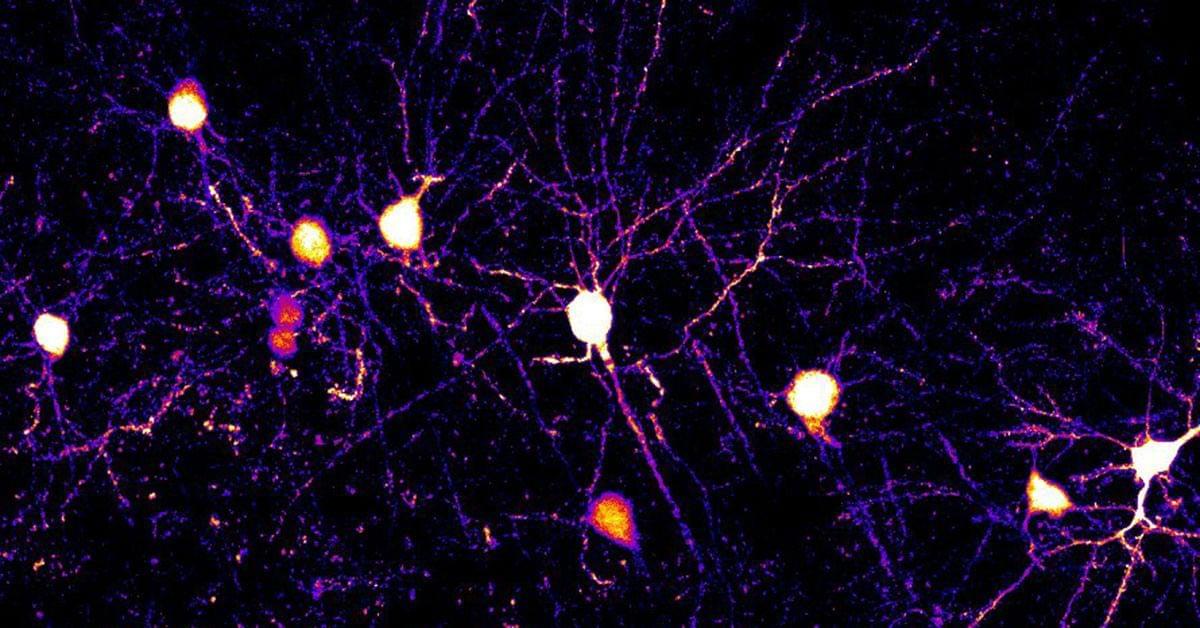
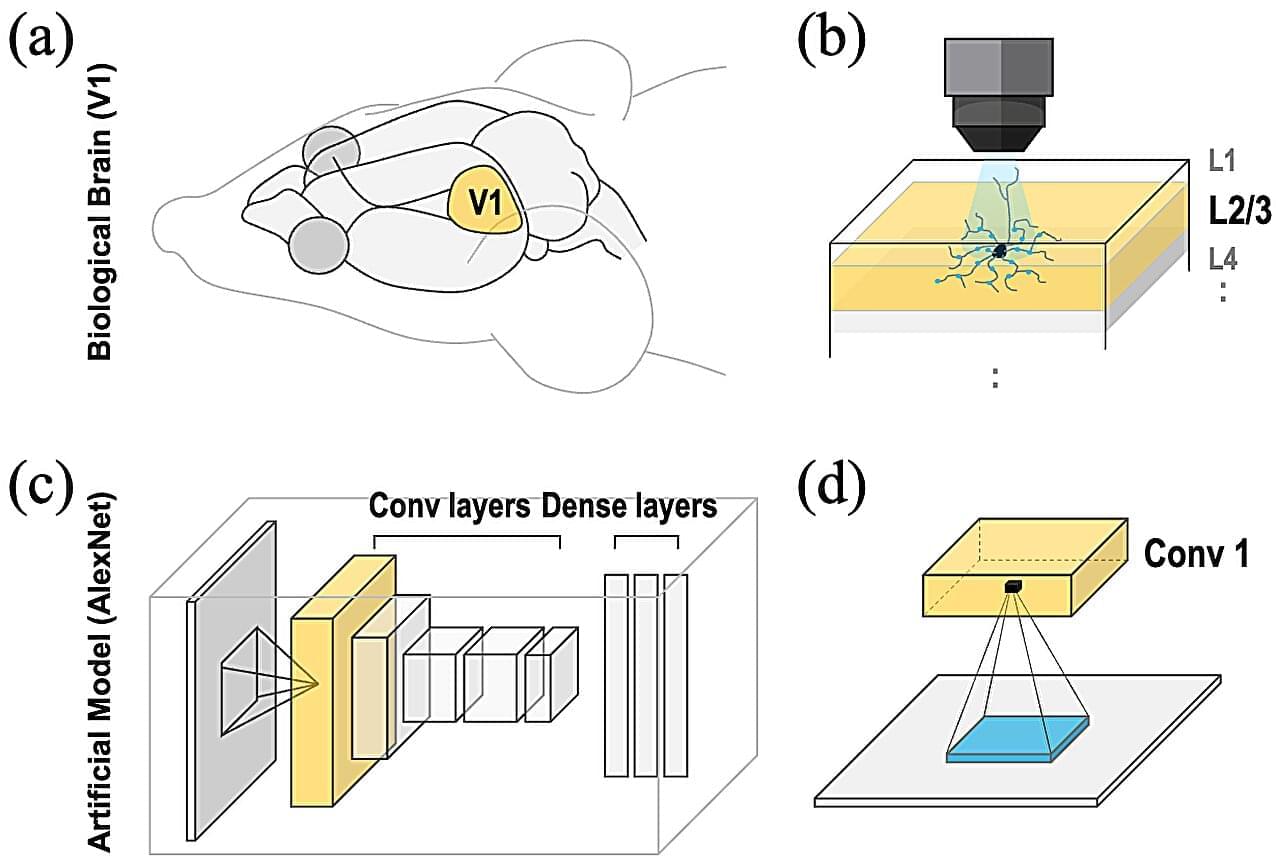
Brain-inspired AI technique mimics human visual processing to enhance machine vision

A team of researchers from the Institute for Basic Science, Yonsei University, and the Max Planck Institute have developed a new artificial intelligence (AI) technique that brings machine vision closer to how the human brain processes images. Called Lp-Convolution, this method improves the accuracy and efficiency of image recognition systems while reducing the computational burden of existing AI models.

The is remarkably efficient at identifying key details in complex scenes, an ability that traditional AI systems have struggled to replicate. Convolutional Neural Networks (CNNs)—the most widely used AI model for image recognition—process images using small, square-shaped filters. While effective, this rigid approach limits their ability to capture broader patterns in fragmented data.

More recently, vision transformers have shown superior performance by analyzing entire images at once, but they require massive computational power and large datasets, making them impractical for many .

Magnetic ‘metabot’ can expand, assume new shapes, and move like a robot—but without motor or internal gears

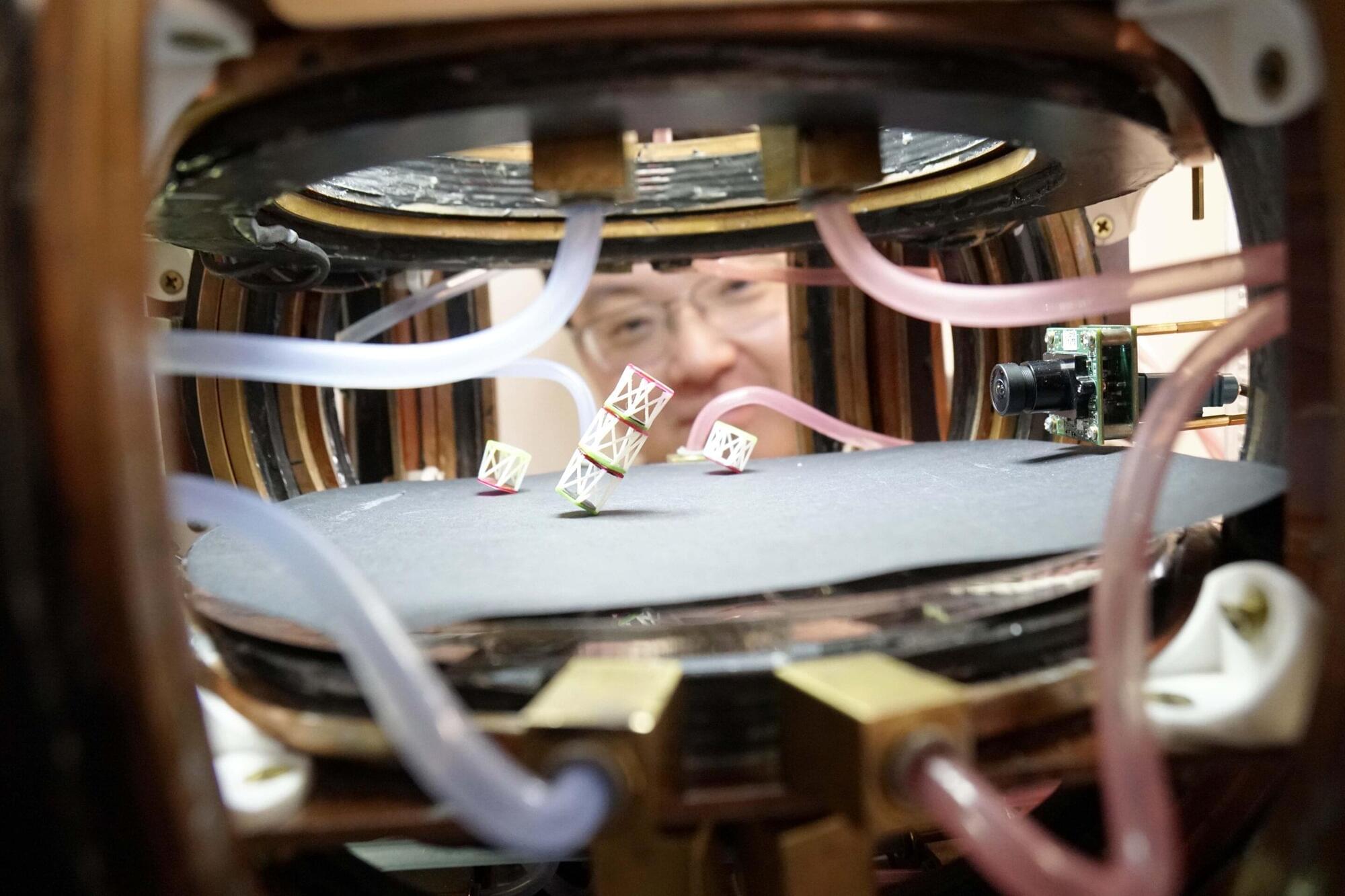
In an experiment reminiscent of the “Transformers” movie franchise, engineers at Princeton University have created a type of material that can expand, assume new shapes, move and follow electromagnetic commands like a remotely controlled robot, even though it lacks any motor or internal gears.

“You can transform between a material and a robot, and it is controllable with an ,” said researcher Glaucio Paulino, the Margareta Engman Augustine Professor of Engineering at Princeton.

In an article published in Nature, the researchers describe how they drew inspiration from the folding art of origami to create a structure that blurs the lines between robotics and materials. The invention is a metamaterial, which is a material engineered to feature new and unusual properties that depend on the material’s physical structure rather than its chemical composition.

Predicting material failure: Machine learning spots early abnormal grain growth signs for safer designs

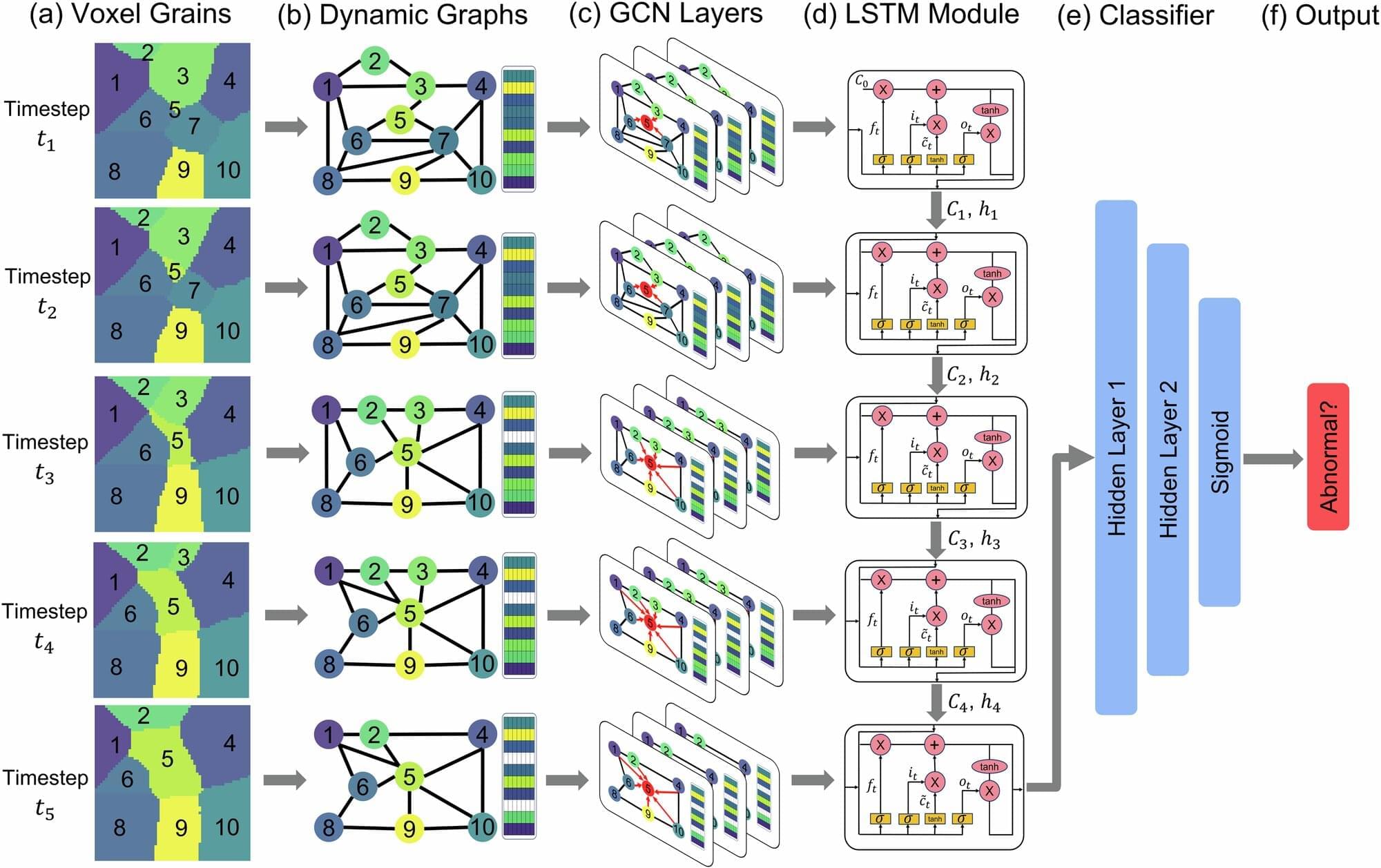
A team of Lehigh University researchers has successfully predicted abnormal grain growth in simulated polycrystalline materials for the first time—a development that could lead to the creation of stronger, more reliable materials for high-stress environments, such as combustion engines. A paper describing their novel machine learning method was recently published in Nature Computational Materials.

“Using simulations, we were not only able to predict abnormal grain growth, but we were able to predict it far in advance of when that growth happens,” says Brian Y. Chen, an associate professor of computer science and engineering in Lehigh’s P.C. Rossin College of Engineering and Applied Science and a co-author of the study. “In 86% of the cases we observed, we were able to predict within the first 20% of the lifetime of that material whether a particular grain will become abnormal or not.”

When metals and ceramics are exposed to continuous heat—like the temperatures generated by rocket or airplane engines, for example—they can fail. Such materials are made of crystals, or grains, and when they’re heated, atoms can move, causing the crystals to grow or shrink. When a few grains grow abnormally large relative to their neighbors, the resulting change can alter the material’s properties. A material that previously had some flexibility, for instance, may become brittle.

Magnetic Field Maneuvers Magnetite Monolayers

Suppose you want to make a tiny robot to perform surgery inside a human patient. To avoid damaging healthy tissue and to squeeze into tight spots, the robot should be squishy. And manipulating the robot’s movements with magnetic fields would make sense, as tissues don’t respond to magnetism. But what material would you use for the robot’s limbs? Magnetic materials are stiff and brittle. Embedding tiny particles of them in a rubbery matrix could work, but the thinner—and therefore bendier—you make the composite material, the less it responds to a magnetic field. Heinrich Jaeger of the University of Chicago, Monica Olvera de la Cruz of Northwestern University, Illinois, and their collaborators have now overcome that obstacle by making thin, flexible sheets out of self-assembled nanoparticles of magnetite [1]. Even a modest field of 100 milliteslas can lift a sheet and bend it by 50°, they found.

At room temperature, magnetite (Fe3O4) is ferrimagnetic—that is, the magnetic moments in its two sublattices align in opposite directions but with unequal magnitudes, yielding a net magnetization. The smaller a ferrimagnet, the greater the chance that it has a single domain, and therefore the lower the temperature at which the domain’s magnetization will flip. When the sample size gets down to a few tens of nanometers, a ferrimagnet made of randomly flipping particles becomes, in effect, a paramagnet—that is, it lacks a net magnetization and is attracted by an applied magnetic field. The attraction can be strong. The discoverers of this phenomenon in 1959 dubbed it superparamagnetism [2].

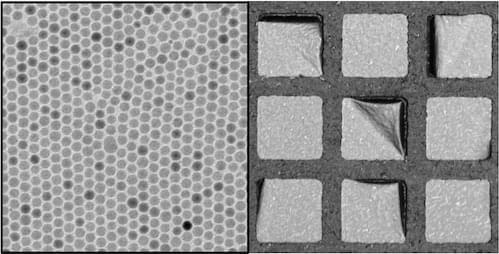
The researchers realized that a sheet made from a single layer of superparamagnetic particles could serve as a viable material for the magnetic actuation of small soft robots. To create the layers, they suspended magnetite nanoparticles in droplets of water coated with an organic solvent. The solvent attracted the nanoparticles, which migrated to a droplet’s surface. The water slowly evaporated, leaving behind a layer of closely packed nanoparticles draped on the droplet’s support structure, a square copper grid. Each of the 20 × 20 µm squares supported a single sheet. As shown in the figure, some of the sheets happened to have a single unattached corner.