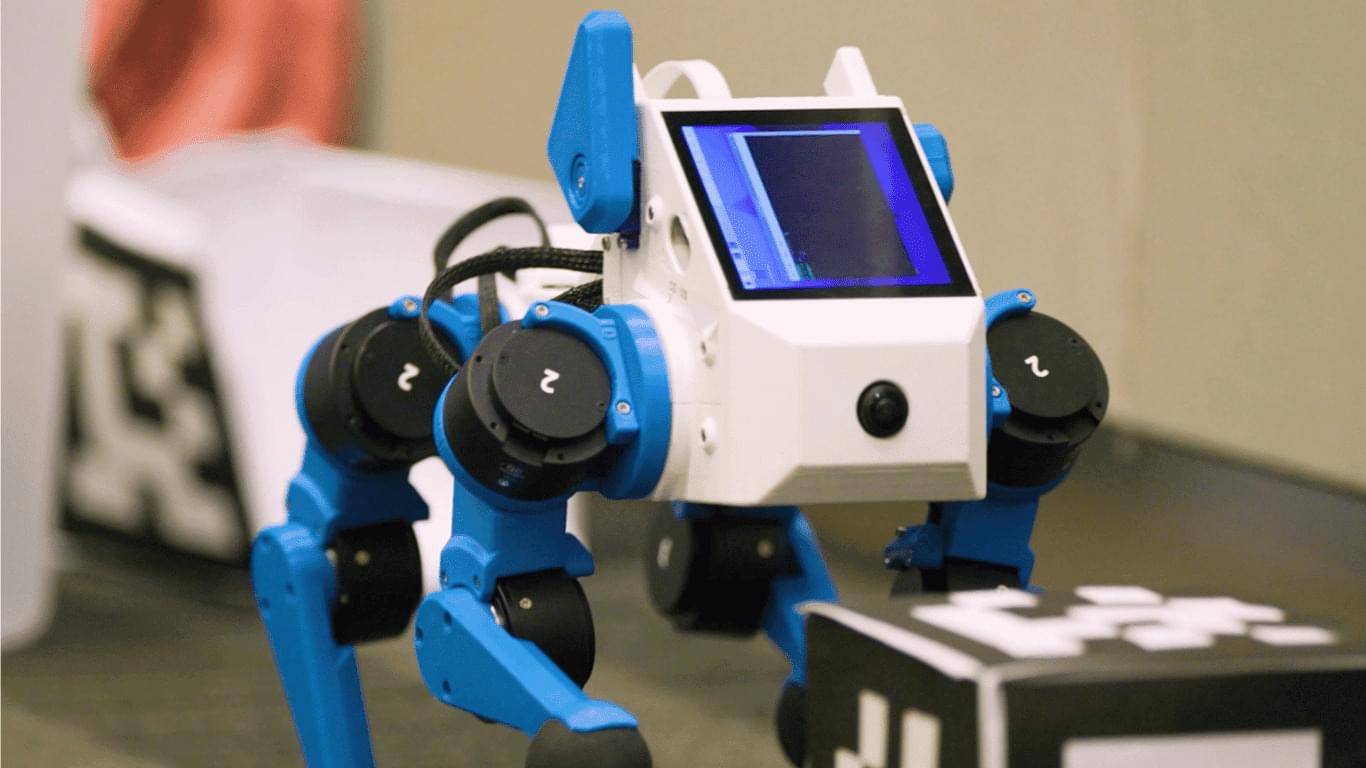
Students from Stanford University built AI-powered robot dogs from scratch, using only a starter hardware kit.
Category: robotics/AI – Page 494

DeepMind’s AlphaGenome Uses AI to Decipher Noncoding DNA for Research, Personalized Medicine
This AI system can analyze up to one million DNA letters at once, predicting how tiny changes in noncoding regions trigger everything from cancer to rare genetic disorders—and potentially revolutionizing personalized medicine
The Industry Reacts to Grok 4
Matthew Berman
Elon Musk Teases MASSIVE Tesla Demo: “Most Epic EVER”
Elon Musk is hinting at revolutionary advancements in AI-generated content, potentially disrupting the gaming industry, with teasers about upcoming Tesla demos and the integration of XAI’s capabilities ## ## Questions to inspire discussion.
Tesla’s Competitive Advantage.
🚗 Q: How does Tesla maintain its lead in autonomous driving? A: Tesla leverages its “data flywheel” built by deploying millions of vehicles to collect real-world data, making it nearly impossible for competitors to replicate.
🤖 Q: What unique combination gives Tesla an edge in AGI development? A: Tesla’s real-world data stream combined with xAI’s language model, voice, video, and image generation capabilities provide the complete recipe for AGI.
Investment Opportunities.
💼 Q: Why do institutional investors undervalue Tesla’s autonomy lead? A: Institutional investors often view Tesla as just a car company, overlooking its unassailable autonomy advantage, while xAI is seen as a pure AI company.

Could AI help fight mosquito-borne diseases?
Diseases like dengue fever, malaria or Zika are responsible for hundreds of thousands of death every year around the globe. Researchers are now trying to use artificial intelligence to help health officials locate and prevent disease-bearing mosquitoes and potential infestations.

AI that thinks like us—and could help explain how we think
Researchers at Helmholtz Munich have developed an artificial intelligence model that can simulate human behavior with remarkable accuracy. The language model, called Centaur, was trained on more than ten million decisions from psychological experiments—and makes decisions in ways that closely resemble those of real people. This opens new avenues for understanding human cognition and improving psychological theories.
For decades, psychology has aspired to explain the full complexity of human thought. Yet traditional models could either offer a transparent explanation of how people think—or reliably predict how they behave. Achieving both has long seemed out of reach.
The team led by Dr. Marcel Binz and Dr. Eric Schulz, both researchers at the Institute for Human-Centered AI at Helmholtz Munich, has now developed a model that combines both. Centaur was trained using a specially curated dataset called Psych-101, which includes over ten million individual decisions from 160 behavioral experiments. The study is published in the journal Nature.
How o3 and Grok 4 Accidentally Vindicated Neurosymbolic AI
Neurosymbolic AI is not one thing, but many. o3’s use of neurosymbolic AI is very different from AlphaFold’s use of neurosymbolic AI. Very little of what has been tried has been discussed explicitly, and because the companies are often quite closed about what they are doing, the public science of neurosymbolic AI is greatly impoverished.

Spectral–Fractal–Symbolic Intelligence: Modeling Cognitive Phase Transitions with AI
Discover how spectral geometry, fractal neuroscience, and AI combine to model cognitive phase transitions and the evolution of symbolic intelligence.

AirComp Transforms Wireless Data Processing
Could AirComp be the key to faster data processing in smart cities? Discover how signals superpose in mid-air for efficiency.

Large Language Models and the Path to AI Singularity
LLMs are doubling their task complexity every 7 months. Could this lead to a future where AI surpasses human capabilities, reshaping society?