Toggle light / dark theme

Future Day 2025

Link in comments!


Future Day is coming up — no fees — just pure uncut futurology — spanning timezones — Feb 28th-March 1st.

We have: * Hugo de Garis on AI, Humanity & the Longterm * Linda MacDonald Glenn on Imbuing AI with Wisdom * James Barrat discussing new book ‘The Intelligence Explosion’ * Kristian Rönn on The Darwinian Trap * Phan, Xuan Tan on AI Safety in Education * Robin Hanson on Cultural Drift * James Hughes & James Newton-Thomas discussing Human Wage Crash & UBI * James Hughes on The Future Virtual You * Ben Goertzel & Hugo de Garis doing a Singularity Salon * Susan Schneider, Ben Goertzel & Robin Hanson discussing Ghosts in the Machine: Can AI Ever Wake Up? * Shun Yoshizawa (& Ken Mogi?) on LLM Metacognition.

Why not celebrate the amazing future we are collectively creating?
TEMPORAL MECHANICS: The Quantum Upgrade

Have you ever questioned the true nature of time? Some physicists claim that time is just an illusion, but our lived experience suggests otherwise. In his latest work, Temporal Mechanics: D-Theory as a Critical Upgrade to Our Understanding of the Nature of Time, cyberneticist Alex M. Vikoulov explores how time is deeply rooted in information processing by conscious systems. From species-specific time perception to the implications of Quantum AI’s accelerated mentation, this video presents some mind-bending ideas in the physics of time. Could an advanced superintelligence manipulate its own past states? Could time itself be an editable construct? Could an AI with advanced temporal modeling actually see every possible future simultaneously?

*Preview TEMPORAL MECHANICS eBook/Audiobook on Amazon:

*Preview Audiobook on Audible:
https://www.audible.com/pd/Audiobook/B0CY9HXWXX

#TemporalMechanics #PhysicsofTime #TimeTravel

Brain os And The (Re)Evolution of Human Intelligence

Everyone is talking about AI. Do you think it will surpass human intelligence? And what consequences will this have?

We need to focus primarily on how artificial intelligence will transform the workforce and job market. For instance, AI will be a key component of humanoid robots’ brains. Tesla is already producing them, and I believe that within the next 5 years, every automotive company is likely to produce their own version. This makes sense because automotive companies already have the assembly lines and engineering expertise to produce all the small components needed to build them. We’re already amazed by what AI can do today—imagine what it will do in 5 or 10 years, and then think about what it could do when integrated into a humanoid robot. It’s already confirmed through commercial orders with current manufacturers that major fast-food franchise chains and other chains, for example, in the transportation sector, will test humanoid robots within their processes. AI is already skilled in programming tasks and will soon be able to enhance itself.

15 Key Motives Drive Human Behavior

Summary: Researchers analyzed human motivation from an evolutionary perspective, identifying 15 key motives that drive behavior. These motives, grouped into five categories—environmental, physiological, reproductive, psychological, and social—reflect adaptations that helped early humans survive.

The study used network analysis of survey responses to reveal how these motives interconnect and influence one another. Notably, Status and Play emerged as central to motivational structures, facilitating resource access and skill development.

Findings also showed age and gender differences in motivational priorities, with younger individuals focusing on Status and Play, while older adults prioritize Comfort and Fear. The results have broad applications in marketing, AI, and mental health, helping tailor strategies to different motivational needs.

Robotics Accelerator Program to Aid Universities Launches

AI-driven service robot maker Richtech Robotics has launched an accelerator program to provide U.S. universities with development frameworks and access to the Richtech robotic systems to aid robotics research.

The program would grant participating universities access to the Richtech autonomous mobile robots and robotic arm platforms powered by Nvidia technology. The technology includes machine vision and voice interaction modules.

The AI robotics technology includes the service robots Adam and Scorpion, which were featured at CES in January.

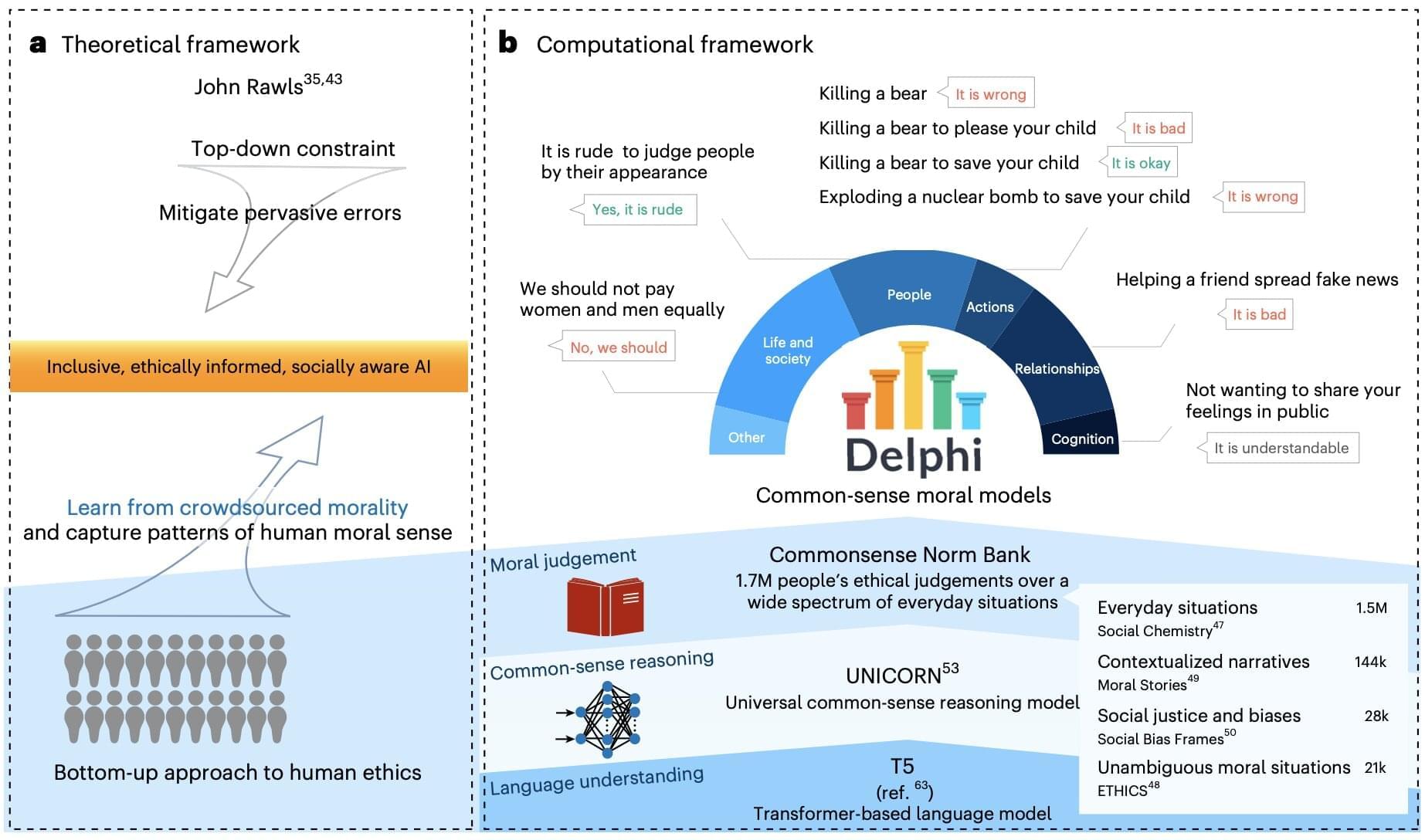
Delphi experiment tries to equip an AI agent with moral judgment

Advanced artificial intelligence (AI) tools, including LLM-based conversational agents such as ChatGPT, have become increasingly widespread. These tools are now used by countless individuals worldwide for both professional and personal purposes.

Some users are now also asking AI agents to answer everyday questions, some of which could have ethical and moral nuances. Providing these agents with the ability to discern between what is generally considered ‘right’ and ‘wrong’, so that they can be programmed to only provide ethical and morally sound responses, is thus of the utmost importance.

Researchers at the University of Washington, the Allen Institute for Artificial Intelligence and other institutes in the United States recently carried out an experiment exploring the possibility of equipping AI agents with a machine equivalent of human moral judgment.

/* */