The 2nd part of my interview with Breitbart on transhumanism, the future, and robots is out.
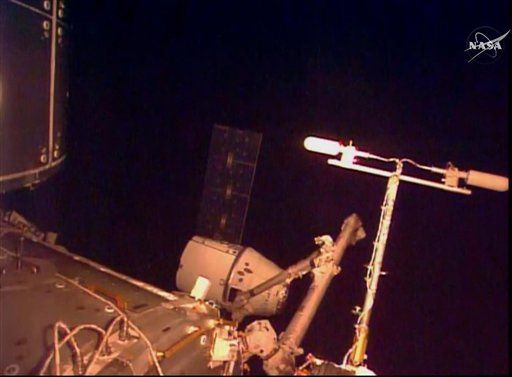
SpaceX has made good on a high-priority delivery: the world’s first inflatable room for astronauts.
A SpaceX Dragon cargo ship arrived at the International Space Station on Sunday, two days after launching from Cape Canaveral. Station astronauts used a robot arm to capture the Dragon, orbiting 250 miles (400 kilometers) above Earth.
The Dragon holds 7,000 pounds (3,175 kilograms) of freight, including the soft-sided compartment built by Bigelow Aerospace. The pioneering pod—packed tightly for launch—should swell to the size of a small bedroom once filled with air next month.
MIT printed this fully functional robot right out of a 3D printer.
MIT printed this robot this fully functional robot right out of a 3D printer. http://voc.tv/14JQHoo
Nice
BraiQ wants to use bio sensors to teach you to trust your self-driving car.

Nice! Now, we’re talking. Check out Meya.ai
Meya wants to make it easy for anybody to design, deploy and use bots on messaging apps with its new bot platform.
Still haven’t had enough of SpaceX’s rocket landing in the middle of the ocean? Well, new 4K video is here to satisfy you and then make you hungry for more. Late last night, SpaceX released high-definition footage taken from a chase plane, showing the Falcon 9’s delicate descent onto the autonomous drone ship “Of Course I Still Love You.”
The extra detail gives you a nice glimpse into how the rocket’s legs deployed just prior to landing (and that one of the legs seemed to lag behind the rest). It also shows how the vehicle landed a little off its mark. SpaceX probably didn’t want to show off too much by hitting the bulls eye. That just wouldn’t have been fair.
IRobot is going after the military dollars. Smart move given that the military in all branches are trying to modernize with AI.
By Sandra I. Erwin.
Now officially in business as an independent company, iRobot’s former defense unit is gearing up to compete for Pentagon contracts in a market that has changed dramatically since the PackBot bomb-clearing robot became a military staple in Afghanistan and Iraq more than a decade ago.
I started writing this column while I was in Manila, Philippines for a talk with UnionBank, one of the most innovative banks I’ve ever come across.
Driving across Manila is often a painful experience with far too many cars locking up all possible arterials, and nowhere near enough money to redesign and build the needed infrastructure. But this is not unique to Manila.
As I’ve traveled around the world, I’ve run into equally bad traffic in Istanbul, Rotterdam, Los Angeles, Seoul, Mexico City, San Francisco, Rome, London, Beijing, and Mumbai. In fact there are literally thousands of cities where bad traffic is a way of life.
Walking up stairs, keeping your balance and doing some light cleaning are easy for people. Less so for robots.

Time to brush up on my Yeats, Browning, or Frost.
Demand for chatting virtual assistants and other artificial intelligence (AI) products is creating favorable job prospects for writers, poets, comedians, and other people of artistic persuasion in Silicon Valley.
The industry is tapping them to engineer the personalities of AI tools to make them capable of seamless interaction with people.
AI writers are tasked with imbuing the AIs with natural-seeming conversational capabilities.
