Toggle light / dark theme

Report:​ Drones, 3D Printing, and A.I. Will All Create Deadly New Challenges for the U.S. Military

We all know that anything that the public can get their hands on, the black market, etc. already has access as well as those hard to get items like a rocket launcher, etc. So, not sure why anyone will be surprised by this article.


New technologies will level the playing field between the major powers and smaller, independent players.

Virtual reality helps farmers connect to kids, public

I expect education to be taught more through VR & AI. I know as a kid, my own elementary, Jr High/ Middle School, and HS experience was pretty mundane and boring at times. By having VR & AI technologies to enable the catering/ customizing of education to the student’s needs and pace will be awesome.


Virtual reality on a Nebraska farm tour combined with a live audience made for a first-time event Tuesday at Deere & Co. headquarters, Moline.

Designed to highlight innovation behind sustainable food production, the web broadcast may have originated in Moline, but it was seen online by 37,000 high school students in the United States.

It was sponsored by the U.S. Farmers & Ranchers Alliance, St. Louis, and Discovery Education, an arm of the Discovery network.

Sydney’s Future Zoo Wants To Use Augmented Reality, Robots And Drones

Western Sydney University (WSU) and Sydney Zoo are collaborating with the goal to deliver “one of the most technologically advanced wildlife experiences in the world” with the assistance of a hackathon.

Speaking with Gizmodo Don Wright, Manager of WSU’s “Launch Pad” program and Zoo Hackathon Coordinator, revealed the possibilities for technology use within the zoo. We’re talking everything from augmented reality to cheetahs chasing drones.

Image: Shutterstock.

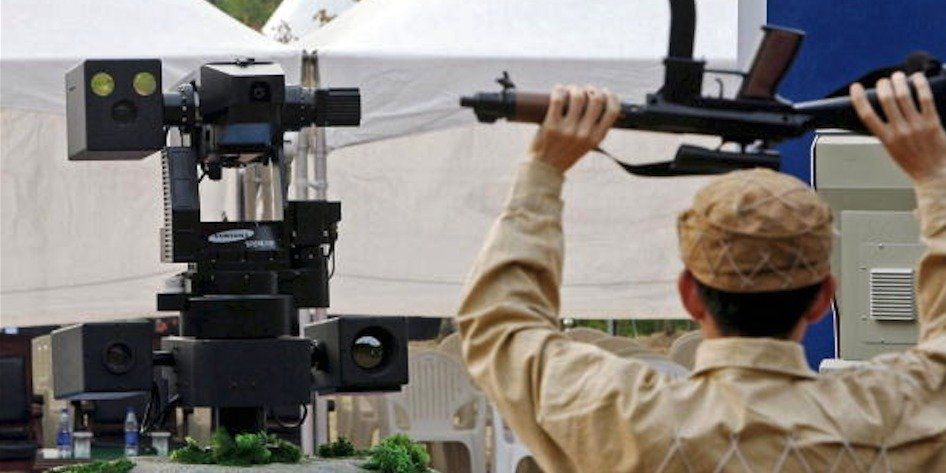
International Petition against Autonomous Weapons

Stuart Russell received his B.A. with first-class honours in physics from Oxford University in 1982 and his Ph.D. in computer science from Stanford in 1986. He then joined the faculty of the University of California at Berkeley, where he is Professor (and formerly Chair) of Electrical Engineering and Computer Sciences and holder of the Smith-Zadeh Chair in Engineering. He is also an Adjunct Professor of Neurological Surgery at UC San Francisco and Vice-Chair of the World Economic Forum’s Council on AI and Robotics. He has published over 150 papers on a wide range of topics in artificial intelligence including machine learning, probabilistic reasoning, knowledge representation, planning, real-time decision making, multitarget tracking, computer vision, computational physiology, and global seismic monitoring. His books include “The Use of Knowledge in Analogy and Induction”, “Do the Right Thing: Studies in Limited Rationality” (with Eric Wefald), and “Artificial Intelligence: A Modern Approach” (with Peter Norvig).

Abstract:

Autonomous weapons systems select and engage targets without human intervention; they become lethal when those targets include humans. LAWS might include, for example, armed quadcopters that can search for and eliminate enemy combatants in a city, but do not include cruise missiles or remotely piloted drones for which humans make all targeting decisions. The artificial intelligence (AI) and robotics communities face an important ethical decision: whether to support or oppose the development of lethal autonomous weapons systems (LAWS).

/* */