Toggle light / dark theme

DARPA to establish satellite-servicing consortium to discuss on-orbit repair standards

A first step in establishing repair standards on satellite in space; wonder could we eventually see a version of the EPA or in space.


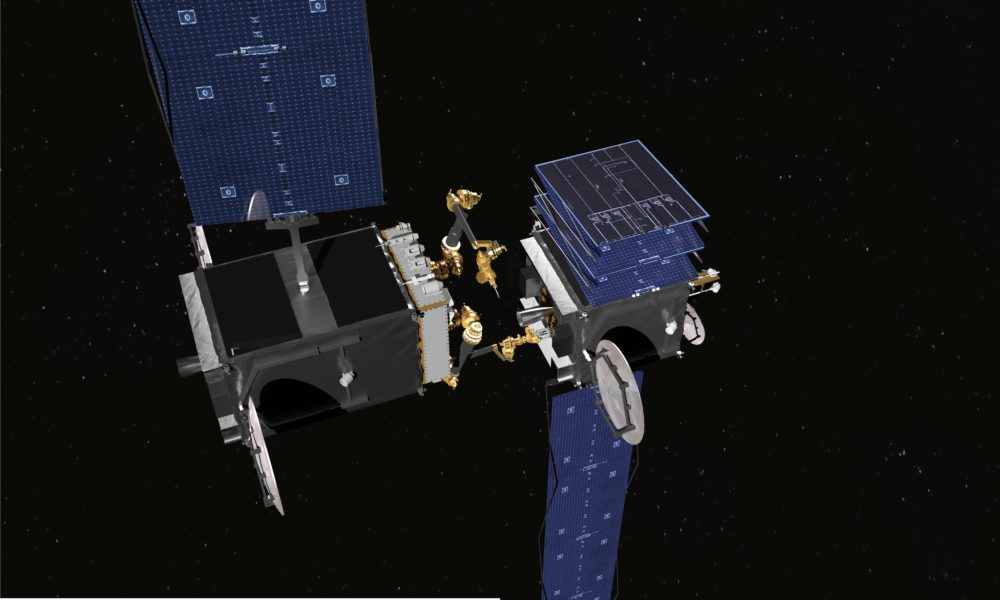
SAN FRANCISCO — The U.S. Defense Research Projects Agency plans to establish a consortium to discuss standards and practices for on-orbit satellite servicing as a corollary to Robotic Servicing of Geostationary Satellites (RSGS), an effort to develop robotic spacecraft to inspect, repair and move other satellites.

“Our fear was that we would create a robotic servicing capability through RSGS and when our industry partner went to Lloyds of London for insurance, someone would say, ‘You have no authority to conduct that mission,’” said Brad Tousley, director of DARPA’s Tactical Technology Office.

Through the construction and operation of the International Space Station, the international community has established laws and regulations concerning government spacecraft conducting rendezvous and proximity operations with other government spacecraft as well as government spacecraft conducting rendezvous and proximity operations with commercial spacecraft.

Groundbreaking Research Shows Conscious Intention Directly Affects Quantum States; Scientific Basis for Mind of Over Matter?

Dean Radin, Ph.D. and Chief Scientist of IONS, the Institute for Noetic Sciences, recently introduced the results of a series of experiments that may provide the missing link between consciousness and matter, turning the tables on materialism and asserting consciousness as a fundamental component of reality itself. Using a variation of the famous double-slit experiment, he and his team hypothesized that the conscious intent of a human mind might be able to collapse a quantum wave function without direct interaction. Simply by concentrating they postulated, meditation might be able to affect and influence quantum particles – the smallest components of matter that form our physical universe. .

Initial experiments used participants 2 meters away from the device. Alternating between asking participants to concentrate on the apparatus, then removing their attention showed astounding results. Fearing that temperature differences or other variables might have influenced the test, they offered the experiment to participants online. Using several thousand robotic control sessions to ensure that a determination could be made for the factor of human consciousness, the results were likewise astounding, with initial trial results of greater than 5 sigma.

Dr. Radin’s video from the April 2016 conference introducing the results from this experiment is available online through the IONS channel. I highly recommend watching the video in its entirety to get a full understanding of the experiment results, research protocols, variables, controls and the results from other labs and researchers who have replicated these results.

Farewell Remote Controllers, Hello Brain Controlled UAV’s

When the Holiday season kicks off next fall (2017); I have a feeling that I may end up buying a Penny Robot or a BMI controlled drone for my niece & nephews.


The post is also available in: Hebrew :הכתבה זמינה גם ב

A new research out of Arizona State University with DARPA funding.

Using a skullcap fitted with 128 electrodes wired to a computer, researchers are able to control multiple drones using human thought and vision to guide the quadcopters wirelessly. The device records electrical brain activity and measures the movement of the drones based on parts of the brain that light up. This signal is monitored and sent to another computer that transmits a signal to the drones, making them move. Panagiotis Artemiadis, director of the Human-Oriented Robotics and Control Lab and an assistant professor of mechanical and aerospace engineering at the School for Engineering of Matter, Transport and Energy in the Ira A. Fulton Schools of Engineering, has been working with funding from the Defense Advanced Research Projects Agency (DARPA) and U.S. Air Force to develop this technology. Artemiadis has been working on brain-to-machine interfaces since 2009, but only recently made the leap to controlling more than one device.

Scientists are working on a real-life Star Trek phaser

Want to be the next Captain Kirk or Spock; we’re getting more close of being a Star Trek & Star Wars world with drones and fighter jets with death lasers, cyborgs with BMI technology, sabers being developed, and now the Star Trek phaser is being developed.


Every year Star Trek’s futuristic sci-fi technology comes closer to just being “technology.” We live in a world where video chats, communicators, and real-time translators are normal, where androids are becoming more and more realistic and food replicators are almost here thanks to 3D printing. The next step? Phasers!

Next month the Smithsonian Channel will air a two-hour Star Trek special to celebrate the show’s 50th Anniversary, which will take a look at some of the technologies the show predicted. In this just-released segment of Building Star Trek, future phaser use is predicated by laser scientist Rob Afzal of Lockheed Martin who, let’s be honest, has one of the coolest titles in the world. (“What do you do?” “I’m a LASER SCIENTIST.”)

US Outspending China and Russia in Hypersonic Weapons Research

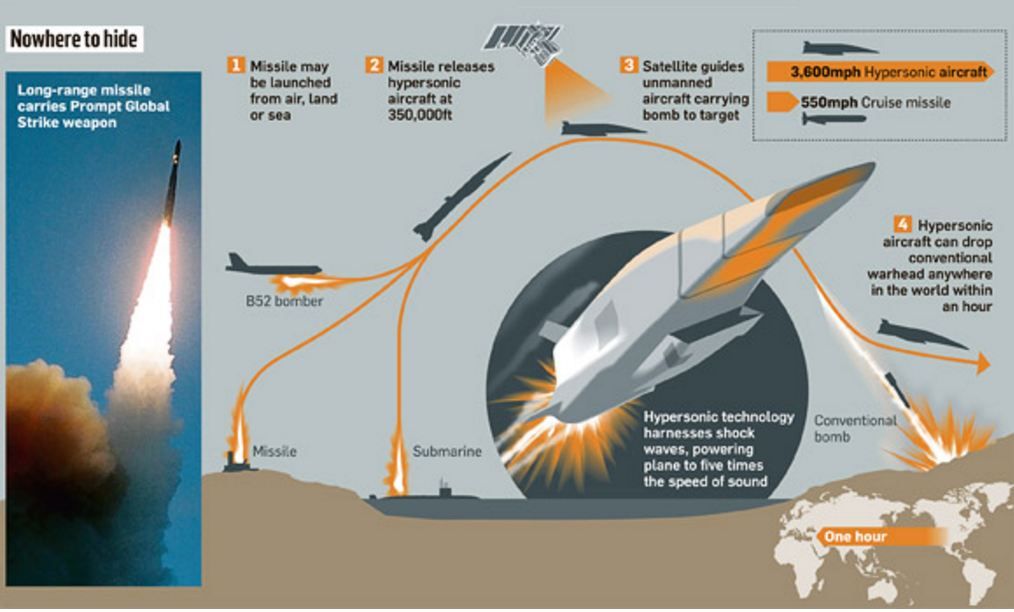
Among others, the Pentagon is funding the Lockheed Martin Falcon Hypersonic Technology Vehicle 2 (HTV-2) program; the Raytheon Hypersonic Air-breathing Weapon Concept (HAWC) and the Raytheon/Lockheed Tactical Boost Glide (TBG) program.

HTV-2 is a multiyear research and development effort to increase the technical knowledge base and advance critical technologies to make long-duration hypersonic flight a reality. The Falcon HTV-2 is an unmanned, rocket-launched, maneuverable aircraft that glides through the Earth’s atmosphere at Mach 20.

HAWC is a joint DARPA/ Air Force effort to develop and demonstrate critical technologies that enable an effective and affordable air-launched hypersonic cruise missile. It will pursue flight demonstrations to address three critical technology challenges: air vehicle feasibility, effectiveness, and affordability.

Artificial Intelligence could help eradicate global poverty

Another spin on AI in how it eradicates poverty; hmmm.


Eradicating extreme poverty, measured as people living on less than $1.25 US a day, by 2030 is among the sustainable development goals adopted by United Nations member states last year.

A team of computer scientists and satellite experts created a self-updating world map to locate poverty, said Marshall Burke, assistant professor in Stanford’s Department of Earth System Science.

It uses a computer algorithm that recognizes signs of poverty through a process called machine learning, a type of artificial intelligence, he said. Results of the two-year research effort have been published in the journal Science.

A Robot Army To Build Solar Panels (On The Moon)

As the global headcount nears 8 billion, our thirst for kilowatts is growing by the minute. How will we keep the lights on without overheating the planet in fossil fuel exhaust? Alternative energy is the obvious choice, but scaling up is hard. It would take an area the size of Nevada covered in solar panels to get enough energy to power the planet, says Justin Lewis-Weber, “and to me, that’s just not feasible.” This past March, Lewis-Weber, a then-high school senior in California, came up with a radical plan: self-replicating solar panels—on the moon.

Here’s the gist: When solar panels are orbiting Earth, they enjoy 24 hours of unfiltered sunshine every day, upping their productivity. Once out there, they could convert that solar radiation into electricity (just as existing solar panels do) and then into microwave beams (using the same principle as your kitchen appliance). Those microwaves then get beamed back to Earth, where receivers convert them back into electricity to power the grid. Simple! Except that Lewis-Weber estimates that building and launching thousands of pounds of solar panels and other equipment into space will be outrageously expensive, in the range of hundreds of trillions of dollars.

Instead, he suggested, why not make them on the moon? Land a single robot on the lunar surface, and then program it to mine raw materials, construct solar panels, and (here’s the fun part) make a copy of itself. The process would repeat until an army of self-replicating lunar robot slaves has churned out thousands of solar panels for its power- hungry masters.

LIDAR on a chip should be 1000 times cheaper and scan 1000 times faster to revolutionize self-driving cars, drones, and robots

DARPA and MIT are leading an effort to take what are now bulky expensive Light Imaging, Detection, And Ranging (LIDAR) systems and make them small enough to fit on a microchip.

LIDAR is one of the key parts of Google’s self driving car.

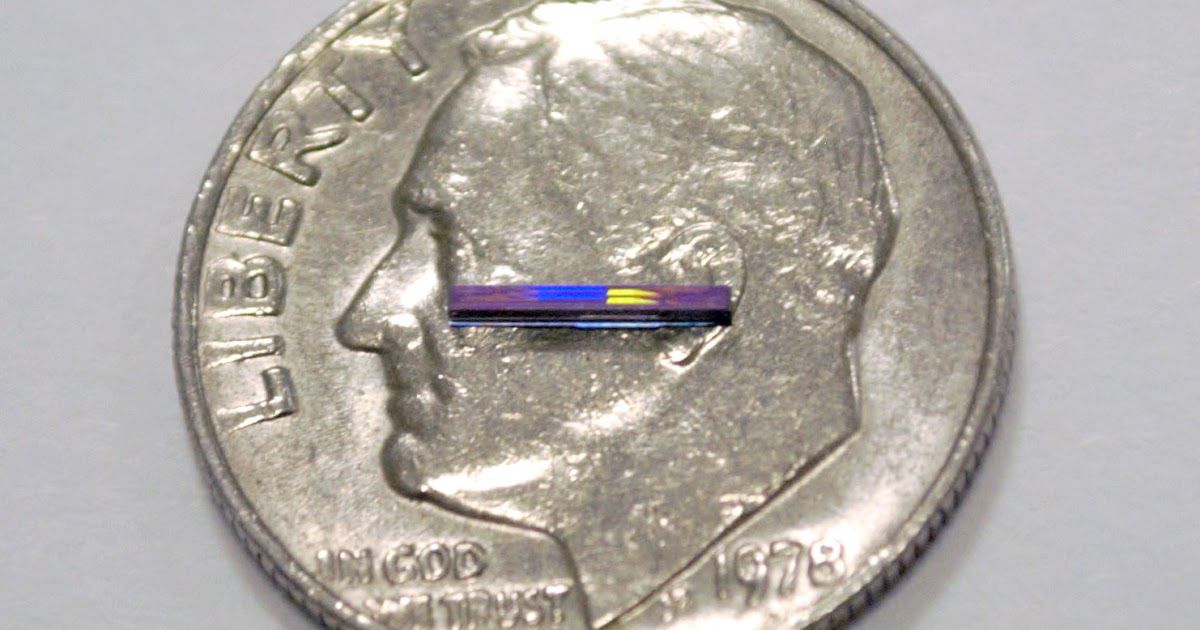
MIT’s Photonic Microsystems Group is developing a lidar-on-a-chip system that is smaller than a dime, has no moving parts, and could be mass-produced at a very low cost for use in self-driving cars, drones, and robots.

/* */