Toggle light / dark theme

Researchers use generative AI to design novel proteins

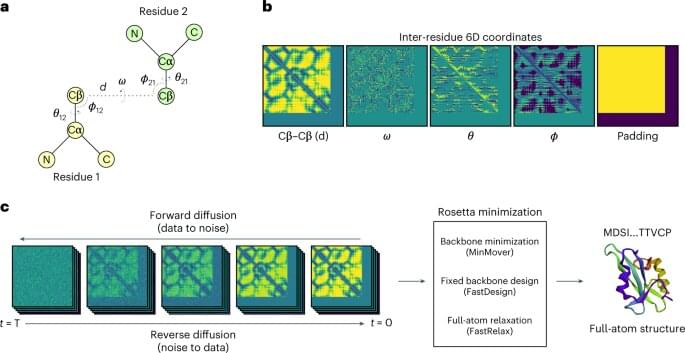
Researchers at the University of Toronto have developed an artificial intelligence system that can create proteins not found in nature using generative diffusion, the same technology behind popular image-creation platforms such as DALL-E and Midjourney.

The system will help advance the field of generative biology, which promises to speed by making the design and testing of entirely new therapeutic proteins more efficient and flexible.

“Our model learns from image representations to generate fully new proteins, at a very high rate,” says Philip M. Kim, a professor in the Donnelly Centre for Cellular and Biomolecular Research at U of T’s Temerty Faculty of Medicine. “All our proteins appear to be biophysically real, meaning they fold into configurations that enable them to carry out specific functions within cells.”

Chemists find that metal atoms play key role in fine organic synthesis

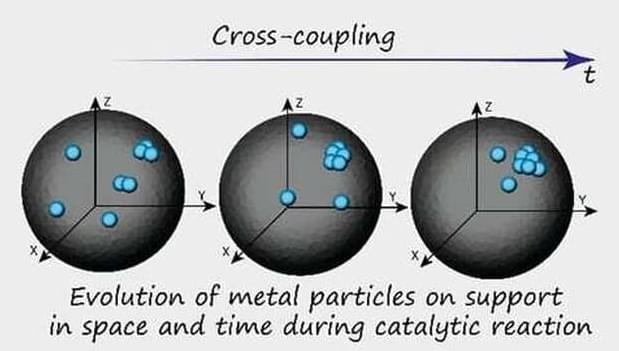
A small team of chemists at the Russian Academy of Sciences, has found that metal atoms, not nanoparticles, play the key role in catalysts used in fine organic synthesis. In the study, reported in the Journal of the American Chemical Society, the group used multiple types of electron microscopy to track a region of a catalyst during a reaction to learn more about how it was proceeding.

Prior research has shown that there are two main methods for studying a reaction. The first is the most basic: As ingredients are added, the reaction is simply observed and/or measured. This can be facilitated through use of high-speed cameras. This approach will not work with nanoscale reactions, of course. In such cases, chemists use a second method: They attempt to capture the state of all the components before and after the reaction and then compare them to learn more about what happened.

This second approach leaves much to be desired, however, as there is no way to prove that the objects under study correspond with one another. In recent years, have been working on a new approach: Following the action of a single particle during the reaction. This new method has proven to have merit but it has limitations as well—it also cannot be used for reactions that occur in the nanoworld. In this new effort, the researchers used multiple types of electron microscopy coupled with .

AI could run a million microbial experiments per year, says study

An artificial intelligence system enables robots to conduct autonomous scientific experiments—as many as 10,000 per day—potentially driving a drastic leap forward in the pace of discovery in areas from medicine to agriculture to environmental science.

Reported today in Nature Microbiology, the research was led by a professor now at the University of Michigan.

That , dubbed BacterAI, mapped the metabolism of two associated with —with no baseline information to start with. Bacteria consume some combination of the 20 amino acids needed to support life, but each species requires specific nutrients to grow. The U-M team wanted to know what amino acids are needed by the beneficial microbes in our mouths so they can promote their growth.

Is it time to ‘shield’ AI with a firewall? Arthur AI thinks so

Join top executives in San Francisco on July 11–12, to hear how leaders are integrating and optimizing AI investments for success. Learn More

With the risks of hallucinations, private data information leakage and regulatory compliance that face AI, there is a growing chorus of experts and vendors saying there is a clear need for some kind of protection.

One such organization that is now building technology to protect against AI data risks is New York City based Arthur AI. The company, founded in 2018, has raised over $60 million to date, largely to fund machine learning monitoring and observability technology. Among the companies that Arthur AI claims as customers are three of the top-five U.S. banks, Humana, John Deere and the U.S. Department of Defense (DoD).

Microsoft launches new features for powered Bing and Edge

Join top executives in San Francisco on July 11–12, to hear how leaders are integrating and optimizing AI investments for success. Learn More

Microsoft announced a major expansion of its artificial intelligence-based search tools today, opening up new features that allow visual and multimodal searches, as well as persistent chat tools. The updates significantly expand the capabilities of Bing, the company’s search engine, and Edge, its web browser.

Only select users have been able to test the new AI search features in a limited preview over the last three months. But the company announced today it is now moving Bing and Edge into an open preview, allowing anyone to test the new tools by signing in with a Microsoft account. The move suggests Microsoft believes the new features are ready for wider use and feedback.

AI offers new tools for making games, but developers worry about their jobs

The early days of AI in game development have been full of questions and murky answers.

For the most part, AI is exceptionally bad at illustrating hands. They come out six-fingered or four-fingered or, even worse, just some wispy ends that fade into the background. AI has been programming large Western 1940s-era smiles onto people of various cultures. It’s been reshaping images we know and refitting them according to prompts. Depending on the data that it’s fed, though, sometimes AI has solutions, and sometimes it doesn’t. Video game developers and AI companies want to use these AI tools to streamline game development and make it faster.


As major video game publishers like Ubisoft start to utilize AI for their development workflows, developers are beginning to worry about future job prospects.

Slack updates aim to put AI at the center of the user experience

Slack has evolved from a pure communications platform to one that enables companies to link directly to enterprise applications without having to resort to dreaded task switching. Today, at the Salesforce World Tour event in NYC, the company announced the next step in its platform’s evolution where it will be putting AI at the forefront of the user experience, making it easier to get information and build workflows.

It’s important to note that these are announcements, and many of these features are not available yet.

Rob Seaman says that rather than slapping on an AI cover, they are working to incorporate it in a variety of ways across the platform. That started last month with a small step, a partnership with OpenAI to bring a ChatGPT app into Slack, the first piece of a much broader vision for AI on the platform. That part is in beta at the moment.

/* */