Toggle light / dark theme

What’s the H100, the Chip Driving Generative AI?

It’s rare that a computer component sets pulses racing beyond the tech industry. But when Nvidia Corp. issued a blowout sales forecast in May to send its market value above $1 trillion, the star of the show was its latest graphics processing unit, the H100. The new data center chip is showing investors that the buzz around generative artificial intelligence — systems that can perform a wide range of tasks at superpowered speed — is translating into real revenue, at least for Nvidia. Demand for the H100 is so great that some customers are having to wait as long as six months to receive it.

The H100, whose name is a nod to computer science pioneer Grace Hopper, is a graphics processor. It’s a type of chip that normally lives in PCs and helps gamers get the most realistic visual experience. Unlike its regular counterparts, though, the chip’s 80 billion transistors are arranged in cores that are tuned to process data at high speed, not generate images. Nvidia, founded in 1993, pioneered this market with investments in technology going back almost two decades, when it bet that the ability to do work in parallel would one day make its chips valuable in applications outside of gaming.

Have a confidential tip for our reporters? Get in Touch.

Chinese robot clones pigs with no human help

A robot that automates a common technique for animal cloning has been used to produce a litter of cloned pigs in China — with a much higher success rate than human scientists.

The challenge: China is both the world’s biggest producer of pork and its largest consumer, so having ideal breeding stock — animals that birthe large litters of quick-growing piglets — is important for the nation’s economy and food security.

However, in 2018 and 2019, an epidemic of deadly African swine fever wiped out almost 50% of China’s pig population. As a result, many farmers have had to import breeding pigs, and China is now eager for its pork industry to become almost entirely self-sufficient.

Raytheon to create DARPA’s airborne “wireless internet for energy”

DARPA has tapped Raytheon to design and develop a wireless, airborne relay system to “deliver energy into contested environments,” as part of its Energy Web Dominance program, in which DARPA wants to be able to power anything from nearly anywhere.

Under a two-year, US$10 million DARPA contract, Raytheon will create a Persistent Optical Wireless Energy Relay (POWER) system, using a series of high altitude unmanned aircraft equipped with laser-based power receiving and transmitting capabilities. Energy will be beamed up to high altitude, then relayed across however many jumps are necessary to reach the target area.

That target might be on the ground, or it might itself be another autonomous aerial platform, in which case it could stay airborne as long as necessary, its batteries being constantly charged from afar.

Jeff Bezos plays down AI dangers and says one trillion humans could live in huge cylindrical space stations

‘’


Artificial intelligence is more likely to save humanity than to destroy it, Jeff Bezos said recently. The billionaire also said he would like to see the human population grow to one trillion, with most people living in huge cylindrical space stations.

In an interview with podcaster Lex Fridman, the Amazon AMZN, +1.73% founder and former CEO rejected the idea that humans should colonize other planets, saying he believes building space colonies is the only way to achieve such population growth.

Japan scientists create world’s 1st mental images with AI tech

Japanese scientists said they have succeeded in creating the world’s first mental images of objects and landscapes from human brain activity by using artificial intelligence technology.

The team of scientists from the National Institutes for Quantum Science and Technology, another national institute and Osaka University was able to produce rough images of a leopard, with a recognizable mouth, ears and spotted pattern, as well as objects like an airplane with red lights on its wings.

The technology, dubbed “brain decoding,” enables the visualization of perceptual contents based on brain activity and could be applied to the medical and welfare fields.

A means for searching for new solutions in mathematics and computer science using an LLM and an evaluator

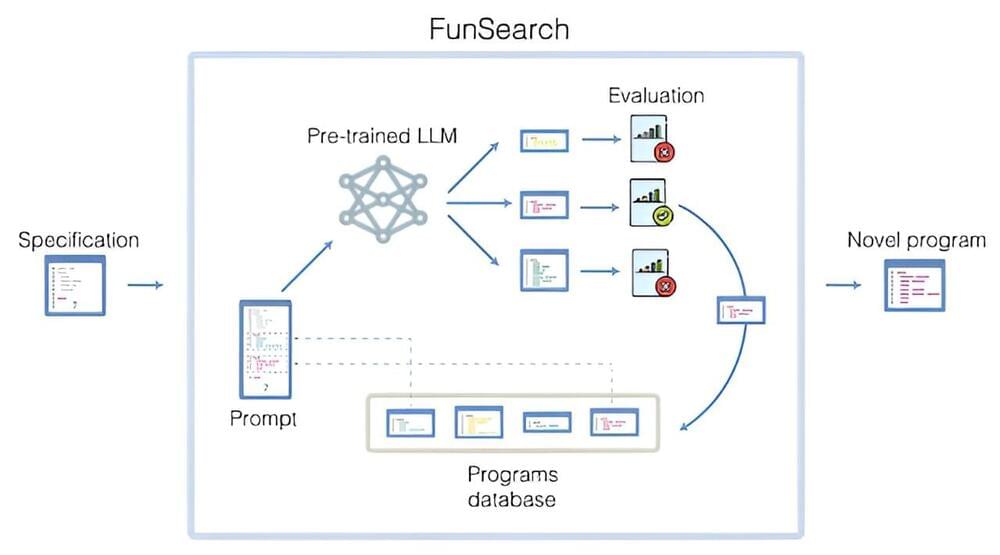
A team of computer scientists at Google’s DeepMind project in the U.K., working with a colleague from the University of Wisconsin-Madison and another from Université de Lyon, has developed a computer program that combines a pretrained large language model (LLM) with an automated “evaluator” to produce solutions to problems in the form of computer code.

In their paper published in the journal Nature, the group describes their ideas, how they were implemented and the types of output produced by the new system.

Researchers throughout the scientific community have taken note of the things people are doing with LLMs, such as ChatGPT, and it has occurred to many of them that LLMs might be used to help speed up the process of scientific discovery. But they have also noted that for that to happen, a method is required to prevent confabulations, answers that seem reasonable but are wrong—they need output that is verifiable. To address this problem, the team working in the U.K. used what they call an automated evaluator to assess the answers given by an LLM.

/* */