With quantum radar, you can map the cosmos with 3D modeling and dwave quantum computer.
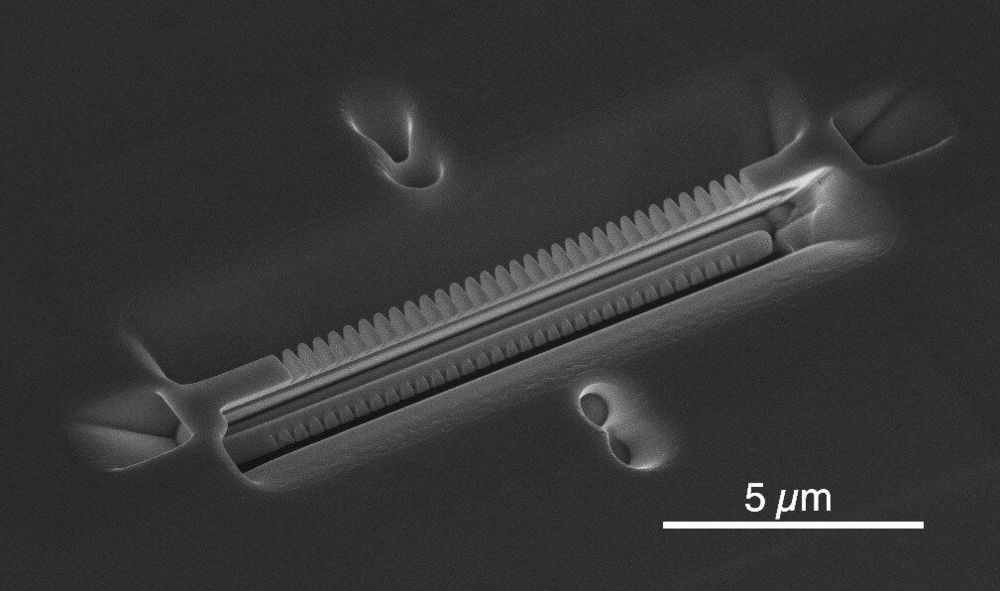
Engineers at Caltech have shown that atoms in optical cavities—tiny boxes for light—could be foundational to the creation of a quantum internet. Their work was published on March 30 by the journal Nature.
Quantum networks would connect quantum computers through a system that also operates at a quantum, rather than classical, level. In theory, quantum computers will one day be able to perform certain functions faster than classical computers by taking advantage of the special properties of quantum mechanics, including superposition, which allows quantum bits to store information as a 1 and a 0 simultaneously.
As they can with classical computers, engineers would like to be able to connect multiple quantum computers to share data and work together—creating a “quantum internet.” This would open the door to several applications, including solving computations that are too large to be handled by a single quantum computer and establishing unbreakably secure communications using quantum cryptography.
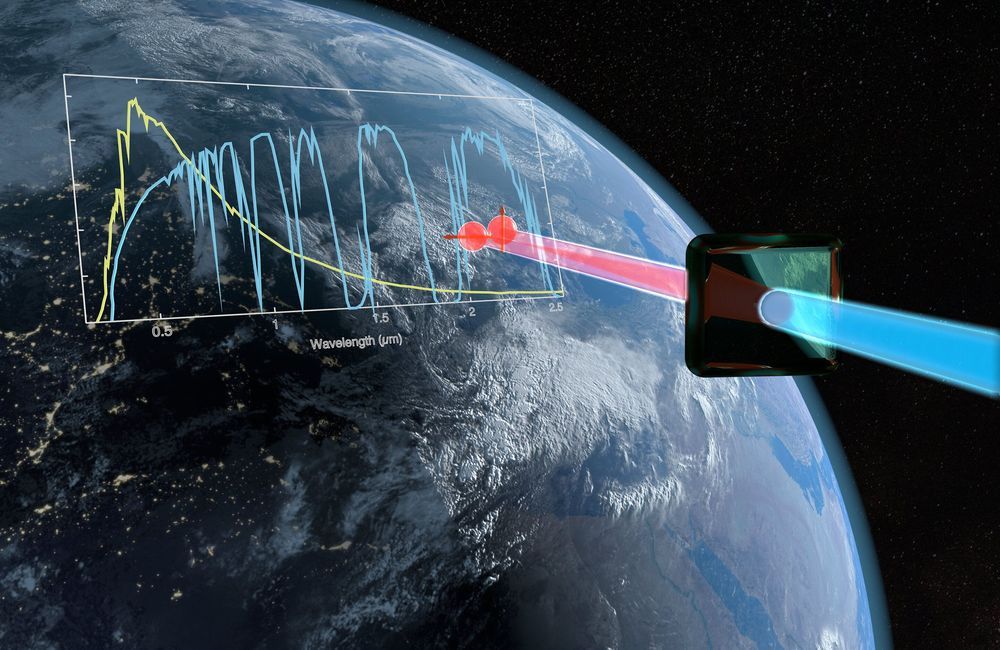
An international team with the participation of Prof. Dr. Michael Kues from the Cluster of Excellence PhoenixD at Leibniz University Hannover has developed a new method for generating quantum-entangled photons in a spectral range of light that was previously inaccessible. The discovery can make the encryption of satellite-based communications much more secure in the future.
A 15-member research team from the U.K., Germany and Japan has developed a new method for generating and detecting quantum-entangled photons at a wavelength of 2.1 micrometers. In practice, entangled photons are used in encryption methods such as quantum key distribution to completely secure telecommunications between two partners against eavesdropping attempts. The research results are presented to the public for the first time in the current issue of Science Advances.
It has been regarded as technically possible to implement encryption mechanisms with entangled photons in the near-infrared range of 700 to 1550 nanometers. However, these shorter wavelengths have disadvantages, especially in satellite-based communication. They are disturbed by light-absorbing gases in the atmosphere as well as the background radiation of the sun. With existing technology, end-to-end encryption of transmitted data can only be guaranteed at night, but not on sunny and cloudy days.

Professor Ronny Thomale holds a chair for theoretical condensed matter physics, the TP1, at the Julius-Maximilian University of Würzburg. The discovery and theoretical description of new quantum states of matter is a prime objective of his research. “Developing a theory for a new physical phenomenon which then inspires new experiments seeking after this effect is one of the biggest moments in a theoretical physicist’s practice,” he says. In an ideal case, such an effect would even unlock unexpected technological potential.
All this has come together with a recent project which Thomale pursued together with the optical experimental group of Professor Alexander Szameit at the University of Rostock, the results of which have now been published in Science.
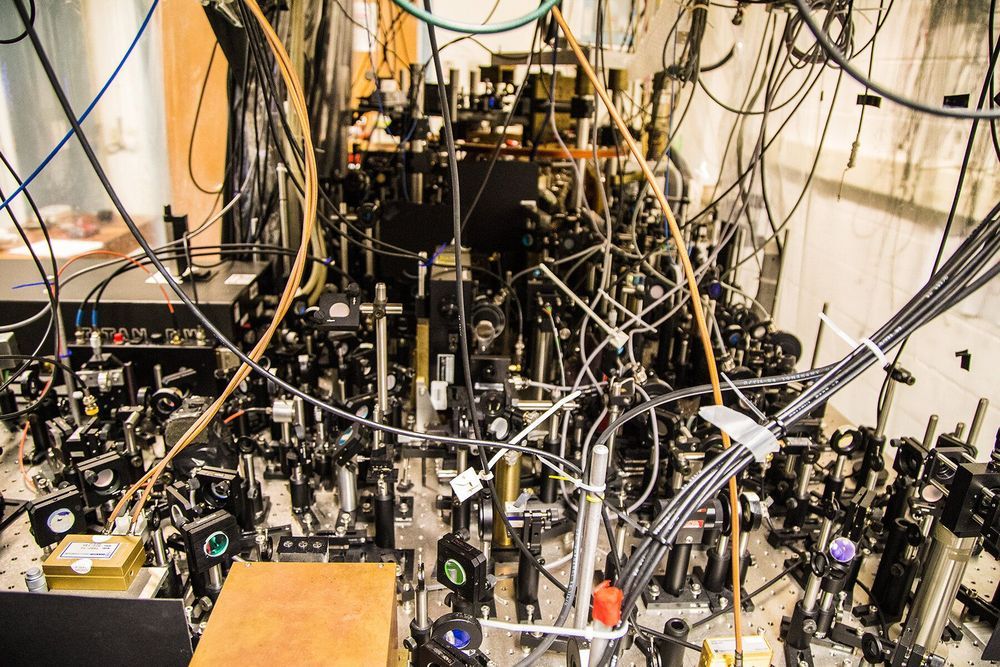
Bosons and fermions, the two classes into which all particles—from the sub-atomic to atoms themselves—can be sorted, behave very differently under most circumstances. While identical bosons like to congregate, identical fermions tend to be antisocial. However, in one dimension—imagine particles that can only move on a line—bosons can become as stand-offish as fermions, so that no two occupy the same position. Now, new research shows that the same thing—bosons acting like fermions—can happen with their velocities. The finding adds to our fundamental understanding of quantum systems and could inform the eventual development of quantum devices.
“All particles in nature come in one of two types, depending on their ‘spin,’ a quantum property with no real analogue in classical physics,” said David Weiss, Distinguished Professor of Physics at Penn State and one of the leaders of the research team. “Bosons, whose spins are whole integers, can share the same quantum state, while fermions, whose spins are half integers, cannot. When the particles are cold or dense enough, bosons behave completely differently from fermions. Bosons form ‘Bose-Einstein condensates,’ congregating in the same quantum state. Fermions, on the other hand, fill available states one by one to form what is called a ‘Fermi sea.’”
Researchers at Penn State have now experimentally demonstrated that, when bosons expand in one dimension—the line of atoms is allowed spread out to become longer—they can form a Fermi sea. A paper describing the research appears March 27, 2020 in the journal Science.
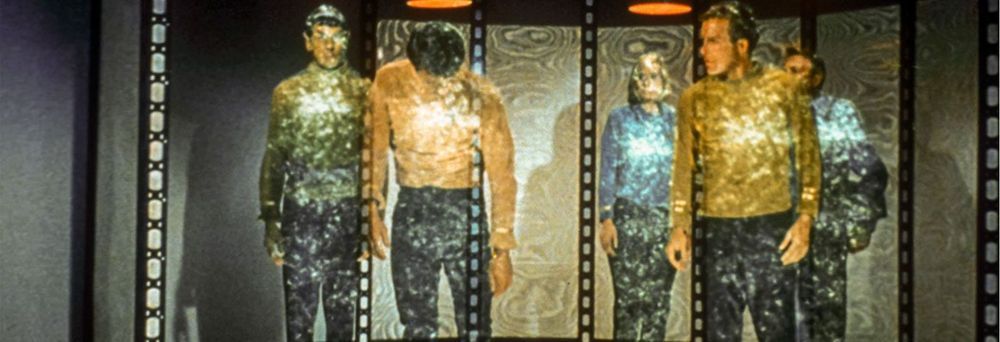
In 2005, the obituary of physicist Asher Peres in the magazine Physics Today told us that when a journalist asked him if quantum teleportation could transport a person’s soul as well as their body, the scientist replied: “No, not the body, just the soul.” More than just a simple joke, Peres’ response offers a perfect explanation, encoded in a metaphor, of the reality of a process that we have seen countless times in science fiction. In fact, teleportation does exist, although in the real world it is quite different from the famous “Beam me up, Scotty!” associated with the Star Trek series.
Teleportation in real science began to take shape in 1993 thanks to a theoretical study published by Peres and five other researchers in Physical Review Letters, which laid the foundation for quantum teleportation. Apparently, it was co-author Charles Bennett’s idea to associate the proposed phenomenon with the popular idea of teleportation, but there is an essential difference between fiction and reality: in the latter it’s not matter that travels, but rather information, which transfers properties from the original matter to that of the destination matter.
Quantum teleportation is based on a hypothesis described in 1935 by physicist Albert Einstein and his colleagues Boris Podolsky and Nathan Rosen, known as the EPR paradox. As a consequence of the laws of quantum physics, it was possible to obtain two particles and separate them in space so that they would continue to share their properties, as two halves of a whole. Thus, an action on one of them (on A, or Alice, according to the nomenclature used) would instantaneously have an effect on the other (on B, or Bob). This “spooky action at a distance”, in Einstein’s words, would seem capable of violating the limit of the speed of light.
Circa 2006
By Maggie Mckee
Nearly all of the information that falls into a black hole escapes back out, a controversial new study argues. The work suggests that black holes could one day be used as incredibly accurate quantum computers – if enormous theoretical and practical hurdles can first be overcome.
Black holes are thought to destroy anything that crosses a point of no return around them called an “event horizon”. But in the 1970s, Stephen Hawking used quantum mechanics to show black holes do emit radiation, which eventually evaporates them away completely.

Based on a lot of study it may be possible that if naturally derived dmt having quantum entanglement properties that someday it could be used to naturally teleport people. Especially if can essentially have suppositions properties that it may in fact allow an interdimensional portal quantum mechanically speaking it also said that cannabis did not start on earth either and is an alien plant. It may that someday we could take a pill to teleport through the fabric of space time with a biochemical means but it would involve a sort higgs mode or higgs boson level quantum teleportation for that amount of energy. But it may eventually lead to real teleportation in human beings naturally someday since it already holds those properties.