Nice.
Now used to brighten displays, quantum dots could one day guide a surgeon’s hand.

If there is any organization on the planet that has had a closer view of the coming demise of Moore’s Law, it is the Institute of Electrical and Electronics Engineers (IEEE). Since its inception in the 1960s, the wide range of industry professionals have been able to trace a steady trajectory for semiconductors, but given the limitations ahead, it is time to look to a new path—or several forks, to be more accurate.
This realization about the state of computing for the next decade and beyond has spurred action from a subgroup, led by Georgia Tech professor Tom Conte and superconducting electronics researcher, Elie Track called “Rebooting Computing,” which produces reports based on invite-only deep dives on a wide range of post-Moore’s Law technologies, many of which were cited here this week via Europe’s effort to pinpoint future post-exascale architectures. The Rebooting Computing effort is opening its doors next week for a wider-reaching, open forum in San Diego to bring together new ideas in novel architectures and modes of computing as well as on the applications and algorithm development fronts.
According to co-chair of the Rebooting Computing effort, Elie Track, a former Yale physicist who has turned his superconducting circuits work toward high efficiency solar cells in his role at startup Nvizix, Moore’s Law is unquestionably dead. “There is no known technology that can keep packing more density and features into a given space and further, the real issue is power dissipation. We just cannot keep reducing things further; a fresh perspective is needed.” The problem with gaining that view, however, is that for now it means taking a broad, sweeping look across many emerging areas; from quantum and neuromorphic devices, approximate computing, and a wide range of other technologies. “It might seem frustrating that this is general, but there is no clear way forward yet. What we all agree on is that we need exponential growth in computing engines.”

Nice.
There are many scientific and non-scientific varieties of the answer about what came before Big Bang. Some say there was literally nothing and some say a black hole or a multiverse. But now a group of mathematicians from Canada and Egypt have analyzed some cutting edge scientific theory and a complex set of equations to find what preceded the universe in which we live. Their research paper has been published in Nature.
To explain it in simple and easily understandable terms; they applied the theories of the very small i.e. the world of quantum mechanics, to the entire universe — explained by general theory of relativity, and discovered the universe essentially goes through four different phases.
Another article on the QC advancement; however, as I told folks synthetic diamonds are key plus the crystalized formation are proven to be very useful not only in QC processing; but also for the light-based (Quantum) networking. I see this only the beginning (as we have seen with Synthetic DNA data storage) for synthetic gem crystalize formations in their usage in technology. Hoping folks are checking out the 3D Printers creating these synthetics because we truly are on the path of seeing our world transform to new levels never imagined.
Abstract: By forcefully embedding two silicon atoms in a diamond matrix, Sandia researchers have demonstrated for the first time on a single chip all the components needed to create a quantum bridge to link quantum computers together.
“People have already built small quantum computers,” says Sandia researcher Ryan Camacho. “Maybe the first useful one won’t be a single giant quantum computer but a connected cluster of small ones.”
Distributing quantum information on a bridge, or network, could also enable novel forms of quantum sensing, since quantum correlations allow all the atoms in the network to behave as though they were one single atom.

China’s latest work on QC.
If early mechanical computers were never introduced to expand people’s computing ability, the invention of the atomic bomb would have gone out the window, and human history would have been rewritten.
This highlights the significance of computer simulation in scientists’ exploration of the physical world, which also explains their strong motivation in continuously pursuing higher computing power.
In a recent case, Chinese scientists managed to tremendously enhance such power — they succeeded in performing quantum simulation with atoms in extraordinarily cold conditions.
New experiments in Calgary tested quantum teleportation in actual infrastructure, representing a major step forward for the technology.
Quantum physics is a field that appears to give scientists superpowers. Those who understand the world of extremely small or cold particles can perform amazing feats with them — including teleportation — that appear to bend reality.
The science behind these feats is complicated, and until recently, didn’t exist outside of lab settings. But that’s changing: researchers have begun to implement quantum teleportation in real-world contexts. Being able to do so just might revolutionize modern phone and Internet communications, leading to highly secure, encrypted messaging.

Los Alamos is the 1st place where QC Internet was launched.
A research team from Los Alamos National Laboratory published a paper in the journal Nature Energy this week that demonstrates an effective method for scaling up quantum dot solar power technology from production models to full-sized windows that could power a building.
“We are developing solar concentrators that will harvest sunlight from building windows and turn it into electricity, using quantum-dot based luminescent solar concentrators,” lead scientist and leader of the Los Alamos Center for Advanced Solar Photophysics (CASP) Victor Klimov said.
The Los Alamos paper advances techniques relating to luminescent solar concentrators (LSCs) – slabs of transparent glass or plastic into or onto which highly emissive fluorophores are placed in order to create large-area sunlight collectors for photovoltaic cells – examining large LSC windows that were created by using a blade to create a thin, highly uniform film on a surface. The quantum dots used in the Nature Energy study are dual-layered semiconductor spheres that enable control over the two separate layers’ emission spectra.
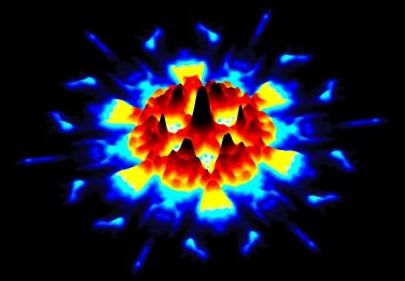
By forcefully embedding two silicon atoms in a diamond matrix, Sandia researchers have demonstrated for the first time on a single chip all the components needed to create a quantum bridge to link “People have already built small quantum computers,” says Sandia researcher Ryan Camacho. “Maybe the first useful one won’t be a single giant quantum computer but a connected cluster of small ones.”
Distributing quantum information on a bridge, or network, could also enable novel forms of quantum sensing, since quantum correlations allow all the atoms in the network to behave as though they were one single atom.
The joint work with Harvard University used a focused ion beam implanter at Sandia’s Ion Beam Laboratory designed for blasting single ions into precise locations on a diamond substrate. Sandia researchers Ed Bielejec, Jose Pacheco and Daniel Perry used implantation to replace one carbon atom of the diamond with the larger silicon atom, which causes the two carbon atoms on either side of the silicon atom to feel crowded enough to flee. That leaves the silicon atom a kind of large landowner, buffered against stray electrical currents by the neighboring non-conducting vacancies.