O Google planeja supremacia quantum.
Google está construindo computador qu ntico de 50 qubits.
Spinning black holes are capable of complex quantum information processes encoded in the X-ray photons emitted by the accretion disk.
The black holes sparked the public imagination for almost 100 years now. Their debated presence in the universe has been proven without a doubt by detecting the X-ray radiation coming from the center of the galaxies, a feature of massive black holes. Black holes emit X-ray radiation, light with high energy, due to the extreme gravity in their vicinity. The vast majority if not all of the known black holes were unveiled by detecting the X-ray radiation emitted by the stellar material accreting around black holes.
X-ray photons emitted near rotating black holes not only exposed the existence of these phantom-like astrophysical bodies, but also seem to carry hidden quantum messages.
Physicists have teased water molecules into a new state—one that has some very peculiar quantum mechanical properties.
For the most part, water on Earth comes in three varieties—solid ice, gaseous vapor, and (everybody’s favorite) liquid form. We’ve all known this since basically forever.
But now physicists, who love throwing monkey-wrenches into things and mucking with our cherished notions of everyday existence, have come up with another doozy—a brand new state of water.
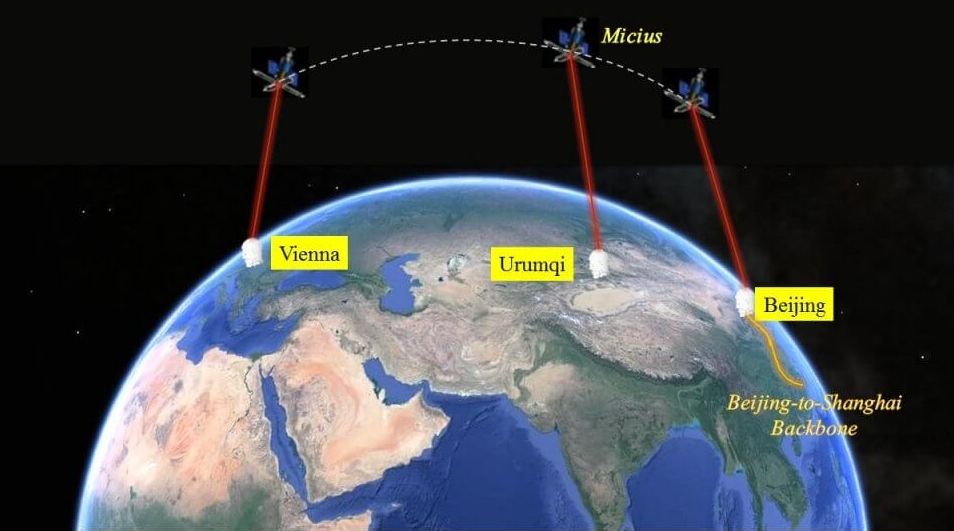
Researchers have demonstrated the requirements for secure quantum teleportation using quantum steering.
An international collaboration of researcher from China, Europe, and Australia have demonstrated the precise requirements needed to secure quantum teleportation, a concept that is essential to the future of a quantum internet that lets information to be transmitted securely.
Of course, quantum teleportation doesn’t mean that it’s possible for a person to instantly pop from New York to London, but they can instantly transport information through a bizarre quantum mechanics property called entanglement.
Quantum entanglement is one of the more bizarre theories to come out of the study of quantum mechanics — so strange, in fact, that Albert Einstein famously referred to it as “spooky action at a distance.”
Essentially, entanglement involves two particles, each occupying multiple states at once — a condition referred to as superposition. For example, both particles may simultaneously spin clockwise and counterclockwise. But neither has a definite state until one is measured, causing the other particle to instantly assume a corresponding state.
The resulting correlations between the particles are preserved, even if they reside on opposite ends of the universe.
A research team led by a Heriot-Watt scientist has shown that the universe is even weirder than had previously been thought.
In 2015 the universe was officially proven to be weird. After many decades of research, a series of experiments showed that distant, entangled objects can seemingly interact with each other through what Albert Einstein famously dismissed as “Spooky action at a distance”.
A new experiment by an international team led by Heriot-Watt’s Dr Alessandro Fedrizzi has now found that the universe is even weirder than that: entangled objects do not cause each other to behave the way they do.
There is a computing revolution coming, although nobody knows exactly when. What are known as “quantum computers” will be substantially more powerful than the devices we use today, capable of performing many types of computation that are impossible on modern machines.
But while faster computers are usually welcome, there are some computing operations that we currently rely on being hard (or slow) to perform.
Specifically, we rely on the fact that there are some codes that computers can’t break – or at least it would take them too long to break to be practical. Encryption algorithms scramble data into a form that renders it unintelligible to anyone that does not possess the necessary decryption key (normally a long string of random numbers).
A discussion that I have had often.
In Beyond Science, Epoch Times explores research and accounts related to phenomena and theories that challenge our current knowledge. We delve into ideas that stimulate the imagination and open up new possibilities. Share your thoughts with us on these sometimes controversial topics in the comments section below.
The Dutch philosopher Baruch Spinoza (1632–1677) wrote in “Ethics I”: “Nothing in Nature is random. … A thing appears random only through the incompleteness of our knowledge.”
In modern physics, certain quantum processes are deemed fundamentally random.
More insights on human conscientious in relation to its state after we die.
Personally, (this is only my own opinion) I believe much of the human conscientious will remain a mystery even in the living as it relates to the re-creation of the human brain and its thinking and decision making patterns on current technology. Namely because any doctor will tell you that a person’s own decisions (namely emotional decision making/ thinking) can be impacted by a whole multitude of factors beyond logical information such as the brain’s chemical balance, physical illness or even injury, etc. which inherently feeds into conscientious state. In order to try to replicate this model means predominantly development of a machine that is predominantly built with synthetic biology; and even then we will need to evolve this model to finally understand human conscientious more than we do today.
Sir Roger Penrose, a mathematical physicist at Oxford University, has asked “what right do we have to claim, as some might, that human beings are the only inhabitants of our planet blessed with an actual ability to be “aware”? It is hard to see how one could begin to develop a quantum-theoretical description of brain action when one might well have to regard the brain as “observing itself” all the time! Beneath all this technicality is the feeling that it is indeed “obvious” that the conscious mind cannot work like a computer, even though much of what is involved in mental activity might do so.
New updated article on the evolution of the processors of tomorrow.
Personally, I find this article runs short in only focusing on carbon, organics aka plastics, and QC as future replacement. With the ongoing emergence of synthetic biology and what this could mean for processors; I would suggest the author explore further the future of synthetic bio.
From stacked CPUs to organic and quantum processing.