Firefox Quantum is the best browser I’ve used in years.

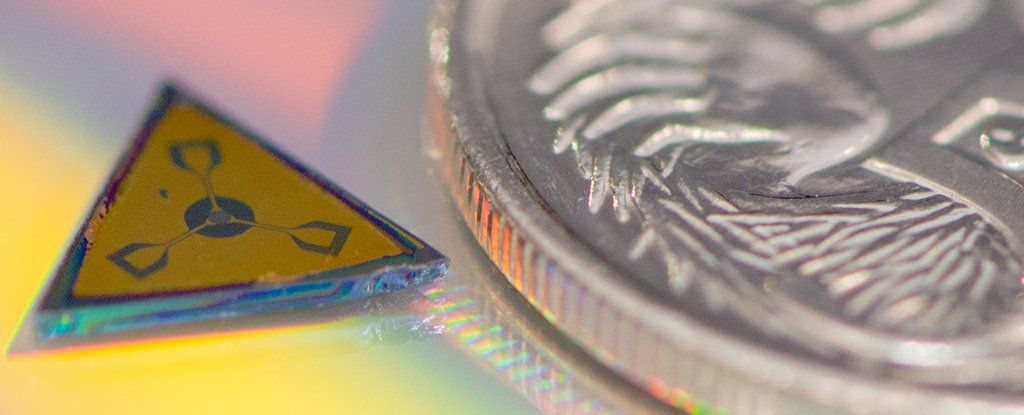
In 2016, the Nobel Prize in Physics went to three British scientists for their work on superconductors and superfluids, which included the explanation of a rather odd phase of matter.
Now, for the first time, their discovery has a practical application – shrinking an electrical component to a size that will help quantum computers reach a scale that just might make them useful.
In a collaboration with Stanford University in the US, a team of scientists from the University of Sydney and Microsoft have used the newly found phase of matter — topological insulator — in shrinking an electrical component called a circulator 1,000 times smaller.
Yes.
Physicists in the QUTIS Quantum Biomimetics and Quantum Artificial Life research group at the Department of Physical Chemistry, University of the Basque Country in Spain have harnessed the unprecedented power of the IBM Q Cloud Quantum Computer —recently made available for public use ( IBM makes 20 qubit quantum computing machine available as a cloud service) —to reproduce the hallmark features of Darwinian life and evolution in microscopic quantum systems, proving they can efficiently encode quantum features and biological behaviors that are usually associated with living systems and natural selection.
Cryptography and radar were technologies that won World War 2. Broken codes let the allies know where major forces were being moved. So the US fleet could choose where to intercept the Japanese Navy for the Battle of Midway. Radar and sonar then provided realtime tracking of the Japanese forces during the battle.
This is a summary of information from a Foreign Policy article by Thomas E. Ricks.
Quantum entanglement, quantum superposition, and quantum tunneling can be applied in new forms of computation, sensing, and cryptography.
Physicists at MIT and Harvard University have demonstrated a new way to manipulate quantum bits of matter. In a paper published today in the journal Nature, they report using a system of finely tuned lasers to first trap and then tweak the interactions of 51 individual atoms, or quantum bits.
The team’s results represent one of the largest arrays of quantum bits, known as qubits, that scientists have been able to individually control. In the same issue of Nature, a team from the University of Maryland reports a similarly sized system using trapped ions as quantum bits.
In the MIT-Harvard approach, the researchers generated a chain of 51 atoms and programmed them to undergo a quantum phase transition, in which every other atom in the chain was excited. The pattern resembles a state of magnetism known as an antiferromagnet, in which the spin of every other atom or molecule is aligned.
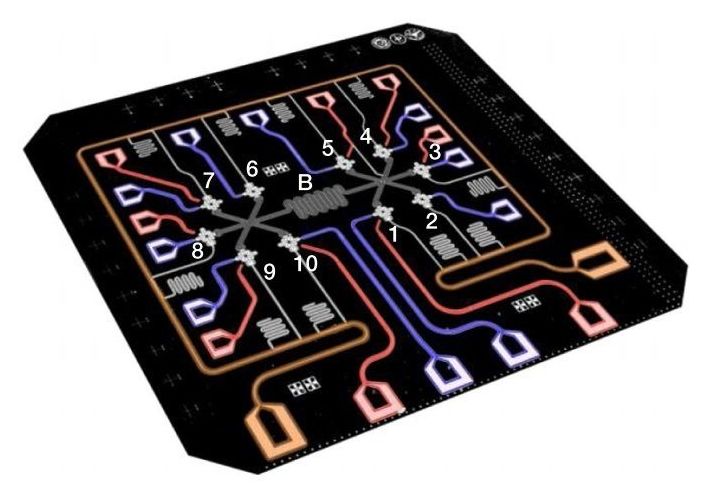
(Phys.org)—Physicists have experimentally demonstrated quantum entanglement with 10 qubits on a superconducting circuit, surpassing the previous record of nine entangled superconducting qubits. The 10-qubit state is the largest multiqubit entangled state created in any solid-state system and represents a step toward realizing large-scale quantum computing.
Lead researcher Jian-Wei Pan and co-workers at the University of Science and Technology of China, Zhejiang University, Fuzhou University, and the Institute of Physics, China, have published a paper on their results in a recent issue of Physical Review Letters.
In general, one of the biggest challenges to scaling up multiqubit entanglement is addressing the catastrophic effects of decoherence. One strategy is to use superconducting circuits, which operate at very cold temperatures and consequently have longer qubit coherence times.
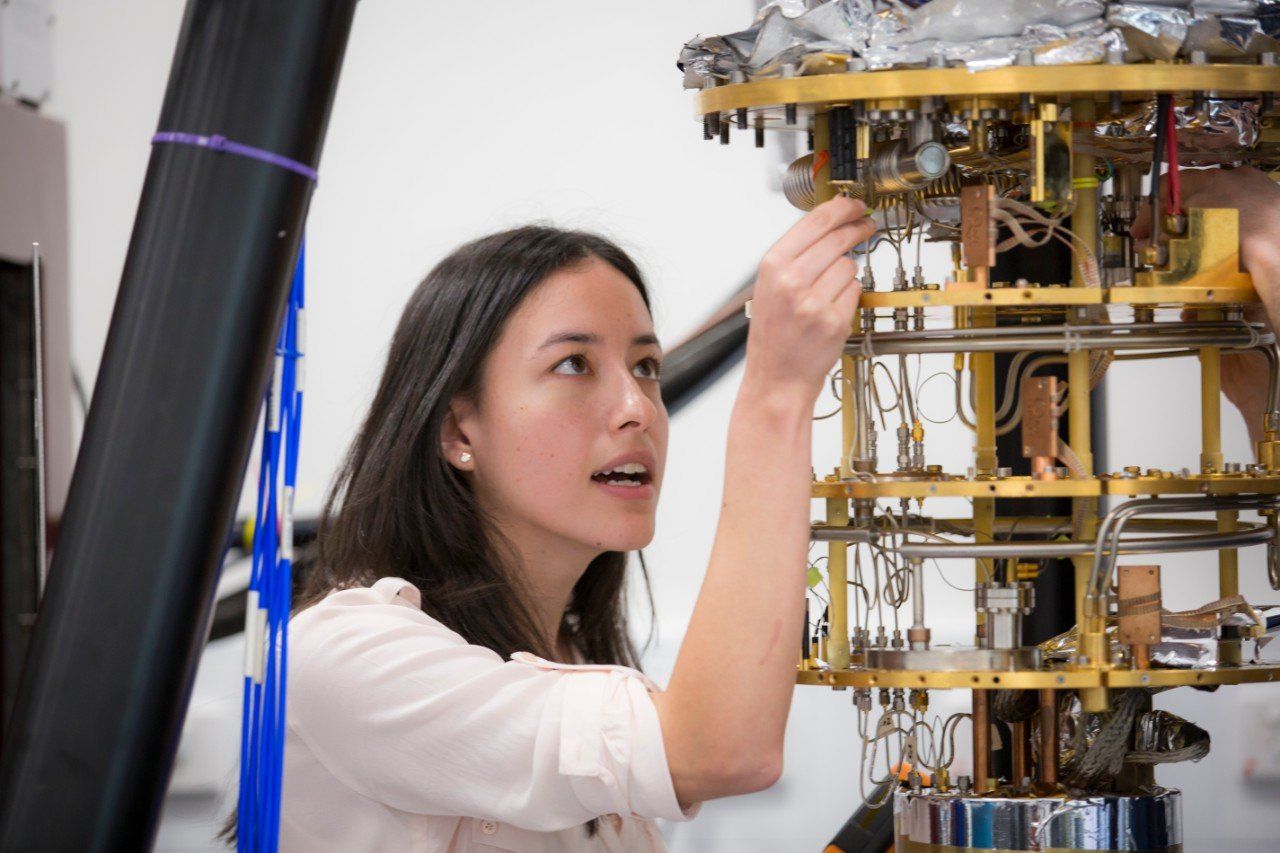
A team at the University of Sydney and Microsoft, in collaboration with Stanford University in the US, has miniaturised a component that is essential for the scale-up of quantum computing. The work constitutes the first practical application of a new phase of matter, first discovered in 2006, the so-called topological insulators.
Beyond the familiar phases of matter — solid, liquid, or gas — topological insulators are materials that operate as insulators in the bulk of their structures but have surfaces that act as conductors. Manipulation of these materials provide a pathway to construct the circuitry needed for the interaction between quantum and classical systems, vital for building a practical quantum computer.
Theoretical work underpinning the discovery of this new phase of matter was awarded the 2016 Nobel Prize in Physics.

Researchers from Google and the University of California Santa Barbara have taken an important step towards the goal of building a large-scale quantum computer.
Writing in the journal Quantum Science and Technology, they present a new process for creating superconducting interconnects, which are compatible with existing superconducting qubit technology.
The race to develop the first large-scale error-corrected quantum computer is extremely competitive, and the process itself is complex. Whereas classical computers encode data into binary digits (bits) that exist in one of two states, a quantum computer stores information in quantum bits (qubits) that may be entangled with each other and placed in a superposition of both states simultaneously.