Toggle light / dark theme

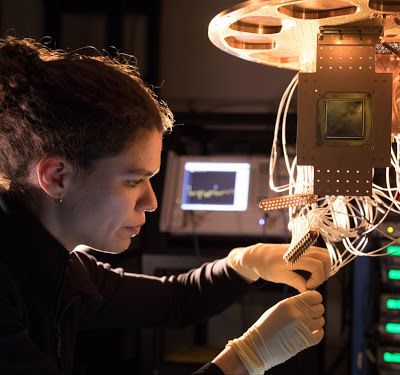
Peter Wittek, a roving adventurer between machine intelligence and quantum physics

I must admit, when people see that you work with Quantum Computing and/ or networking; they have no idea how to classify you because you’re working on Nextgen “disruptive” technology that most of mainstream has not been exposed to.


Peter Wittek and I met more than a decade ago while he was an exchange student in Singapore. I consider him one of the most interesting people I’ve met and an inspiration to us all.

Currently, he is a research scientist working on quantum machine learning, an emergent field halfway between data science and quantum information processing. Peter also has a long history in machine learning on supercomputers and large-scale simulations of quantum systems. As a former digital nomad, Peter has been to over a hundred countries, he is currently based in Barcelona where, outside work hours, he focuses on dancing salsa, running long distances, and advising startups.

2016-02-28-1456691593-1100960-IMG_2684.jpg

Sharing secrets with light

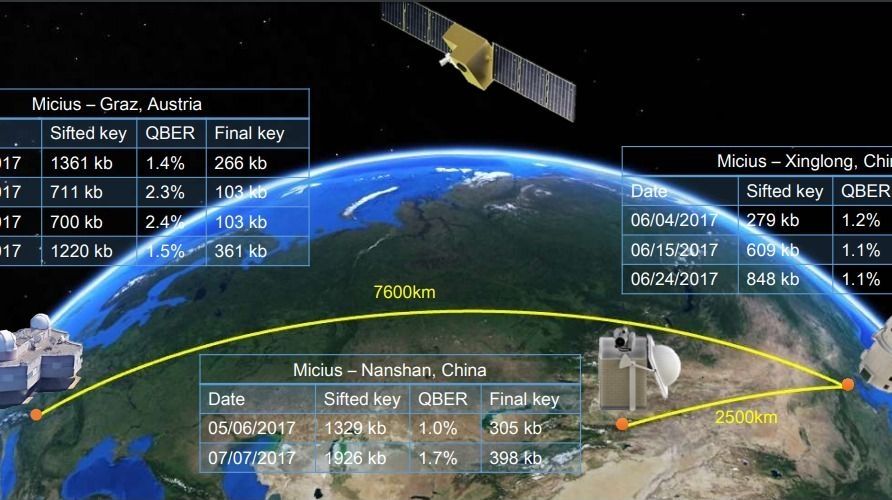
More great news on Quantum Networks; some banks in Europe are leveraging the technology to communicate among themselves.


Light is everywhere. Even the darkest of rooms in our homes contain a handful of blinking LEDs. But what is light? Few of us ever stop to think about this question. Around a hundred years ago scientists discovered that light comes in granules, much like the sand on a beach, which we now call photons.

These are truly bizarre objects that obey the rules of the quantum world. The rules allow some pairs of photons to share a property called entanglement. After being entangled, two photons behave as one object. Changing one photon will affect the other at exactly the same time, no matter how far apart they are.

Far from being a strange but useless property, this is now being put to good use to build computer networks that cannot be hacked. Imagine the scenario where you’re buying a gift over the internet. You will need to input your credit card details, hoping nobody steals them. But what happens if there is a smart criminal tapping your line, listening in to all your communications? Well, there is nothing stopping that eavesdropper from making off with your credit card details and using them on their next shopping spree.

Quantum dot solids: a new era in electronics?

Connecting the dots: Playing ‘LEGO’ at the atomic scale to build atomically coherent quantum dot solids (credit: Kevin Whitham, Cornell University)

Just as the single-crystal silicon wafer forever changed the nature of communication 60 years ago, Cornell researchers hope their work with quantum dot solids — crystals made out of crystals — can help usher in a new era in electronics.

The team has fashioned two-dimensional superstructures out of single-crystal building blocks. Using a pair of chemical processes, the lead-selenium nanocrystals are synthesized into larger crystals, then fused together to form atomically coherent square superlattices.

Cornell University | Quantum dot solids

The difference between these and previous crystalline structures is the atomic coherence of each 5-nanometer crystal (a nanometer is one-billionth of a meter). They’re not connected by a substance between each crystal — they’re connected to each other directly. The electrical properties of these superstructures are potentially superior to existing semiconductor nanocrystals, with anticipated applications in energy absorption and light emission.

HKUST students should consider careers in quantum computing, expert says

I have been encouraging my nephews to consider this as well.


After nearly three decades of searching for ways to build superfast computers that operate on the principles of quantum mechanics, the reality of a fully-fledged quantum computer is moving closer, says professor Andrew Yao Chi-chih, dean of the Institute for Interdisciplinary Information Sciences, Tsinghua University, Beijing.

“Quantum computing is no longer viewed as a fad, or a scientist’s pie in the sky,’’ Yao told an audience of students, faculty, and invited guests during his presentation at a Hong Kong University of Science and Technology (HKUST) 25th Anniversary Distinguished Speakers Series event on January 28. Yao also took the opportunity to explain his rationale for quantum computing to be recognised as a Great Science. “Great Science involves the intersection of different scientific disciplines to create new knowledge that allows the exploration of the previously unimaginable,’’ stressed Yao, adding that Great Science also lifts the human spirit.

Yao believes computers built on the principles of quantum physics could revolutionise the information processes used for a range of applications, including precision weather forecasting and replacement aircraft fuselage wind tunnel testing. He also pointed out that increasingly powerful computers are needed to solve fresh challenges.

Are Quantum Dots the Silicon Wafers of the Future?

I cannot wait until Q-Dot technology is commercially available to industries. When we start releasing Q-Dots to the commercial sector we’re going to see some real magic happen and possibly even able to improve many things that are refined, or created today. https://lnkd.in/bF4xm73


Silicon wafers have long been the go-to for all things electronic. First appearing in the ‘50s, they quickly made it as THE connectors, basically singlehandedly kickstarting the silicon revolution. A team of researchers from the Cornell University have discovered something they consider to be the next big step in quantum electronics. They are quite certain of the answer to the question “Are Quantum Dots the Silicon Wafers of the Future?”.

Is this the future of work? Scientists predict which jobs will still be open to humans in 2035

1st; we all know in 30 years anything can change, wars can be fought & lost, natural disasters can occur, etc. However, posting for everyone’s amusement. 30 years ago which would be 1986; no one thought USSR would be broken up, 9/11 would happen creating the US Homeland Security, Lybia & Eygpt would overthrow their own leaders, that US Space missions would be outside the US Government, hacking at the levels we have today creating the CISO roles, of VR technology would exist, DNA and CRISPR would be discovered, etc.

So, who really knows what jobs will be fully automated v. not in 30 years or even created as a result of Quantum technology (Computing, Networking, Q-Dots for numerous thing that are not only technology, etc.). Just a fun article to share with everyone.


CSIRO says the Australian workplace of the future will be increasingly digitally-focused and automated, with titles such as online chaperone.

Quantum experiments designed by machines

Very nice.


Quantum physicist Mario Krenn and his colleagues in the group of Anton Zeilinger from the Faculty of Physics at the University of Vienna and the Austrian Academy of Sciences have developed an algorithm which designs new useful quantum experiments. As the computer does not rely on human intuition, it finds novel unfamiliar solutions. The research has just been published in the journal Physical Review Letters. The idea was developed when the physicists wanted to create new quantum states in the laboratory, but were unable to conceive of methods to do so. “After many unsuccessful attempts to come up with an experimental implementation, we came to the conclusion that our intuition about these phenomena seems to be wrong. We realized that in the end we were just trying random arrangements of quantum building blocks. And that is what a computer can do as well — but thousands of times faster”, explains Mario Krenn, PhD student in Anton Zeilinger’s group and first author research.

After a few hours of calculation, their algorithm — which they call Melvin — found the recipe to the question they were unable to solve, and its structure surprised them. Zeilinger says: “Suppose I want build an experiment realizing a specific quantum state I am interested in. Then humans intuitively consider setups reflecting the symmetries of the state. Yet Melvin found out that the most simple realization can be asymmetric and therefore counterintuitive. A human would probably never come up with that solution.”

The physicists applied the idea to several other questions and got dozens of new and surprising answers. “The solutions are difficult to understand, but we were able to extract some new experimental tricks we have not thought of before. Some of these computer-designed experiments are being built at the moment in our laboratories”, says Krenn.

Defence white paper faces the reality of Australia’s engagement with Asia and the Pacific

Australia’s improved alliance with China on defense, and Quantum Computing. Australia has been one of the early R&D groups working on Quantum Computing just like D-Wave, Stanford, UC Berkley, etc. So, this could help China drastically migrate much sooner to a Quantum infrastructure.


You think you’ve heard it before: Australia’s great security challenge this century is the dramatic shift in power to Asia epitomised by the rise of China.

But read of the latest Defence white paper if you want that abstract idea to sink in.

“Asia’s defence spending is now larger than Europe’s,” the paper states.

NP-complete problem solved with biological motors

I am glad to see this article publish because it expresses well how technology and biological properties can be intertwined and advance collectively together. It will take this type of an approach to provide the foundation that is needed to enable the future visions that Kurzweil and others have shared around Singularity.

2 decades ago, Lucent experimented with the cells from fish to see how they could enable digital transmission through their experiments. They had some small successes; however, it never fully matured. Today, however, with Quantum we will finally see the advancements in technology, medicine, and science that many have only dreamed about or read from books or saw in movies.


Biological systems can explore every possible solution rapidly.

/* */