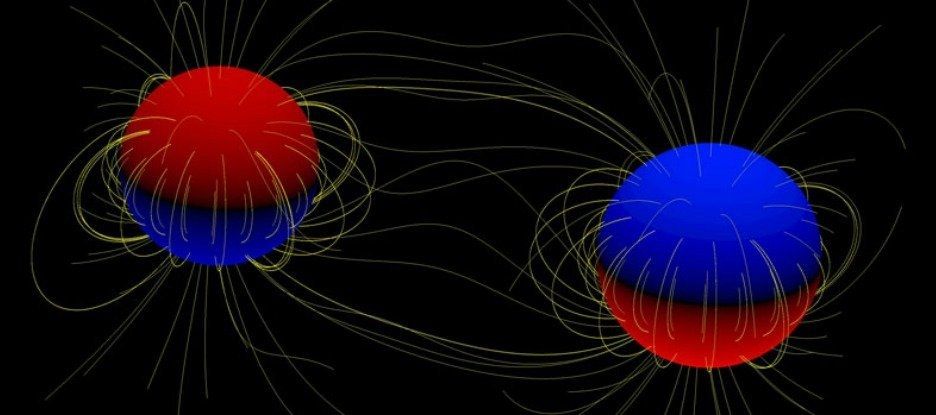
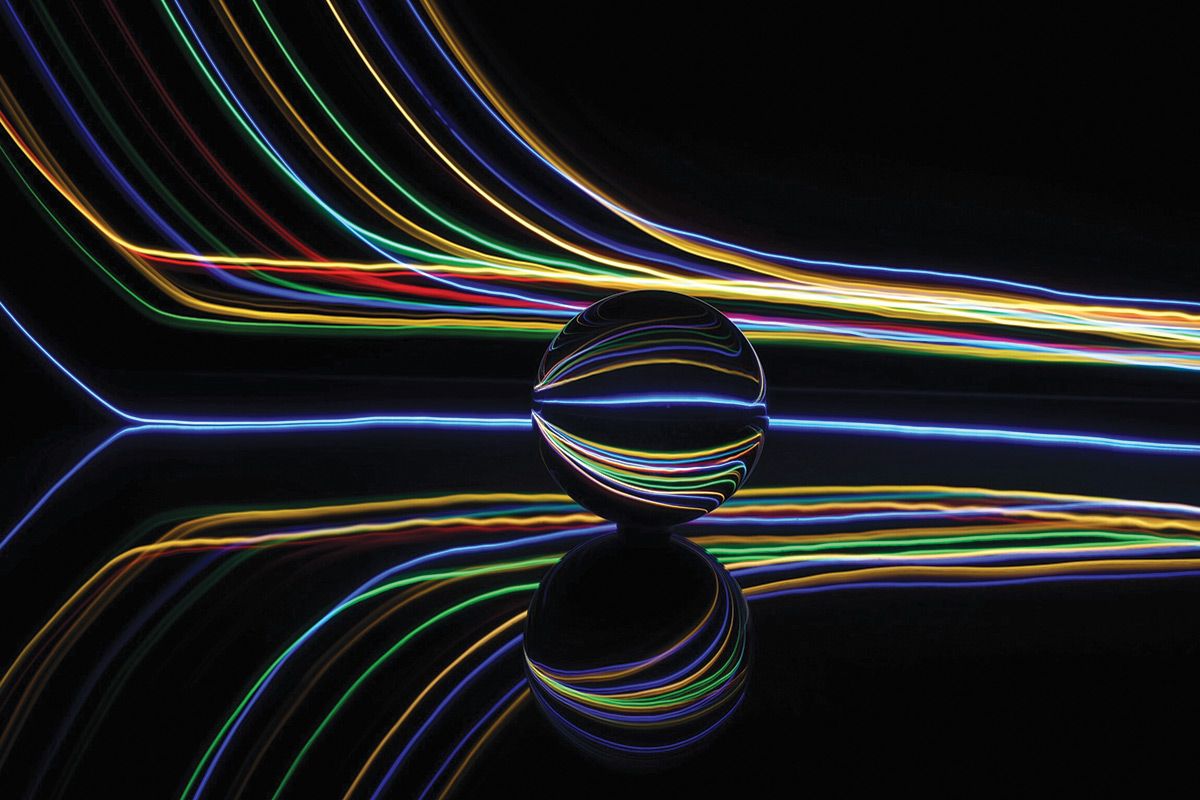
A trio of physicists in Europe has come up with an idea that they believe would allow a person to actually witness entanglement. Valentina Caprara Vivoli, with the University of Geneva, Pavel Sekatski, with the University of Innsbruck and Nicolas Sangouard, with the University of Basel, have together written a paper describing a scenario where a human subject would be able to witness an instance of entanglement—they have uploaded it to the arXiv server for review by others.
Category: physics – Page 408
The First Planet Discovered By Math
Two astronomers fought for credit when Neptune’s presence was confirmed in 1846: John Couch Adams from Britain, and Urbain Le Verrier from France. Both had used math and physics to predict Neptune’s position, but Le Verrier’s prediction turned out to be more accurate. See references.
LIGO’s black holes may have lived and died inside a huge star
But now it seems that collision may have been followed by a bright burst of gamma rays. NASA’s Fermi gamma-ray space telescope detected such an eruption just 0.4 seconds after LIGO’s gravitational waves arrived at Earth. It’s not clear whether the same event triggered both signals, but the Fermi team calculated that the probability of a coincidence was just 0.0022.
The problem is that no one expected such a bright gamma-ray burst to accompany a black-hole merger. Coalescing black holes orbit each other in a cosmic do-si-do, clearing out a region of empty space. According to models of gamma-ray bursts, isolated black holes can’t ignite them.
Strange signal
“Everything smells like a short gamma-ray burst in our signal,” says Valerie Connaughton of the Fermi team. “And that’s a real problem in a way – you don’t expect this signal from merging black holes.”
We’ve finally found gravitational waves, so can we time travel?
Physicists working with a powerful observatory on Earth announced Thursday that they have finally detected ripples in space and time created by two colliding black holes, confirming a prediction made by Albert Einstein 100 years ago.
These ripples in the fabric of space-time, called gravitational waves, were created by the merger of two massive black holes 1.3 billion years ago. The Laser Interferometer Gravitational-Wave Observatory (LIGO) on Earth detected them on Sept. 14, 2015, and scientists evaluated their findings and put them through the peer review process before publicly disclosing the landmark discovery today.
SEE ALSO: Einstein was right: Scientists detect gravitational waves for the first time.
Holy Shit! Scientists Have Confirmed the Existence of Gravitational Waves
Since Albert Einstein first predicted their existence a century ago, physicists have been on the hunt for gravitational waves, ripples in the fabric of spacetime. That hunt is now over. Gravitational waves exist, and we’ve found them.
That’s according to researchers at the Laser Interferometer Gravitational Wave Observatory (LIGO), who have been holed up for weeks, working round-the-clock to confirm that the very first direct detection of gravitational waves is the real deal. False signals have been detected before, and even though the rumors first reported by Gizmodo have been flying for a month, the LIGO team wanted to be absolutely certain before making an official announcement.
That announcement has just come. Gravitational waves were observed on September 14th, 2015, at 5:51 am ET by both of the LIGO detectors, located in Livingston, Louisiana, and Hanford, Washington. The source? A supermassive black hole collision that took place 1.3 billion years ago. When it occurred, about three times the mass of the sun was converted to energy in a fraction of a second.
Interesting Physics Animation
Science has finally confirmed that Einstein was right — gravitational waves DO exist: http://engt.co/1PPNv4W
Albert Einstein
A landmark day for Einstein and our understanding of the universe: the detection of gravitational waves. World Science Festival’s own Brian Greene explains the discovery.
Gravitational Waves
Scientists Have Confirmed the Existence of Gravitational Waves.
We just found gravitational waves!! Scientists at LIGO have confirmed!
Black Holes Could Be Gateways After All
Physicists can now simulate the interiors of black holes using high-powered computers–and it looks like science fiction authors were right: black holes could be portals for space travel.
What Are Gravitational Waves And Why Do They Matter?
Physicists have been buzzing (or rather, tweeting) about the possibility that the Laser Interferometer Gravitational-Wave Observatory (LIGO) experiment finally discovered gravitational waves. LIGO has been searching for these cosmic ripples for over a decade. Last September, it upgraded to Advanced-LIGO, a more sensitive system that’s also better at filtering out noise. Advanced-LIGO has a much stronger chance of collecting concrete evidence of gravitational waves—if it hasn’t already.
Scientists may be excited, but talk of gravitational waves leaves most people scratching their heads. What are these cosmic vibrations, and why are they making waves in the scientific community?
What are gravitational waves?
Gravitational waves are disturbances in the fabric of spacetime. If you drag your hand through a still pool of water, you’ll notice that waves follow in its path, and spread outward through the pool. According to Albert Einstein, the same thing happens when heavy objects move through spacetime.