Toggle light / dark theme

Researchers Devise a New Way to Solve Long-Standing Mystery About the Universe

We know that the universe is expanding, but a strange discrepancy in just how fast that expansion is occurring continues to confound physicists—and make them wonder whether there’s some new, unexplained physics afoot.

For every 3.3 million light years, or one megaparsec, the universe expands around another 70 kilometers per second faster. There are two discrepant measurements of this so-called “Hubble constant.” The light from the most distant parts of the universe reveals an expansion of 68 km/s per megaparsec, while a method taken from extrapolating data from nearby sources reveals a rate of 73 km/s per megaparsec. Scientists can’t explain this discrepancy by chance alone, which means they’re leaving something out, either in their experiments or in the laws of physics. A team of researchers have an idea for another measurement that could help close the gap between these numbers—by measuring how gravity affects the light from distant supernovae.

“If you want to tell the difference between new physics and unknown errors, you need another measurement,” study author Thomas Collett from the University of Portsmouth in the UK told Gizmodo. “If you have measurements that have completely independent methods and they’re all pointing in the same direction, you can robustly believe it’s new physics, not that they’re screwing up in the same way.”

First light which ever shone in universe picked up

T he first light which ever shone in the universe has been detected by astronomers scouring the skies for the earliest stars.

Using a simple radio antenna positioned in the quietest place on Earth — the western Australian desert — scientists picked up a signal of the long-sought ‘cosmic dawn.’

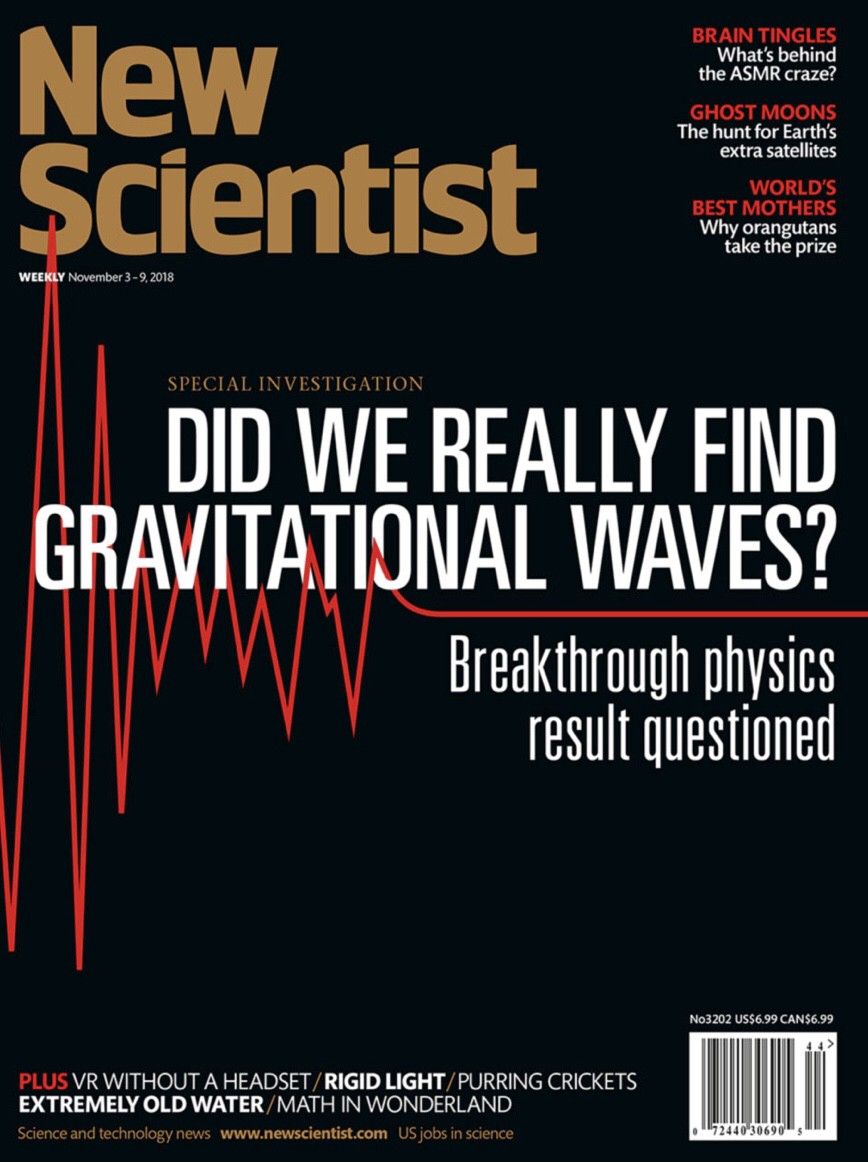
The breakthrough was described as ‘revolutionary’, ‘trailblazing’ and the most important discovery in astronomy since the detection of gravitational waves in 2015.

Physicists Have Confirmed a Pear-Shaped Nucleus, And It Could Ruin Time Travel Forever

Physicists have confirmed the existence of a new form of atomic nuclei, and the fact that it’s not symmetrical challenges the fundamental theories of physics that explain our Universe.

But that’s not as bad as it sounds, because the 2016 discovery could help scientists solve one of the biggest mysteries in theoretical physics — where is all the dark matter? — and could also explain why travelling backwards in time might actually be impossible.

“We’ve found these nuclei literally point towards a direction in space. This relates to a direction in time, proving there’s a well-defined direction in time and we will always travel from past to present,” Marcus Scheck from the University of the West of Scotland told Kenneth MacDonald at BBC News at the time.

Astronomers Just Found Some of The Most Massive Black Holes Discovered in Our Universe

A study on dozens of galaxies within several billion light years of our own has revealed black holes that far exceed our expectations on just how big these monsters can grow.

The discovery not only helps us better understand the evolution of our Universe’s building blocks, it leaves us with a new intriguing question – just how do black holes like these get to be so incredibly massive?

By now, the collapsed cores of massive stars known as black holes need no introduction. We’ve heard about their cosmic crashes rippling space-time, watched them belch, and expect to capture the closest look yet at their nature very soon.

For the First Time, Physicists Accelerated Light Beams in Curved Space in the Lab

Physicists have demonstrated accelerating light beams on flat surfaces.

Where acceleration has caused the beams to follow curved trajectories.

However, a new experiment has pushed the boundaries of what’s possible to demonstrate in a lab. For the first time in an expeirment, physicists have demonstrated an accelerating light beam in curved space. Instead of traveling along a geodesic trajectory (the shortest path on a curved surface) it bends away from this trajectory due to the acceleration.

Theoretical physicists manipulate light with nanoscale objects

Credit: University of New Mexico For years, scientists have long wrestled with the control and manipulation of light, a long-standing scientific ambition with major implications for the development of technology. With the growth in nanophotonics, scientists are making gains faster than ever exploiting structures with dimensions comparable to the wavelength of light. Scientists at The University of New Mexico studying the field of nanophotonics are developing new perspectives never seen before through their research. In turn, the understanding of these theoretical concepts is enabling physic…

/* */