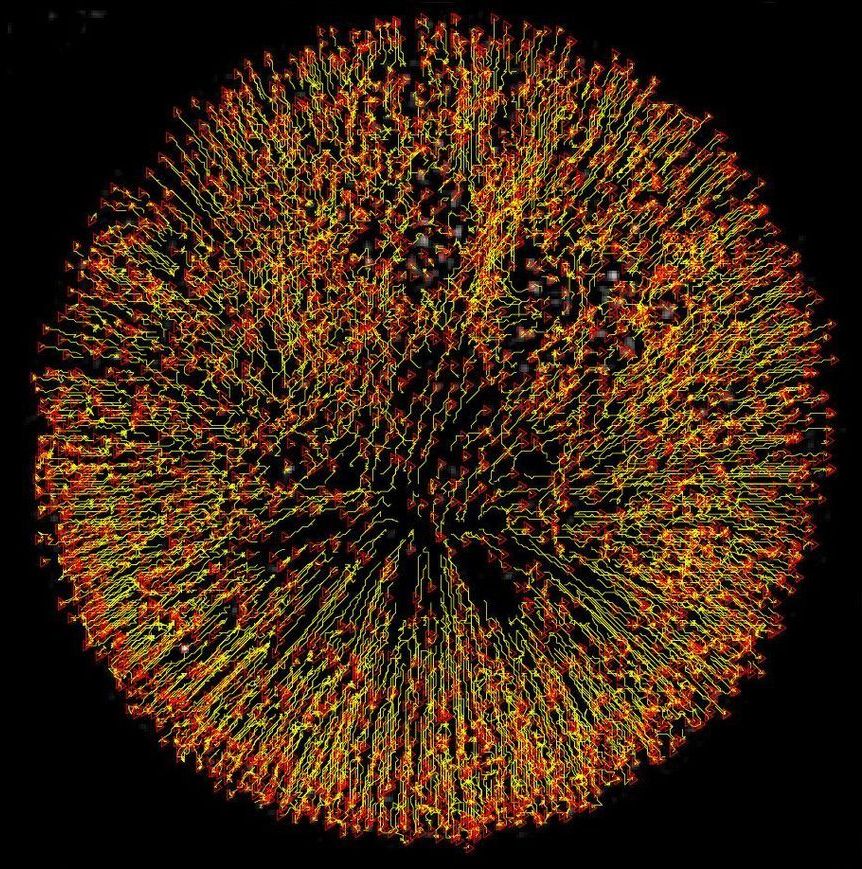
An electron spin resonance spectrometer using an artificial atom (a superconducting flux qubit) is realized, featuring both high sensitivity (400 spins/√Hz) and high spatial resolution (0.05 pL).
Everything you see around you is made up of elementary particles called quarks and leptons, which can combine to form bigger particles such as protons or atoms.
But that doesn’t make them boring – these subatomic particles can also combine in exotic ways we’ve never spotted.
Now CERN’s LHCb collaboration has announced the discovery of a clutch of new particles dubbed “pentaquarks”. The results can help unveil many mysteries of the theory of quarks, a key part of the standard model of particle physics.
If you throw a ball at a wall, it’s going to bounce back at you – that’s classical physics at work. But of course, the world of quantum physics is much spookier, so if you did the same with a particle, there’s a chance that it will suddenly appear on the other side. This is thanks to a phenomenon known as quantum tunneling, and now a team of physicists has measured just how long that process takes.
Time may be a human construct but that hasn’t stopped physicists from perfecting it.
JILA’s 3D Quantum Gas Atomic Clock Offers New Dimensions in Measurement
https://www.nist.gov/news-events/news/2017/10/jilas-3-D-quan…easurement
“JILA physicists have created an entirely new design for an atomic clock, in which strontium atoms are packed into a tiny three-dimensional (3D) cube at 1,000 times the density of previous one-dimensional (1-D) clocks. In doing so, they are the first to harness the ultra-controlled behavior of a so-called “quantum gas” to make a practical measurement device.”
Jun Ye: Let There Be Light (and Thus, Time)
Dr. Jun Ye, professor of physics at the University of Colorado at Boulder and a fellow of both the National Institute of Standards and Technology and JILA, explains how lasers are used to manipulate atoms inside and out for ultra-precise clocks.
Ultra-Accurate Clocks Lead Search for New Laws of Physics.
Atomic clocks are letting physicists tighten the lasso around elusive phenomena such as dark matter.
Sign Up For The Seeker Newsletter Here — http://bit.ly/1UO1PxI
____________________
About the Presenter:
After getting his Ph.D. in physics from UC San Diego, Garrett moved to Maui, seeking an optimum balance between surfing and his theoretical research. While pursuing an unanswered question at the heart of Quantum Field Theory, he began to develop what he called “An Exceptionally Simple Theory of Everything,” which proposed a unified field theory combining particle physics and Albert Einstein’s theory of gravitation. His story and work have been featured at TED, in Outside Magazine, The New Yorker, Surfer, and recently in Scientific American.
#FQXiVideoContest2014
About TEDx
In the spirit of ideas worth spreading, TEDx is a program of local, self-organized events that bring people together to share a TED-like experience. At a TEDx event, TEDTalks video and live speakers combine to spark deep discussion and connection in a small group. These local, self-organized events are branded TEDx, where x = independently organized TED event. The TED Conference provides general guidance for the TEDx program, but individual TEDx events are self-organized.* (*Subject to certain rules and regulations)
What exactly would it take to create our very own Swartzchild Kugelblitz?
Could a Dyson Sphere Harness the Full Power of the Sun? — https://youtu.be/jOHMQbffrt4
Kugelblitz! Powering a Starship With a Black Hole
https://www.space.com/24306-interstellar-flight-black-hole-power.html
“Interstellar flight certainly ranks among the most daunting challenges ever postulated by human civilization. The distances to even the closest stars are so stupendous that constructing even a scale model of interstellar distance is impractical. For instance, if on such a model the separation of the Earth and sun is 1 inch (2.5 centimeters), the nearest star to our solar system (Proxima Centauri) would be 4.3 miles (6.9 kilometers) away!”
Kugelblitz Black Holes: Lasers & Doom
https://futurism.com/kugelblitz-black-holes-lasers-doom
“A kugelblitz black hole could theoretically be created by aiming lasers vastly more powerful than anything we have today at a single point. Logically, one could assume that turning off the lasers would ‘turn off’ the black hole? Well, that’s not quite right”
What is a Dyson sphere?
“In recent years, astronomers explored that possibility with a bizarre star, known to astronomers as KIC 8462852 – more popularly called Tabby’s Star for its discoverer Tabetha Boyajian. This star’s strange light was originally thought to indicate a possible Dyson sphere. That idea has been discarded, but, in 2018, other possibilities emerged, such as that of using the Gaia mission to search for Dyson spheres.“
____________________
Elements is more than just a science show. It’s your science-loving best friend, tasked with keeping you updated and interested on all the compelling, innovative and groundbreaking science happening all around us. Join our passionate hosts as they help break down and present fascinating science, from quarks to quantum theory and beyond.
Tomasz Skwarnicki, professor of physics in the College of Arts and Sciences at Syracuse University, has uncovered new information about a class of particles called pentaquarks. His findings could lead to a new understanding of the structure of matter in the universe.
Assisted by Liming Zhang, an associate professor at Tsinghua University in Beijing, Skwarnicki has analyzed data from the Large Hadron Collider beauty (LHCb) experiment at CERN’s Large Hadron Collider (LHC) in Switzerland. The experimental physicist has uncovered evidence of three never-before-seen pentaquarks, each divided into two parts.
“Until now, we had thought that a pentaquark was made up of five elementary particles [called quarks], stuck together. Our findings prove otherwise,” says Skwarnicki, a Fellow of the American Physical Society.