To demonstrate a new system for rapidly rearranging thousands of atoms, researchers produced an animation featuring Schrödinger’s famous feline.

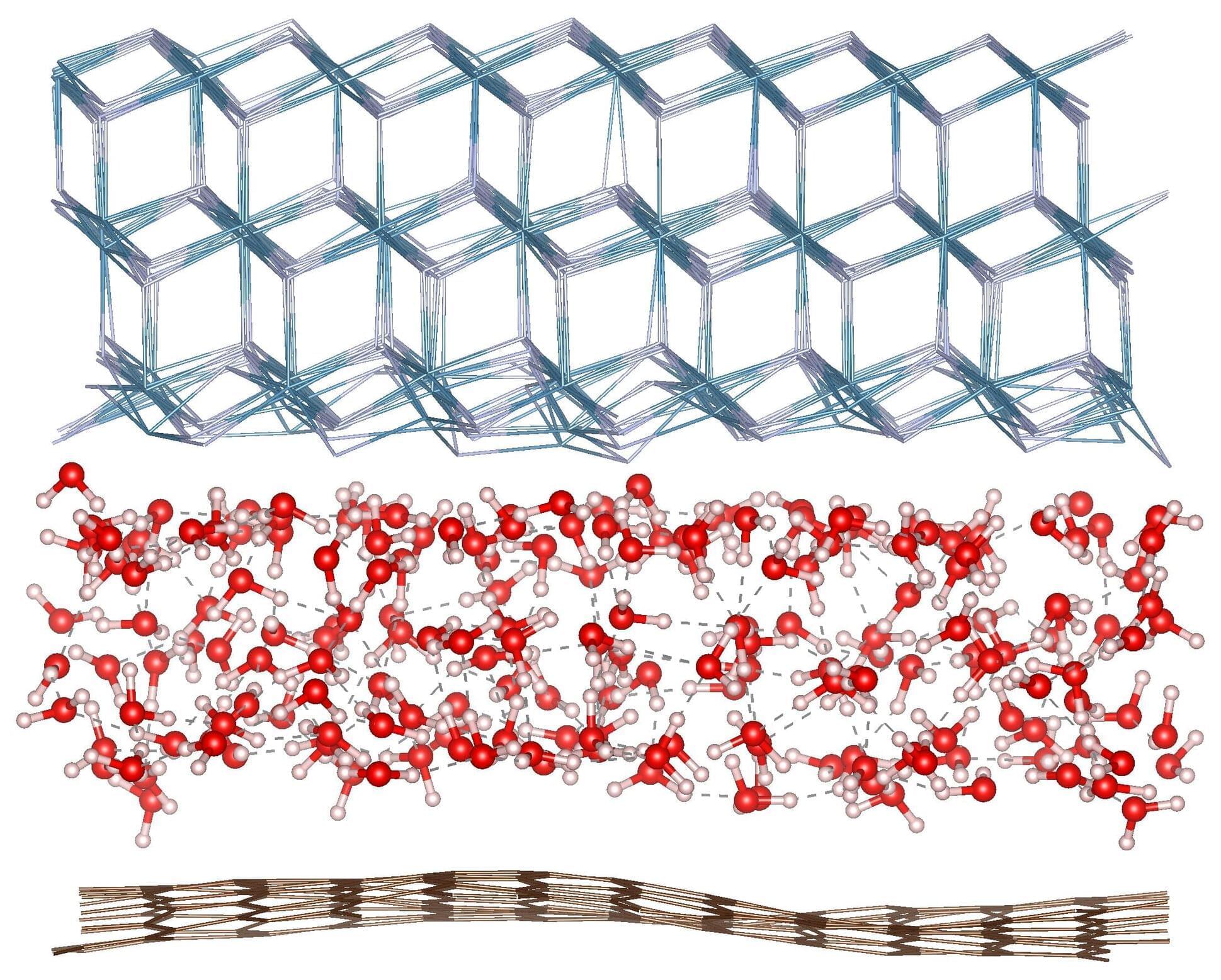
Researchers at the Max Planck Institute for Polymer Research have upended assumptions about how water behaves when squeezed into atom-scale spaces. By applying spectroscopic tools together with the machine learning simulation technique to water confined in a space of only a few molecules thick, the team, led by Mischa Bonn, found that water’s structure remains strikingly “normal” until confined to below a nanometer, far thinner than previously believed.
The research, “Interfaces Govern the Structure of Angstrom-Scale Confined Water Solutions,” was published in Nature Communications.
Peering into the structure of a layer of water molecules that is only a few molecules thick is a formidable scientific challenge. The team fabricated a nanoscale capillary device by trapping water between a single layer of graphene and a calcium fluoride (CaF₂) substrate. They then wielded cutting-edge vibrational surface-specific spectroscopy—capable of detecting the microscopic structure of confined water, including the orientation and hydrogen-bonding of water molecules—to “see” the elusive few layers of water.

Most of us find it difficult to grasp the quantum world. According to Heisenberg’s uncertainty principle, it’s like observing a dance without being able to see simultaneously exactly where someone is dancing and how fast they’re moving—you always must choose to focus on one.
And yet, this quantum dance is far from chaotic; the dancers follow a strict choreography. In molecules, this strange behavior has another consequence: Even if a molecule should be completely frozen at absolute zero, it never truly comes to rest. The atoms it is made of perform a constant, never-ending quiet dance driven by so-called zero-point energy.
A new experimental design eliminates the top source of clock uncertainty.
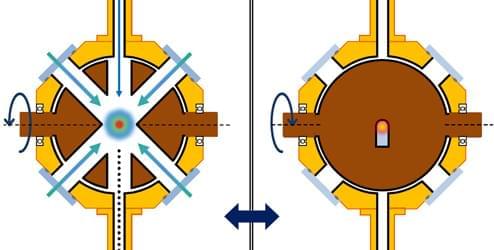
Optical lattice clocks (OLCs) are among the world’s best atomic clocks. Their largest source of uncertainty results from the ubiquitous blackbody radiation (BBR). Now Youssef Hassan of the National Institute of Standards and Technology in Colorado and his colleagues have demonstrated a cryogenic OLC with a radiation shield that virtually eliminates BBR-associated uncertainty [1]. The researchers expect this OLC design to allow major improvements in clock accuracy.
In an OLC, hundreds to tens of thousands of atoms are lined up in a 1D lattice formed by a laser beam. A second (clock) beam, whose frequency can be tuned, then excites the atoms to a specific quantum state. The clock-beam frequency that maximizes the number of atoms making the transition defines the “ticking rate” of the OLC. BBR perturbs the atoms’ quantum states and decreases the OLC’s accuracy.

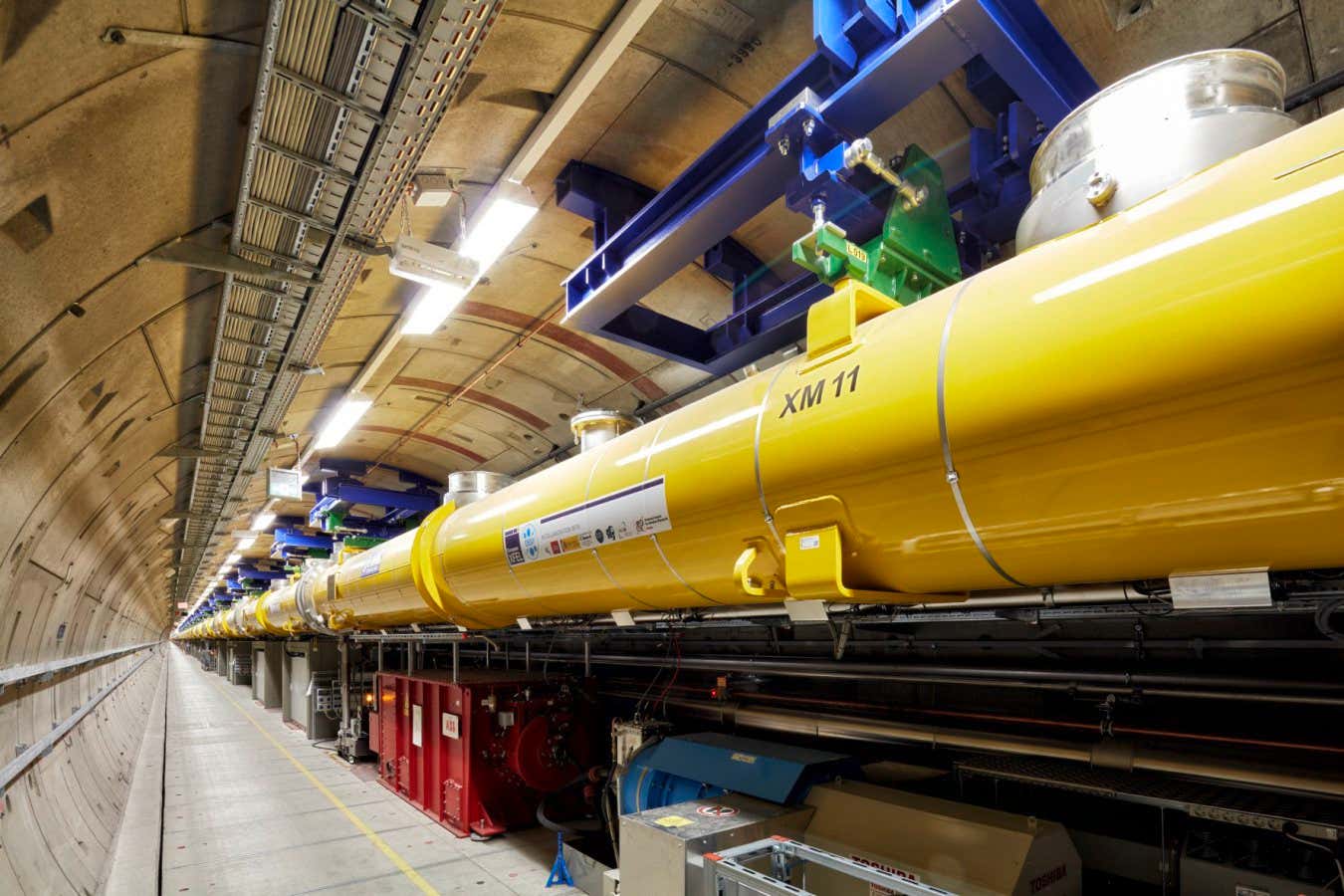
Researchers at European XFEL in Germany have tracked in real time the movement of individual atoms during a chemical reaction in the gas phase. Using extremely short X-ray flashes, they were able to observe the formation of an iodine molecule (I₂) after irradiating diiodomethane (CH₂I₂) molecules by infrared light, which involves breaking two bonds and forming a new one.
At the same time, they were able to distinguish this reaction from two other reaction pathways, namely the separation of a single iodine atom from the diiodomethane, or the excitation of bending vibrations in the bound molecule. The results, published in Nature Communications, provide new insights into fundamental reaction mechanisms that have so far been very difficult to distinguish experimentally.
So-called elimination reactions in which small molecules are formed from a larger molecule are central to many chemical processes—from atmospheric chemistry to catalyst research. However, the detailed mechanism of many reactions, in which several atoms break and re-form their bonds, often remains obscure. The reason: The processes take place in incredibly short times—in femtoseconds, or a few millionths of a billionth of a second.


In the race toward practical quantum computers and networks, photons — fundamental particles of light — hold intriguing possibilities as fast carriers of information at room temperature. Photons are typically controlled and coaxed into quantum states via waveguides on extended microchips, or through bulky devices built from lenses, mirrors, and beam splitters. The photons become entangled – enabling them to encode and process quantum information in parallel – through complex networks of these optical components. But such systems are notoriously difficult to scale up due to the large numbers and imperfections of parts required to do any meaningful computation or networking.
Could all those optical components could be collapsed into a single, flat, ultra-thin array of subwavelength elements that control light in the exact same way, but with far fewer fabricated parts?
Optics researchers in the Harvard John A. Paulson School of Engineering and Applied Sciences (SEAS) did just that. The research team led by Federico Capasso, the Robert L. Wallace Professor of Applied Physics and Vinton Hayes Senior Research Fellow in Electrical Engineering, created specially designed metasurfaces — flat devices etched with nanoscale light-manipulating patterns — to act as ultra-thin upgrades for quantum-optical chips and setups.
Researchers blend theoretical insight and precision experiments to entangle photons on an ultra-thin chip.
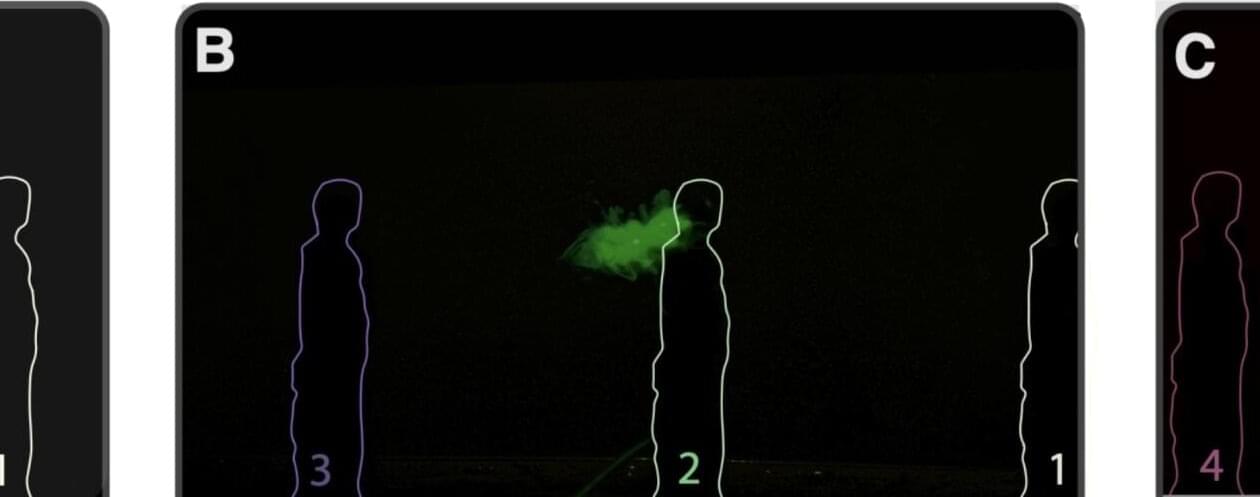
We all remember the advice frequently repeated during the COVID pandemic: maintain six feet of distance from every other human when waiting in a line to avoid transmitting the virus. While reasonable, the advice did not take into account the complicated fluid dynamics governing how the airborne particles actually travel through the air if people are also walking and stopping. Now, a team of researchers led by two undergraduate physics majors at the University of Massachusetts Amherst has modeled how aerosol plumes spread when people are waiting and walking in a line.
The results, published recently in Science Advances, grew out of a question that many of us may have asked ourselves when standing in marked locations six-feet apart while waiting for a vaccine, to pay for groceries or to get a cup of coffee: what’s the science behind six-feet of separation? If you are a physicist, you might even have asked yourself, “What is happening physically to the aerosol plumes we’re all breathing out while waiting in a line, and is the six-foot guideline the best way to design a queue?”
To find answers to these questions, two UMass Amherst undergrads, Ruixi Lou and Milo Van Mooy, took the lead.
A new class of advanced steels needs more fine-tuning before use in system components for fusion energy—a more sustainable alternative to fission that combines two light atoms rather than splitting one heavy atom. The alloy, a type of reduced activation ferritic/martensitic or RAFM steel, contains billions of nanoscale particles of titanium carbide meant to absorb radiation and trap helium produced by fusion within a single component.
When subjected to radiation damage and helium concentrations representative of fusion, the titanium-carbide precipitates initially helped trap helium but later dissolved under high damage levels. After dissolving, the alloy swelled as it was no longer able to disperse and trap helium, which could compromise fusion energy system components.
The first-of-its-kind systematic investigation led by University of Michigan engineers was published in Acta Materialia and the Journal of Nuclear Materials in a series of three papers.