Toggle light / dark theme

Discovery of ‘thought worms’ opens window to the mind

Queen’s University researchers uncover brain-based marker of new thoughts and discover we have more than 6,000 thoughts each day.

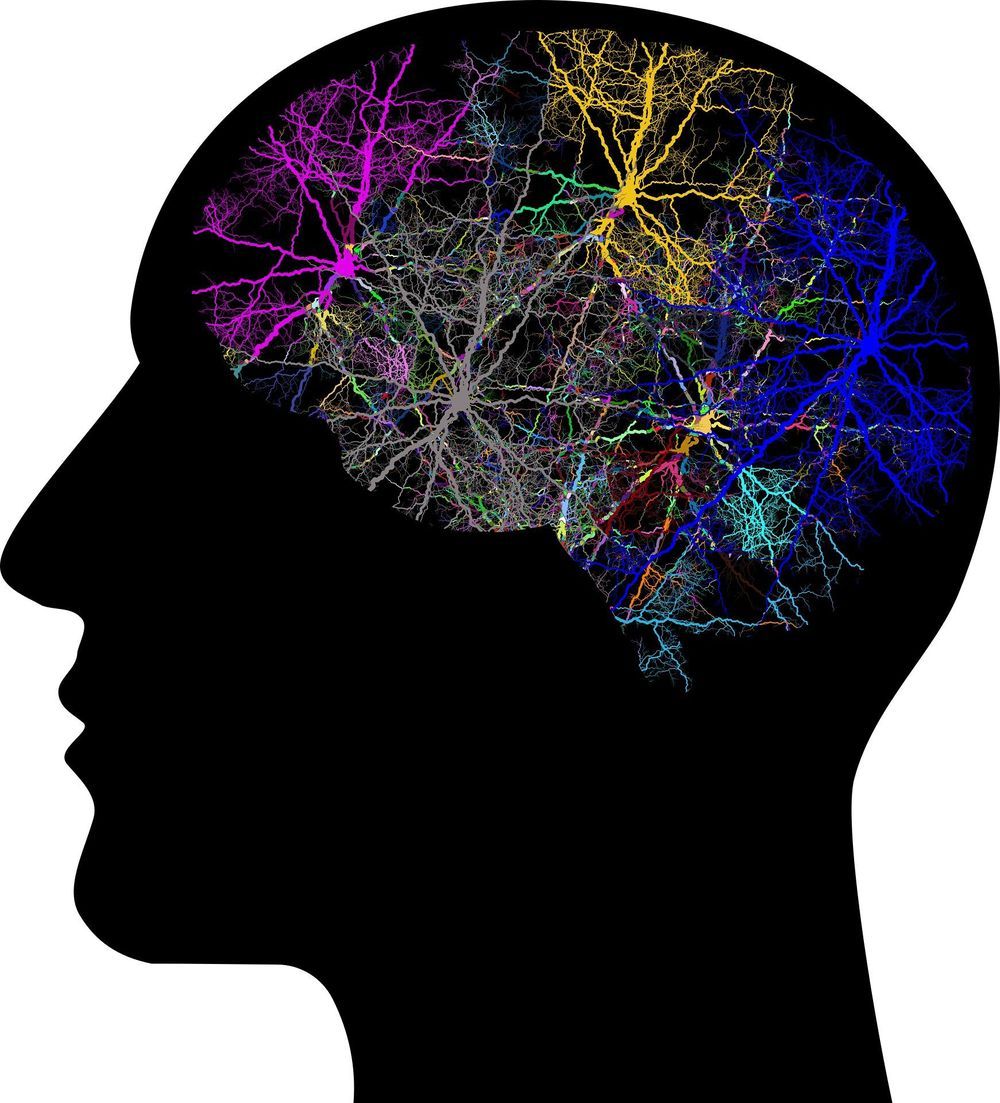
Researchers at Queen’s University have established a method that, for the first time, can detect indirectly when one thought ends and another begins. Dr. Jordan Poppenk (Psychology) and his master’s student, Julie Tseng, devised a way to isolate “thought worms,” consisting of consecutive moments when a person is focused on the same idea. This research was recently published in Nature Communications.

“What we call thought worms are adjacent points in a simplified representation of activity patterns in the brain. The brain occupies a different point in this ‘state space’ at every moment. When a person moves onto a new thought, they create a new thought worm that we can detect with our methods,” explains Dr. Poppenk, who is the Canada Research Chair in Cognitive Neuroscience. “We also noticed that thought worms emerge right as new events do when people are watching movies. Drilling into this helped us validate the idea that the appearance of a new thought worm corresponds to a thought transition.”
Scientists find new link between delirium and brain energy disruption

Scientists from Trinity College Dublin have discovered a new link between impaired brain energy metabolism and delirium—a disorienting and distressing disorder particularly common in the elderly and one that is currently occurring in a large proportion of patients hospitalized with COVID-19 [15th of July 2020].

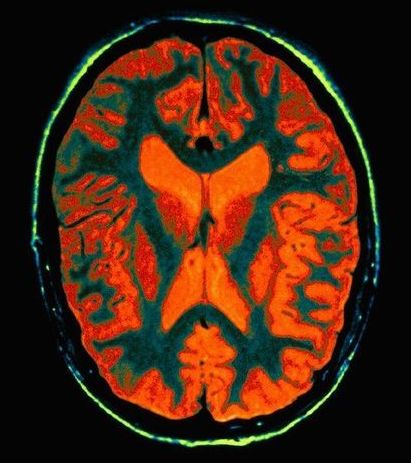
While much of the research was conducted in mice, additional work suggests overlapping mechanisms are at play in humans because cerebrospinal fluid (CSF) collected from patients suffering from delirium also contained tell-tale markers of altered brain glucose .

Collectively, the research, which has just been published in the Journal of Neuroscience, suggests that therapies focusing on brain energy metabolism may offer new routes to mitigating delirium.

Study shows how our brains remain active during familiar, repetitive tasks

New research, based on earlier results in mice, suggests that our brains are never at rest, even when we are not learning anything about the world around us.

Our brains are often likened to computers, with learned skills and memories stored in the of billions of . However, new research shows that memories of specific events and experiences may never settle down. Instead, the activity patterns that store information can continually change, even when we are not learning anything new.

Why does this not cause the to forget what it has learned? The study, from the University of Cambridge, Harvard Medical School and Stanford University, reveals how the brain can reliably access stored information despite drastic changes in the brain signals that represent it.

Amygdala, the brain’s threat detector, has broad roles in autism

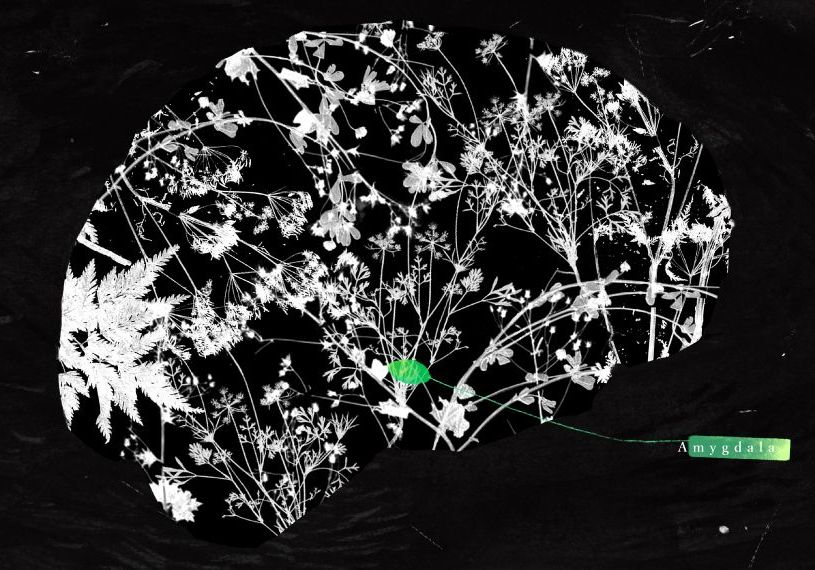
The amygdala is the brain’s surveillance hub: involved in recognizing when someone with an angry face and hostile body language gets closer, tamping down alarm when a honeybee buzzes past, and paying attention when your mother teaches you how to cross the street safely and points out which direction traffic will be coming from — in other words, things people should run away from, but also those they should look toward, attend to and remember.

In that sense, researchers say, this little knot of brain tissue shows just how tangled up emotion and social behavior are for humans. “Important events tend to be emotional in nature,” as do most aspects of social behavior, says John Herrington, assistant professor of psychiatry at the Children’s Hospital of Philadelphia in Pennsylvania.

As a result, the amygdala has long been a focus of autism research, but its exact role in the condition is still unclear.

How to Trick Your Brain to Remember Almost Anything

Nelson Dellis is a four-time USA Memory Champion and Grandmaster of Memory. Some of his feats of recollection include memorizing 10,000 digits of pi, the order of more than nine shuffled decks of cards, and lists of hundreds of names after only hearing them once.

But with a little dedication, Dellis says that anyone can improve their memory. Here are five steps to follow that will get your filling your head with information.

1. Start With Strong Images

What Is Intelligence? Where Does it Begin?

You can find our beautiful education posters in our shop: https://shop.kurzgesagt.org

This video was made possible by a grant from the Templeton World Charity Foundation.

Sources & further reading:
https://sites.google.com/view/sourcesintelligence

Humans are proud of a lot of things, from particle accelerators, to poetry to pokemon. All of them made possible because of something humans value extremely highly: intelligence.

OUR CHANNELS
▀▀▀▀▀▀▀▀▀▀▀▀▀▀▀▀▀▀▀▀▀▀▀▀▀▀
German Channel: https://kgs.link/youtubeDE
Spanish Channel: https://kgs.link/youtubeES

HOW CAN YOU SUPPORT US?

Using astrocytes to change the behavior of robots controlled by neuromorphic chips

Neurons, specialized cells that transmit nerve impulses, have long been known to be a vital element for the functioning of the human brain. Over the past century, however, neuroscience research has given rise to the false belief that neurons are the only cells that can process and learn information. This misconception or ‘neurocomputing dogma’ is far from true.

An is a different type of cell that has recently been found to do a lot more than merely fill up spaces between neurons, as researchers believed for over a century. Studies are finding that these cells also play key roles in brain functions, including learning and central pattern generation (CPG), which is the basis for critical rhythmic behaviors such as breathing and walking.

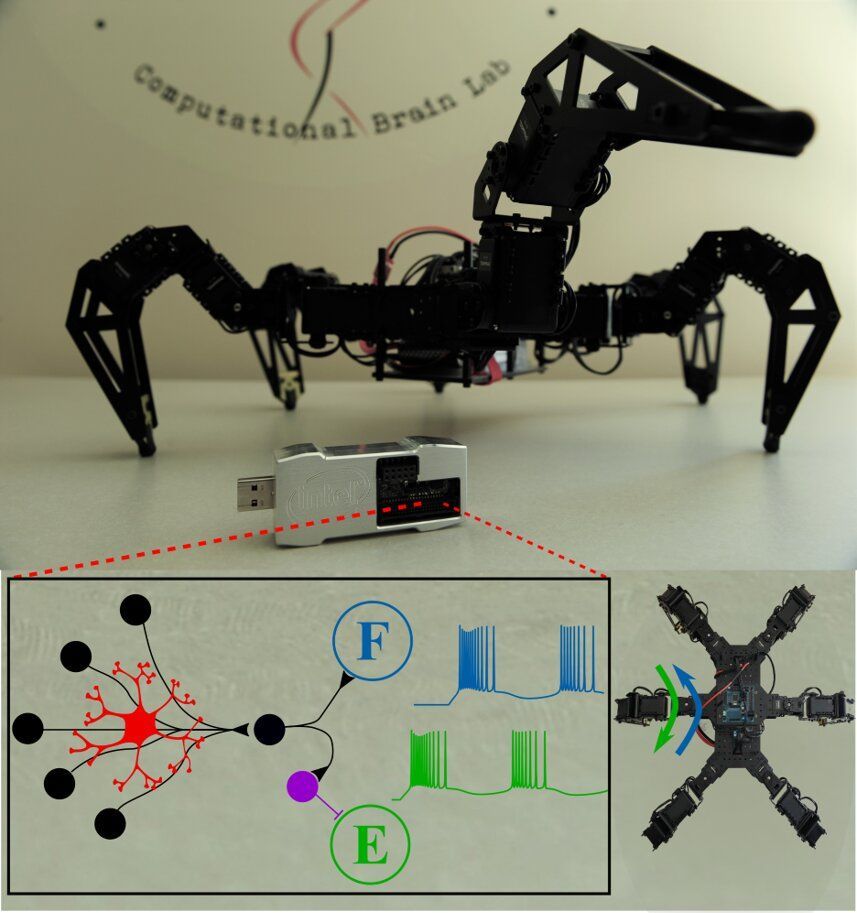
Although astrocytes are now known to underlie numerous brain functions, most existing inspired by the only target the structure and function of neurons. Aware of this gap in existing literature, researchers at Rutgers University are developing brain-inspired algorithms that also account for and replicate the functions of astrocytes. In a paper pre-published on arXiv and set to be presented at the ICONS 2020 Conference in July, they introduce a neuromorphic central pattern generator (CPG) modulated by artificial astrocytes that successfully entrained several rhythmic walking behaviors in their in-house robots.

/* */