Toggle light / dark theme

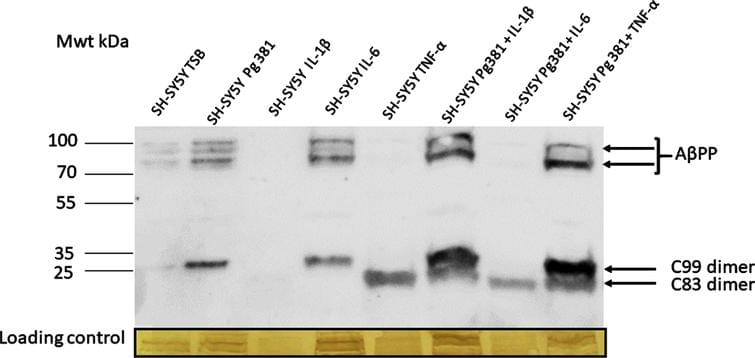
Porphyromonas gingivalis Conditioned Medium Induces Amyloidogenic Processing of the Amyloid-β Protein Precursor upon in vitro Infection of SH-SY5Y Cells

Researchers at the School of Dentistry, University of Central Lancashire (UCLan) were the first to report the link between gum disease and Alzheimer’s disease. Now two new studies from the same research group at the School of Dentistry demonstrate that progress is being made in making much stronger connections between gum disease in the mouth and deteriorating brain function.

Abstract: Journal of Alzheimer’s Disease.

Antimicrobial, Polarizing Light, and Paired Helical Filament Properties of Fragmented Tau Peptides of Selected Putative Gingipains https://content.iospress.com/articles/journal-of-alzheimers-disease/jad220486

Abstract: journal of alzheimer’s disease reports.

Porphyromonas gingivalis Conditioned Medium Induces Amyloidogenic Processing of the Amyloid-β Protein Precursor upon in vitro Infection of SH-SY5Y Cells.

#gumdisease #science #brain #neuroscience #dentist #dentistry #alzheimersawareness #alzheimersdisease #alzheimer #gingivitis #tau #plaques #nervecell


Brain size vs. body size and the roots of intelligence

Behavior that we’d consider intelligent is oddly widespread in the animal kingdom. Animals with very different brains from ours—a species of octopus and various birds—engage with tools, to give just one example. It seems intuitive that a brain needs a certain level of size and sophistication to enable intelligence. But figuring out why some species seem to have intelligence while closely related ones don’t has proven difficult—so difficult that we don’t really understand it.

One of the simplest ideas has been that size is everything: have a big enough brain, and you at least have the potential to be smart. But lots of birds seem to be quite intelligent despite small brains—possibly because they cram more neurons into a given volume than other species. Some researchers favor the idea that intelligence comes out of having a large brain relative to your body size, but the evidence there is a bit mixed.

This week, a team of researchers published a paper arguing that the answer is a little of both: relative and absolute size matter when it comes to the brain. And they argue that a specific approach to brain development helps enable it.

Human Brain is as Powerful as Digital & Analog Computers Combined; Uses 90 Percent of its Capacity

A new study challenges the common belief that human brain’s functions such as learning, memory, and perception occur in the central part of neurons called soma. In a brain structure, neurons’ three-like feature has soma in the middle and branches called dendrites. Soma will spike whenever there is data that needs processing and dendrites will communicate with each other — but not until the University of California, Los Angeles discovered the opposite.

UCLA team tested the theory of “soma to dendrites” and found a contradicting result. Dendrites are electrically active and generate 10 times more spikes that somas. Scientists are now on to new finding that dendrites’ role is to form and store memories.

According to Mayank Mehta, senior author of the study, dendrites are not passive conduits. They themselves are moving around freely and generate spikes or brain activity. This also shows that 90 percent of the brain is being utilized since dendrites comprise 90 percent of the brain tissue. Meaning, the human brain has almost 10 times more computational capability than previously thought.

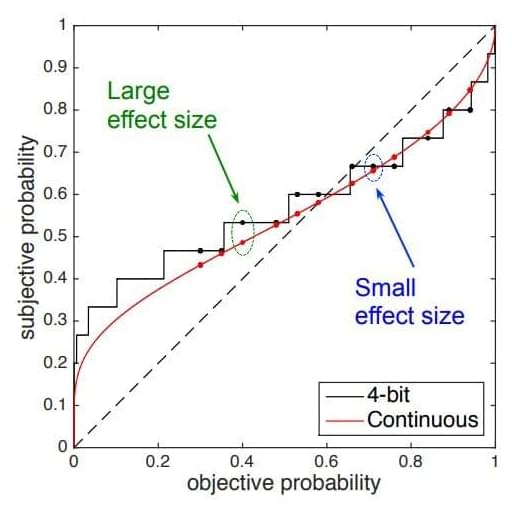
Does the brain store information in discrete or analog form?

For engineers, the question of whether to store information in analog or discrete form is easy to answer. Discrete data storage has clear advantages, not least of which is that it is much more robust against degradation.

Engineers have exploited this property. Provided noise is below some threshold level, digital music can be copied endlessly. By contrast, music stored in analog form, such as on cassette or vinyl LP, can be copied only a few times before noise degrades the recording beyond recognition.

Scientists found going to bed before 9 p.m. has a 70% higher risk of developing dementia

So early to bed early to rise does not necessarily make a person healthy wealthy and wise.


In a recent study, scientists found early sleeping had a 70% higher risk of developing dementia.

Sleep may impact both physical and mental health and has been linked to various health conditions such as heart disease, stroke, dementia, depression, and obesity.

On September 21, researchers published a study in the Journal of the American Geriatrics Society, which shows early sleeping had a 70% higher risk of developing dementia and cognitive decline.

Improve Lung Function, Reduce Blood Pressure, Slow Brain Aging?

Join us on Patreon!
https://www.patreon.com/MichaelLustgartenPhD

Bristle Discount Link (Oral microbiome quantification):
ConquerAging15
https://www.bmq30trk.com/4FL3LK/GTSC3/

TruDiagnostic Discount Link (Epigenetic Testing)
CONQUERAGING!
https://bit.ly/3Rken0n.

Quantify Discount Link (At-Home Blood Testing)
https://getquantify.io/mlustgarten.

Cronometer Discount Link (Daily diet tracking):
https://shareasale.com/r.cfm?b=1390137&u=3266601&m=61121&urllink=&afftrack=

Support the channel with Buy Me A Coffee!

Art and music therapy seem to help with brain disorders. Scientists want to know why

When Michael Schneider’s anxiety and PTSD flare up, he reaches for the ukulele he keeps next to his computer.

“I can’t actually play a song,” says Schneider, who suffered two serious brain injuries during nearly 22 years in the Marines. “But I can play chords to take my stress level down.”

It’s a technique Schneider learned through Creative Forces, an arts therapy initiative sponsored by the National Endowment for the Arts, in partnership with the departments of Defense and Veterans Affairs.


Arts therapies appear to ease brain disorders from Parkinson’s to PTSD. Now, artists and scientists have launched an effort to understand how these treatments change the brain.

#59 JEFF HAWKINS — Thousand Brains Theory

Patreon: https://www.patreon.com/mlst.

The ultimate goal of neuroscience is to learn how the human brain gives rise to human intelligence and what it means to be intelligent. Understanding how the brain works is considered one of humanity’s greatest challenges.

Jeff Hawkins thinks that the reality we perceive is a kind of simulation, a hallucination, a confabulation. He thinks that our brains are a model reality based on thousands of information streams originating from the sensors in our body. Critically — Hawkins doesn’t think there is just one model but rather; thousands.

Jeff has just released his new book, A thousand brains: a new theory of intelligence. It’s an inspiring and well-written book and I hope after watching this show; you will be inspired to read it too.

Pod version: https://anchor.fm/machinelearningstreettalk/episodes/59—Je…ry-e16sb64

https://numenta.com/a-thousand-brains-by-jeff-hawkins/

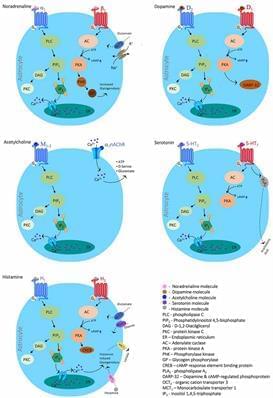
Neuromodulation of Glial Function During Neurodegeneration

Glia, a non-excitable cell type once considered merely as the connective tissue between neurons, is nowadays acknowledged for its essential contribution to multiple physiological processes including learning, memory formation, excitability, synaptic plasticity, ion homeostasis, and energy metabolism. Moreover, as glia are key players in the brain immune system and provide structural and nutritional support for neurons, they are intimately involved in multiple neurological disorders. Recent advances have demonstrated that glial cells, specifically microglia and astroglia, are involved in several neurodegenerative diseases including Amyotrophic lateral sclerosis (ALS), Epilepsy, Parkinson’s disease (PD), Alzheimer’s disease (AD), and frontotemporal dementia (FTD). While there is compelling evidence for glial modulation of synaptic formation and regulation that affect neuronal signal processing and activity, in this manuscript we will review recent findings on neuronal activity that affect glial function, specifically during neurodegenerative disorders. We will discuss the nature of each glial malfunction, its specificity to each disorder, overall contribution to the disease progression and assess its potential as a future therapeutic target.

Glia are non-neuronal cells of the nervous system which do not generate electrical impulses yet communicate via other means such as calcium signals. Due to their lack of electrical activity, it was previously assumed that glial cells primarily functioned as “nerve-glue” (Virchow, 1860) and performed house-keeping functions for neurons; however, this concept has shifted due to recent findings showing glia are key components in many neuronal functions that go far beyond housekeeping (Araque et al., 1999; Buskila et al., 2019a).

Glial cells are categorized into two main groups; macroglia, which includes astrocytes, oligodendrocytes, NG2-glia and ependymal cells, and microglia which are the resident phagocytes of the central nervous system (CNS). Each population of glial cells is specialized for a particular function in the central or peripheral nervous system (García-Cabezas et al., 2016), and normal brain function depends on the interplay between neurons and the various types of glial cells. In this review, we will focus on astrocytes and microglia.

/* */