Toggle light / dark theme

DARPA and the JASON Scientists – The Pentagon’s Maladaptive Brain | Nathaniel Mauka – Waking Times

Nathaniel Mauka, Staff Writer Waking Times

An uncensored look into DARPA, the US government’s secretive agency, reveals exactly how the brain of the military industrial complex operates. Utilizing the super-scientific intellects of men, the agency may have stumbled upon the ultimate code to utterly control the human race, making all other DoD achievements pale in comparison.

DARPA’s arms reach far and wide – touching universities, small businesses, the public, of course, and also the established media. Despite its collaborative success, the brain running the show is acutely flawed, for its aim is not to protect and serve, but to control.

China’s Newly Launched SpaceLab Empowers Human Brain/Computer Interaction –“Can Transmit Astronauts’ Thoughts into Operations”

No surprise; we knew this was going to happen.


China launched its second space lab, Tiangong-2, on Thursday, paving the way for a permanent space station that the country plans to build around 2022. In a space science first, a human brain-computer interaction test system, developed by Tianjin University, has been installed in the lab and it is set to conduct a series of experiments in space, People’s Daily reported. According to Ming Dong, the leader of the research team in charge of the brain-computer test system, the brain-computer interaction will eventually be the highest form of human-machine communication.

Mind-Controlled Nanobots Used to Release Chemicals in Living Cockroaches

This is wild: a team of Israeli scientists developed a contraption that uses a person’s brain waves to remotely control DNA-based nanorobots — while the nanobots were inside a living cockroach. When prompted by a human thought, the clam shell-like robots opened up, revealing a drug-like molecule that tweaked the physiology of the cockroach’s cells.

Though “merely a demonstration and proof of concept,” the technology represents a new era of brain-nanomachine interfaces that links a person’s mental state to bioactive payloads such as drugs. Future techniques that build upon this prototype could be helpful for schizophrenia, depression or other mental disorders, in that the drugs only activate when a patient’s brain waves show signs of abnormality.

Talk about the power of positive thinking!

This physicist says consciousness could be a new state of matter

Consciousness isn’t something scientists like to talk about much. You can’t see it, you can’t touch it, and despite the best efforts of certain researchers, you can’t quantify it. And in science, if you can’t measure something, you’re going to have a tough time explaining it.

But consciousness exists, and it’s one of the most fundamental aspects of what makes us human. And just like dark matter and dark energy have been used to fill some otherwise gaping holes in the standard model of physics, researchers have also proposed that it’s possible to consider consciousness as a new state of matter.

To be clear, this is just a hypothesis, and one to be taken with a huge grain of salt, because we’re squarely in the realm of the hypothetical here, and there’s plenty of room for holes to be poked.

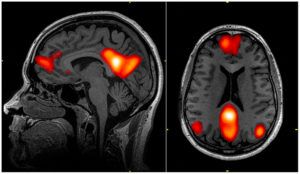
MRI scanner sees emotions flickering across an idle mind

As you relax and let your mind drift aimlessly, you might remember a pleasant vacation, an angry confrontation in traffic or maybe the loss of a loved one.

And now a team of researchers at Duke University say they can see those various emotional states flickering across the human brain.

“It’s getting to be a bit like mind-reading,” said Kevin LaBar, a professor of psychology and neuroscience at Duke. “Earlier studies have shown that functional MRI can identify whether a person is thinking about a face or a house. Our study is the first to show that specific emotions like fear and anger can be decoded from these scans as well.”

Brain-sensing tech helps people with movement disorders communicate via text

New Stanford tech enables typing directly from brain signals.

How many monkeys does it take to type a passage of Shakespeare? One monkey, equipped with brain-sensing technology.

Developed by scientists at Stanford University, the technology can directly read brain signals to drive a cursor moving over a keyboard. In an experiment with monkeys, the primates were able to transcribe passages from Hamlet and The New York Times at a rate of 12 words per minute. Earlier versions of the technology were successfully tested in people with paralysis, but the typing was slow and imprecise.

New technology may help read brain signals directly

Nice.


Researchers have developed a new technology that can help read brain signals directly and may also aid people with movement disabilities to better communicate their thoughts and emotions. The technology involves a multi-electrode array implanted in the brain to directly read signals from a region that ordinarily directs hand and arm movements used, for example, to move a computer mouse.

The algorithms translate those signals and help to make letter selections.

“Our results demonstrate that this interface may have great promise for use in people as it enables a typing rate sufficient for a meaningful conversation,” said Paul Nuyujukian, postdoctoral student at Stanford University in California, US.

Elon Musk has some really strange ideas about connecting computers to your brain

This is not that far fetch especially when we have seen DARPA’s efforts around BMI, the nanobot technology being experimented on to enable BMI, stent technology as well that is being looked at for BMI, etc. which all leads us into the concept of superhumans.


“Humans are so slow” says Elon Musk, so let’s become AI-human symbiotes instead.

Is it already too late to consider the ethics of mind control technology?

Very true points that many have been raising with CRISPR, Synthetic Biology, BMI, and humanoid technology. I am glad to see this article on ethics and standards because it really needs to be discussed and implemented.


New brain technologies will increasingly have the potential to alter how someone thinks, feels, behaves and even perceives themselves.

By Nicholas West

/* */