iOS/Android/Desktop: Default calculator apps suck. They work like a traditional handheld calculator, which only displays one value at a time and can only do basic math. If you want to do anything more than calculate a tip, you’re better off with these free and cheap calculator apps.
These apps help you do typical “real life math” or solve basic textbook math problems.
Cooperation means that one individual pays a cost for another to receive a benefit. Cooperation can be at variance with natural selection: Why should you help a competitor? Yet cooperation is abundant in nature and is an important component of evolutionary innovation. Cooperation can be seen as the master architect of evolution and as the third fundamental principle of evolution beside mutation and selection. I will present mathematical principles of cooperation.
Hundreds of the world’s brightest minds — engineers from Google and IBM, hedge funds quants, and Defense Department contractors building artificial intelligence — were gathered in rapt attention inside the auditorium of the San Francisco Masonic Temple atop Nob Hill. It was the first day of the seventh annual Singularity Summit, and Julia Galef, the President of the Center for Applied Rationality, was speaking onstage. On the screen behind her, Galef projected a giant image from the film Blade Runner: the replicant Roy, naked, his face stained with blood, cradling a white dove in his arms.
At this point in the movie, Roy is reaching the end of his short, pre-programmed life, “The poignancy of his death scene comes from the contrast between that bitter truth and the fact that he still feels his life has meaning, and for lack of a better word, he has a soul,” said Galef. “To me this is the situation we as humans have found ourselves in over the last century. Turns out we are survival machines created by ancient replicators, DNA, to produce as many copies of them as possible. This is the bitter pill that science has offered us in response to our questions about where we came from and what it all means.”
The Singularity Summit bills itself as the world’s premier event on robotics, artificial intelligence, and other emerging technologies. The attendees, who shelled out $795 for a two-day pass, are people whose careers depend on data, on empirical proof. Peter Norvig, Google’s Director of Research, discussed advances in probabilistic first-order logic. The Nobel prize-winning economist Daniel Kahneman lectured on the finer points of heuristics and biases in human psychology. The Power Point presentations were full of math equations and complex charts. Yet time and again the conversation drifted towards the existential: the larger, unanswerable questions of life.
In music, “portamento” is a term that’s been used for hundreds of years, referring to the effect of gliding a note at one pitch into a note of a lower or higher pitch. But only instruments that can continuously vary in pitch—such as the human voice, string instruments, and trombones—can pull off the effect.
Now an MIT student has invented a novel algorithm that produces a portamento effect between any two audio signals in real-time. In experiments, the algorithm seamlessly merged various audio clips, such as a piano note gliding into a human voice, and one song blending into another. His paper describing the algorithm won the “best student paper” award at the recent International Conference on Digital Audio Effects.
The algorithm relies on “optimal transport,” a geometry-based framework that determines the most efficient ways to move objects—or data points—between multiple origin and destination configurations. Formulated in the 1700s, the framework has been applied to supply chains, fluid dynamics, image alignment, 3D modeling, computer graphics, and more.
Linear algebra is a field of mathematics that has been thoroughly investigated for many centuries, providing invaluable tools used not only in mathematics, but also across physics and engineering as well as many other fields. For years physicists have used important theorems in linear algebra to quickly calculate solutions to the most complicated problems.
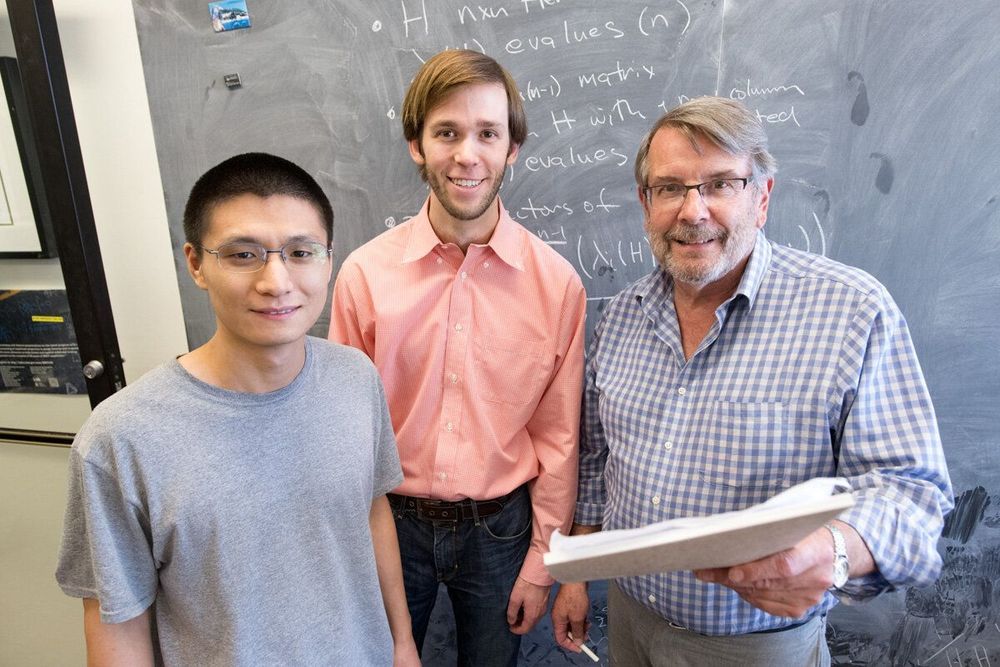
This August, three theoretical physicists—Peter Denton, a scientist at Brookhaven National Laboratory and a scholar at Fermilab’s Neutrino Physics Center; Stephen Parke, theoretical physicist at Fermilab; and Xining Zhang, a University of Chicago graduate student working under Parke—turned the tables and, in the context of particle physics, discovered a fundamental identity in linear algebra.
The identity relates eigenvectors and eigenvalues in a direct way that hadn’t been previously recognized. Eigenvectors and eigenvalues are two important ways of reducing the properties of a matrix to their most basic components and have applications in many math, physics and real-world contexts, such as in analyzing vibrating systems and facial recognition programs. The eigenvectors identify the directions in which a transformation occurs, and the eigenvalues specify the amount of stretching or compressing that occurs.
SHA-256 is a one way hashing algorithm. Cracking it would have tectonic implications for consumers, business and all aspects of government including the military.
It’s not the purpose of this post to explain encryption, AES or SHA-256, but here is a brief description of SHA-256. Normally, I place reference links in-line or at the end of a post. But let’s get this out of the way up front:
One day after Treadwell Stanton DuPont claimed that a secret project cracked SHA-256 more than one year ago, they back-tracked. Rescinding the original claim, they announced that an equipment flaw caused them to incorrectly conclude that they had algorithmically cracked SHA-256.
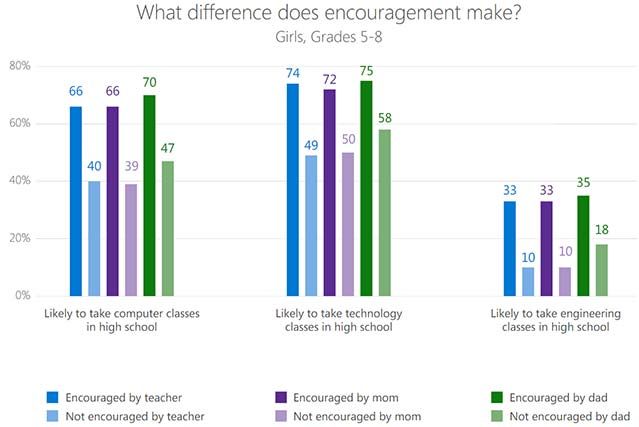
Generally girls lose interest in STEM careers as they get older. But, according to a new study, small changes at school and at home can have a profound impact on how girls perceive STEM careers, how confident they feel in class and how likely they are to pursue STEM academically and into their careers.
The study, “Closing the STEM Gap,” published today by Microsoft, surveyed more than 6,000 girls and young women on their interests and perceptions of science, technology, engineering and math. It found that girls tended to lose interest in STEM as they headed toward adulthood. And, by the time they’d finished high school, their interest had dropped substantially. For example, the report found that interest in computer science among females dropped 27 percentage points between middle school and college. According to the report: “In middle school … 31 percent of girls believe that jobs requiring coding and programming are ‘not for them.’ In high school, that percentage jumps up to 40. By the time they’re in college, 58 percent of girls count themselves out of these jobs.”
But, the study found, countermeasures both large and small can have a profound effect, including:
The Electric Coin Company (ECC) says it discovered a new way to scale blockchains with “recursive proof composition,” a proof to verify the entirety of a blockchain in one function. For the ECC and zcash, the new project, Halo, may hold the key to privacy at scale.
A privacy coin based on zero-knowledge proofs, referred to as zk-SNARKs, zcash’s current underlying protocol relies on “trusted setups.” These mathematical parameters were used twice in zcash’s short history: upon its launch in 2016 and first large protocol change, Sapling, in 2018.
Zcash masks transations through zk-SNARKs but the creation of initial parameters remains an issue. By not destroying a transaction’s mathematical foundation – the trusted setup – the holder can produce forged zcash.