In response to the recently imposed ban on Free Basics by TRAI, Facebook CEO Mark Zuckerberg has reiterated his commitment towards his Internet.org initiative.
Category: internet – Page 353

Should We Worry That We’re Headed for Cyber World War I?
Reserve you calendars for March 9th because New America’s Cybersecurity Initiative is hosting its annual Cybersecurity for a New America Conference in Washington, D.C.
On Wednesday, March 9, New America’s Cybersecurity Initiative will host its annual Cybersecurity for a New America Conference in Washington, D.C. This year’s conference will focus on securing the future cyberspace. For more information and to RSVP, visit the New America website.
So, what does cyberwar mean anyway?
At core, when we talk about cyberwar, we’re just talking about warfare conducted through computers and other electronic devices, typically over the Internet. As the very ’90s prefix cyber– (when was the last time you heard someone talk about cyberspace with a straight face?) suggests, it’s been part of our cultural and political conversations since the early ’80s. In recent years, however, such conversations have picked up as those in power become more conscious of our reliance on computers—and our consequent vulnerability. Perhaps more importantly, information like that disclosed by Edward Snowden has demonstrated that governments have already made preparations for virtual conflict, whether or not they’re actively engaging in it now. (Click here for a cheat sheet.)



China looks to ramp up Internet growth, and its controls
Something for everyone to keep a closer eye on in the coming year/s — And, they are indeed well on their way with Quantum and their partnership with Australia. Australia (as we recall) has been the one country outside the US and Canada that has made incredible progress in Quantum Computing especially introducing in Nov 2015 their discovery in developing a machine language for the Quantum platform.
BEIJING (AP) — China’s government has highlighted big data, encryption technology and “core technologies” such as semiconductors as the key elements of its push to grow into a tech powerhouse, according to a new five-year plan released Saturday that envisages the Internet as a major source of growth as well as a potential risk.

“Internet pioneer”: Interview With Google Vice President Vint Cerf
Google’s VP Vint Cerf states in the future that “The brain will be digitally altered by software”.
Considered one of the fathers of Internet, renowned in the computer industry, awarded with the highest award of US government, co-creator of TCP/IP internet and current vice president of Google, the Phd Vint Cerf emerges as one of the most authoritative voices in the world to reflect on new technologies around the world.
The computing Scientific who the United States commissioned along with Bob Khan the creation of a network protocol that will interconnect computers in 1973 in the age of cold war who at the age of 20 will work on F-1 engines used as propellant rocket of Saturn V rocket that “visited” the moon, apart from his academic skills, he can be characterized as a very simple person having fine and good sense of humor and very elegant, like someone from an European royalty party, definitely a different personality and image projecting into the collective imagination a professional of his career.
Reflections about internet of things, the possibility of extraterrestrial life, scanning the brain, space internet and even the possibility that humans can communicate with animals were the subjects Cerf answered who recently toured South America sharing time with inhabitants of end of the world.


AT&T will start selling you cable TV over the Internet
AT&T is going “over the top” with television.
In the fourth quarter of this year, AT&T will start selling cable-like bundles of TV to people across the country through a new app. Subscribers won’t need an AT&T wireless phone or an AT&T broadband connection at home.
It’ll be like Netflix — download the app, sign up, type in a credit card number, and start streaming a TV show.
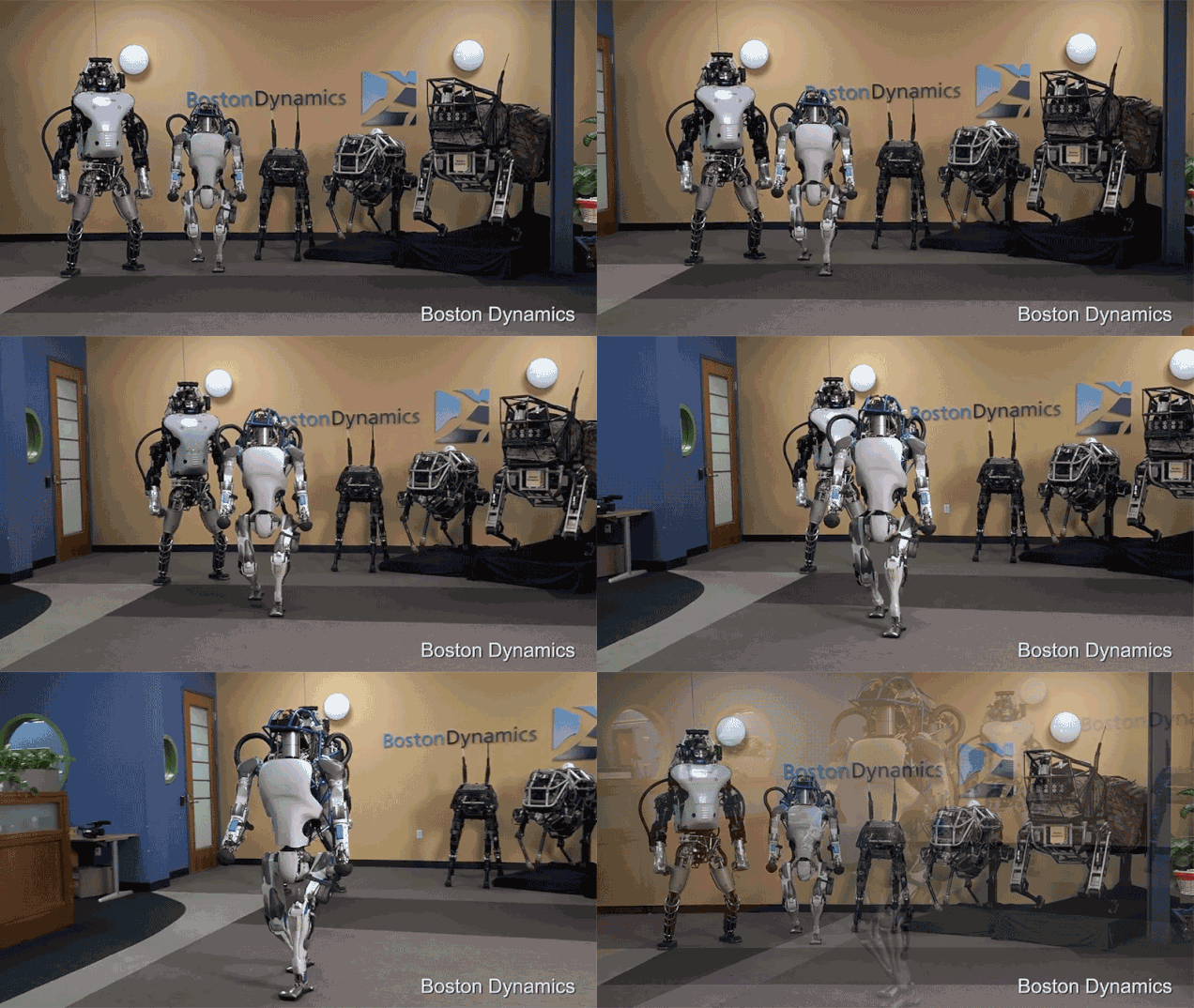
Atlas The Robot Can Enlist in the US Military Anytime She Wants
I hear this author; however, can it pass military basic training/ boot camp? Think not.
Back when Alphabet was known as Google, the company bought Boston Dynamics, makers of the amazingly advanced robot named Atlas. At the time, Google promised that Boston Dynamics would stop taking military contracts, as it often did. But here’s the open secret about Atlas: She can enlist in the US military anytime she wants.
Technology transfer is a two-way street. Traditionally we think of technology being transferred from the public to the private sector, with the internet as just one example. The US government invests in and develops all kinds of important technologies for war and espionage, and many of those technologies eventually make their way to American consumers in one way or another. When the government does so consciously with both military and civilian capabilities in mind, it’s called dual-use tech.
But just because a company might not actively pursue military contracts doesn’t mean that the US military can’t buy (and perhaps improve upon) technology being developed by private companies. The defense community sees this as more crucial than ever, as government spending on research and development has plummeted. About one-third of R&D was being done by private industry in the US after World War II, and two-thirds was done by the US government. Today it’s the inverse.