Toggle light / dark theme

“Glowing Mushroom” Discovery Could Revolutionize Biology

  • Of the estimated 100,000 mushroom species on Earth, only about 80 glow. Scientists uncovered the explanation behind two of these glowing mushrooms.
  • Studying the mushrooms allowed researchers to make chemicals that glow various colors that may help us make more scientific breakthroughs.

Mushrooms are our favorite fungi. From savory dishes to surprising video game power-ups — we can’t seem to get enough of the little things. What’s more interesting, however, is the fact that mushrooms can be far more relevant to our own progress as a society than we imagined. The Neonothopanus gardneri and Neonothopanus nambi are two distinct species of glow-in-the-dark mushroom found in Brazil and Vietnam respectively, that have reshaped our perspective on bioluminescence permanently.

The Winners Of 2017’s A’ Design Award & Competition Have Just Been Announced, And They’re Genius

The A’ Design Award & Competition is a magnet for creativity, and every year the contest attracts thinkers and inventors from all over the globe. The winners of the 2016–2017 period have just been announced, and they’re so innovative they could change the world as we know it – or at least make it a little more functional.

Show Full Text

The awards were doled out to over 1200 projects spanning a wide spectrum of categories, including but not limited to furniture, packaging, graphics, and architecture. The designs share common themes of practicality, modernity, and efficient use of space and materials. A’ Design is a unique concept in the competitive world, offering winners the prize of mass publicity rather than cash, and giving the designers an arsenal of tools to forge success on their own terms.

Scientists Witnessed DNA Protecting Itself From Radiation

DNA protects itself from damage naturally, and scientists are hoping to gain insight into how the process works. When DNA is bathed in ultraviolet light, it can eject a single proton from a hydrogen atom to rid itself of excess energy, ensuring other chemical bonds remain intact. This protective mechanism is called an excited state proton transfer, and it is the focus of new research by a team of scientists.

The researchers used the Linac Coherent Light Source (LCLS) at the SLAC National Accelerator Laboratory to generate X-ray laser pulses capable of probing the nitrogen molecule — in the simple molecule 2-thiopyridone — for quadrillionths of a second. The short period of time matters because when molecules are exposed to this kind of light they react incredibly quickly. The brightness of the light is equally important, because only very brilliant illumination renders these ultrafast changes visible to the researchers.

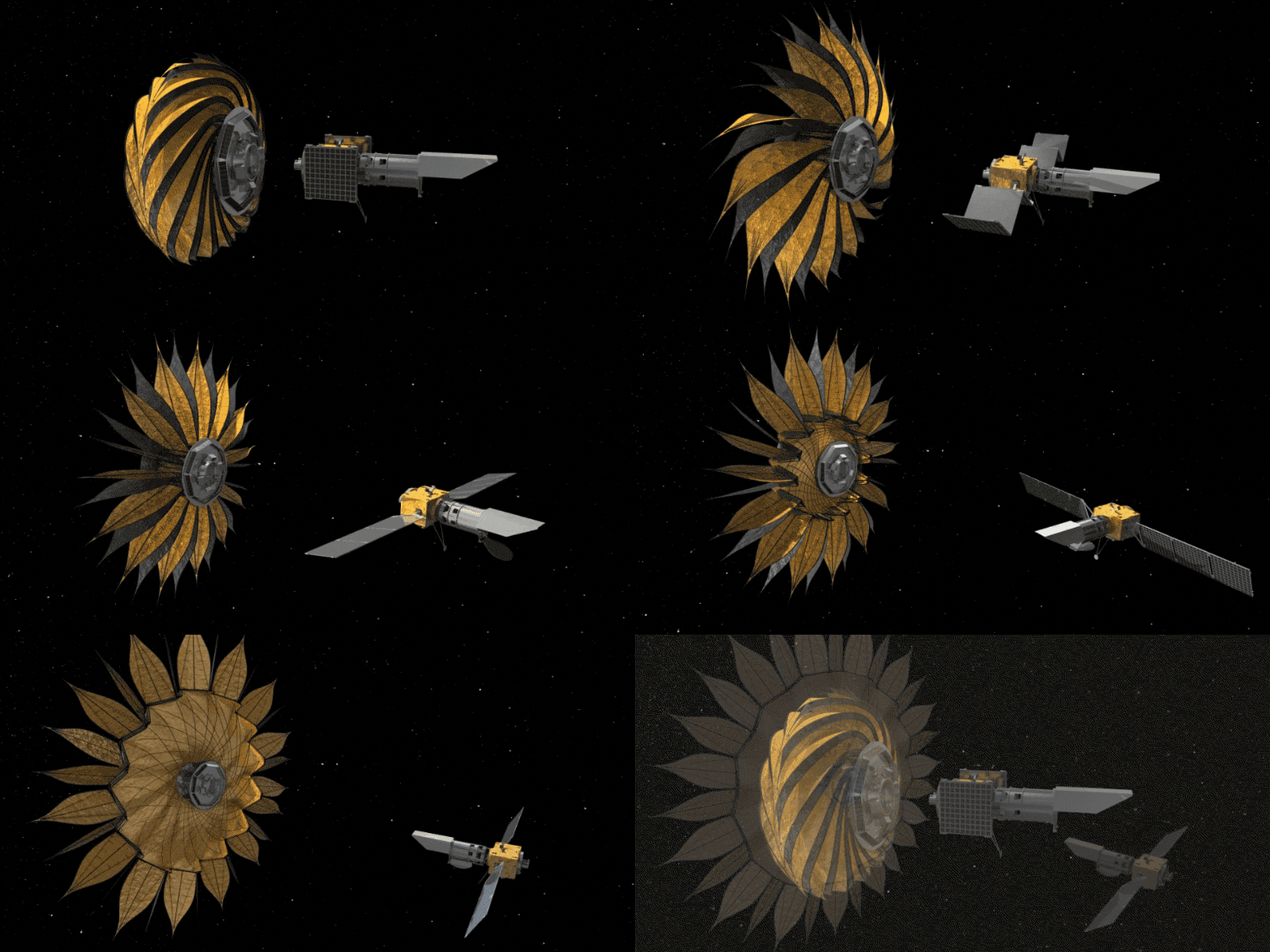
Stellar echoes, Venusian automatons and more gain NASA moonshot funding

NASA has announced the recipients of its most recent round of highly experimental projects it deems promising enough to fund. These NASA Innovative Advanced Concepts aren’t guaranteed to go all the way, but are rather sort of low-risk, high potential reward moonshots — science fiction they hope will be more the former than the latter.

The awards are a regular occurrence and divided into Phase I and Phase II: Phase I projects are more or less in the concept stage and will get around $125,000 over 9 months to see if they’re at all viable, essentially from “might work” to “should work.” Phase II projects get a more flexible amount, but as much as half a million dollars over 2 years, to see about going from “should work” to “works.”

The full list of awards can be found here, but I’ve selected a few I think are especially promising.

Silicon Valley is living in a bubble of technology that’s not accessible to the rest of the world

Science-fiction author William Gibson famously said, “The future is already here; it’s just not evenly distributed yet.”

Nowhere is that more true than in the tech world, where it’s easy to think that innovations, products and services available to us are ubiquitous, even when their distribution is, in fact, very limited.


Many of the innovations that we take for granted are simply not available elsewhere.

Breakthrough Starshot Project Amps Up: Ball, Brakes To Be Added Into The Interstellar Sail

Scientists are proposing new methods of stabilizing the design of the first of its kind tiny and lightweight space probe.

(Photo : SciNews/YouTube screenshot)

Ever since Alpha Centauri was discovered, scientists have been trying to devise new ways of studying it. The Alpha Centauri star is around 4.37 light-years away from Earth, and it is expected that it will take a minimum of 20 years to reach near it.

/* */