This is one breakthrough we need badly to help finally solve Dystonia, and other Central Nervous System disorders and diseases.
Researchers squeeze a three-step optogenetics process into one nifty probe and demonstrate it in mice.
This is one breakthrough we need badly to help finally solve Dystonia, and other Central Nervous System disorders and diseases.
Researchers squeeze a three-step optogenetics process into one nifty probe and demonstrate it in mice.
Rare breeds of chickens could soon come from entirely different types of hens. The University of Edinburgh’s Roslin Institute with help from US biotechnology company Recombinetics used gene editing techniques to create surrogate hens that grow up to produce eggs with all the genetic information of different breeds.
We’ve seen gene editing and transfer techniques used to create better yeast, bigger trees and even glowing pigs, among numerous other examples, but this is believed to be the first gene-edited bird to come out of Europe.
The team used a gene editing tool called TALEN (for transcription activator-like effector nucleases), which is similar to the more widely publicized CRISPR/Cas9, to delete part of a chicken gene called DDX4 that is related to fertility. Hens with this modification did not produce eggs but were healthy in all other ways.
Mantas from CellAge picks a winner for the iPhone Raffle Reward! ►Campaign Link: https://www.lifespan.io/campaigns/cellage-targeting-senescen…c-biology/ ►Subscribe:
►Reddit AMA: https://www.reddit.com/r/Futurology/comments/5hfmsl/cellage_…ells_with/
Our society has never aged more rapidly – one of the most visible symptoms of the changing demographics is the exponential increase in the incidence of age-related diseases, including cancer, cardiovascular diseases and osteoarthritis. Not only does aging have a negative effect on the quality of life among the elderly but it also causes a significant financial strain on both private and public sectors. As the proportion of older people is increasing so is health care spending. According to a WHO analysis, the annual number of new cancer cases is projected to rise to 17 million by 2020, and reach 27 million by 2030. Similar trends are clearly visible in other age-related diseases such as cardiovascular disease. Few effective treatments addressing these challenges are currently available and most of them focus on a single disease rather than adopting a more holistic approach to aging.
Recently a new approach which has the potential of significantly alleviating these problems has been validated by a number of in vivo and in vitro studies. It has been demonstrated that senescent cells (cells which have ceased to replicate due to stress or replicative capacity exhaustion) are linked to many age-related diseases. Furthermore, removing senescent cells from mice has been recently shown to drastically increase mouse healthspan (a period of life free of serious diseases).
Here at CellAge we are working hard to help translate these findings into humans!
CellAge, together with a leading synthetic biology partner, Synpromics, is going to develop synthetic promoters which are specific to senescent cells (SeneSENSE), as promoters that are currently being used to track senescent cells are simply not good enough to be used in therapies. The most prominently used p16 gene promoter has a number of limitations, for example. As our primary mission is to expand the interface between synthetic biology and aging research as well as drive translational research forward, we will offer senescence reporter assay to academics for free. We predict that in the very near future this assay will be also used as a quality control step in the cell therapy manufacturing process to make cell therapies safer!
Scientists just endorsed human gene manipulation.
Husar, a 38-year-old telecom salesman, had spent most of his life eating the sort of Eastern European fare typical of his native Ukraine: lots of meat, potatoes, salt and saturated fats. DNA Lifestyle Coach suggested his body might appreciate a more Mediterranean diet instead.
Recently, Vitaliy Husar received results from a DNA screening that changed his life. It wasn’t a gene that suggested a high likelihood of cancer or a shocking revelation about his family tree. It was his diet. It was all wrong.
Cool story!
Biohackers push back as the scientific establishment charts a course through the ethics of genetic interference.
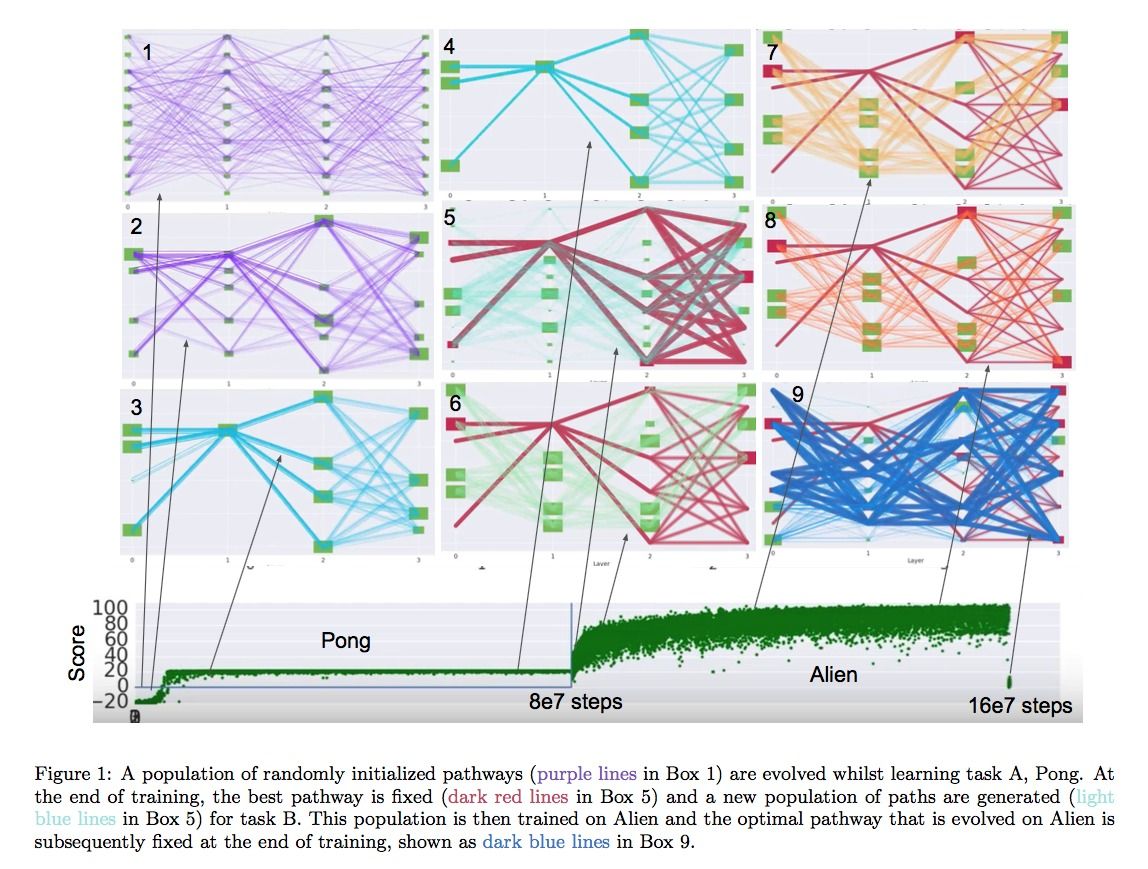
Potentially describing how general artificial intelligence will look like.
Since scientists started building and training neural networks, Transfer Learning has been the main bottleneck. Transfer Learning is the ability of an AI to learn from different tasks and apply its pre-learned knowledge to a completely new task. It is implicit that with this precedent knowledge, the AI will perform better and train faster than de novo neural networks on the new task.
DeepMind is on the path of solving this with PathNet. PathNet is a network of neural networks, trained using both stochastic gradient descent and a genetic selection method.
Definitely yes on gene mutations; however, those where the disease has already appeared, or cancer that has occurred before will require another form of eradication/ prevention. And, that is where Quantum Biosystem technology will be effective in eliminating disease.
ALL inherited diseases could be cured within 20 years, a leading British expert claims.
It includes eradicating life-limiting conditions such as cystic fibrosis and Huntington’s disease.
The Broad Institute in Cambridge, Mass., will retain potentially lucrative rights to a powerful gene-editing technique that could lead to major advances in medicine and agriculture, the federal Patent and Trademark Office ruled on Wednesday.
The decision, in a bitterly fought dispute closely watched by scientists and the biotechnology industry, was a blow to the University of California, often said to be the birthplace of the technique, which is known as Crispr-Cas9.
An appeals board of the patent office ruled that the gene-editing inventions claimed by the two institutions were separate and do not overlap.
This video is part of a series on genius, in proud collaboration with 92Y’s 7 Days of Genius Festival.
In the late 1990s, scientists thought they were close to locating specific genes that controlled for human intelligence in all its manifestations: musical genius, analytical acumen, physical prowess, etc. But the truth turns out to be more complicated, says Harvard psychologist and linguist Steven Pinker. There are many genes — perhaps thousands — that affect human intelligence, and while manipulating them may have predictable benefits, the adverse consequences remain unpredictable. Thus experimenting with our so-called intelligence genes will likely be met with high levels of skepticism in caution. It’s proof, says Pinker, that technological advancement doesn’t always march to the drum beat of inexorable forward progress.