Category: futurism – Page 779
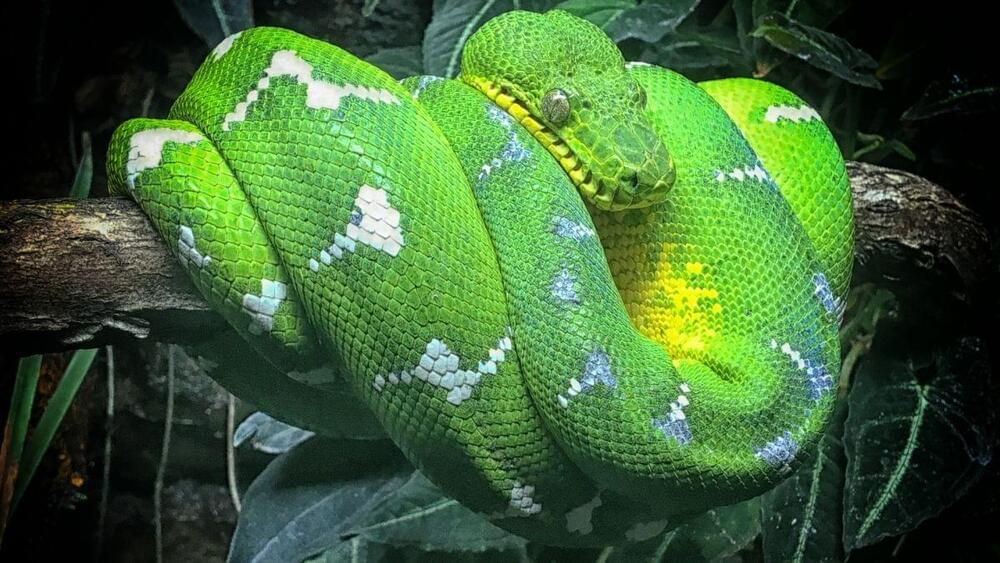

Spiders can fly hundreds of miles with the help of the electric fields on Earth
Air conducts electricity. In the vicinity of the Earth, the electrical conductivity of the atmosphere is — fortunately — very low. However, already about 50 km above the Earth, air becomes a good conductor of electricity.
By this method, spiders can float away from their predators or any competitors. They can even go to any new land where there is an abundance of resources. It is an effective way of traveling for spiders a report by The Atlantic explained. The spiders have been observed to have gone as high as two-and-a-half miles up in the air and as far as 1,000 miles out in the sea.
It is generally believed that ballooning can work as the silk strands catch the wind and tend to drag the spider along with the flow. However, it has been observed that spiders balloon only when there is light wind speed. But such low wind speed can barely move the silk strands let alone move the entire spider or provide high acceleration.
Scientists at the University of Bristol have now shown that spiders can sense the electric field of the Earth, and use it for launching themselves into the air. “When one thinks of airborne organisms, spiders do not usually come to mind,” Erica Morley and Daniel Robert, the researchers from the University of Bristol, said in their study.
The Machine — A Thought Experiment That Changes Your Life
Thank you to the data skills learning platform DataCamp for sponsoring this video. Use my link to try the first chapter of any course for free: https://bit.ly/3bo9Uq7
(This story is inspired by Robert Nozick’s “experience machine” thought experiment, which can be found in his book, “Anarchy, State, and Utopia.”) In this story, we follow one of the future’s most influential thinkers as he encounters a new technology that changes everything and forces him to rethink his entire life and work.
If you are interested in supporting the channel.
you can shop Pursuit of Wonder merch here: https://www.pursuitofwonder.com/store.
Or contribute to our Patreon here: https://www.patreon.com/pursuitofwonder.
New Pursuit of Wonder book available here: https://www.amazon.com/dp/B08D4VSD88?tag=lifeboatfound-20
(Now also available to more international locations here: https://pursuitofwonder.com/store)
Special thank you to our very generous Patreon supporters:
Stanley Chan.
Dave Portnoy.
Jaad Van der Wee.
Justin Redenbaugh.
Fathy Abdalla.
Christian Villanueva.
George Leontowicz.
Kelly J. Rose.
Asael Ramirez.
Terry Gilmour.
Follow Pursuit of Wonder on:
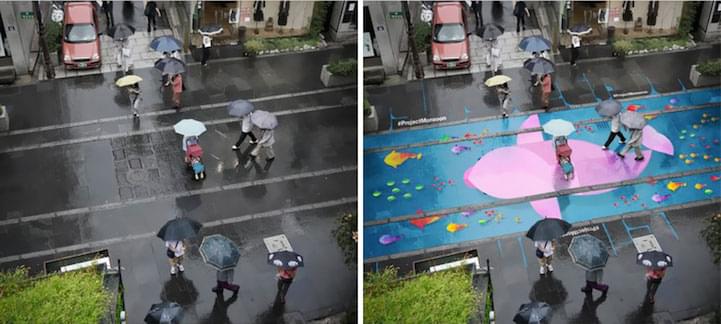
Water-Activated Street Murals Come to Life When It Rains
Making a rainy day fun. bigsmile
PANTONE recently collaborated with the School of the Art Institute of Chicago’s designers and art directors to transform Seoul, Korea’s streets during the dreary monsoon season. The appropriately titled Project Monsoon venture began with the creative team painting Seoul’s somber roads with hydrochromic paint–a type of paint that changes from transparent to opaque when it gets wet–to form colorful murals inspired by South Korean culture. East Asian customs focus on the river and its elegant flow, which is exactly what the designers wanted to capture in their public works of art. These exuberant pieces are then unexpectedly unveiled as rain falls from the cheerless gray sky and the water droplets come in contact with the ground.