McAfee says the campaign uses unsigned. NET and Golang installers, EtherHiding C2, and silent Chromium extension injection to swap wallet addresses.


Alpha Centauri is 4.37 light years away—so could we reach it in 20 years? Only by leaving ordinary rockets behind for beamed sails, antimatter, or stranger drives. 🚀 Join this channel to get access to perks: https://www.youtube.com/channel/UCZFipeZtQM5CKUjx6grh54g/join 🛒 SFIA Merchandise: https://isaac-arthur-shop.fourthwall.com/ 🌐 Visit our Website: http://www.isaacarthur.net ❤️ Support us on Patreon: https://www.patreon.com/IsaacArthur ⭐ Support us on Subscribestar: https://www.subscribestar.com/isaac-arthur 👥 Facebook Group: https://www.facebook.com/groups/1583992725237264/ 📣 Reddit Community: https://www.reddit.com/r/IsaacArthur/ 🐦 Follow on Twitter / X: https://twitter.com/Isaac_A_Arthur 💬 SFIA Discord Server: https://discord.gg/53GAShE

I show how the time dilation derived in special relativity by assuming an abstract concept of malleable time, can be derived in a more mechanistic manner by assuming that the cosmos is like a simulation \& time is a processing delay.
I had this idea while playing minecraft with my son — every time I approached a large villager-town the PC slowed down and I thought \.
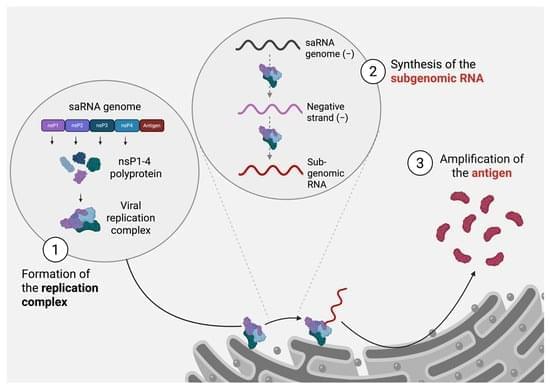
Self-amplifying RNA is synthetic nucleic acid engineered to replicate within cells without generating viral particles. Derived from alphavirus genomes, saRNA retains the non-structural elements essential for replication while replacing the structural elements with an antigen of interest. By enabling efficient intracellular amplification, saRNA offers a promising alternative to conventional mRNA vaccines, enhancing antigen expression while requiring lower doses. However, this advantage comes with challenges. In this review, we highlight the key limitations of saRNA technology and explore potential strategies to overcome them. By identifying these challenges, we aim to provide insights that can guide the future design of saRNA-based therapeutics, extending their potential beyond vaccine applications.
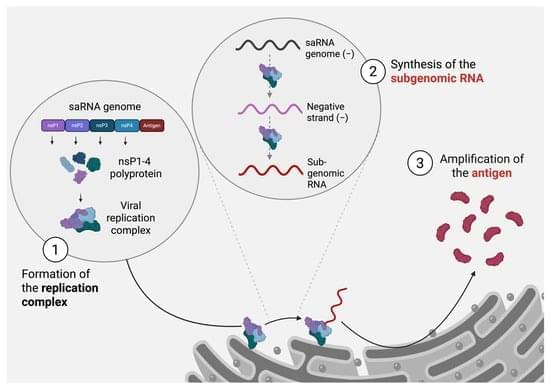
Self-amplifying RNA is synthetic nucleic acid engineered to replicate within cells without generating viral particles. Derived from alphavirus genomes, saRNA retains the non-structural elements essential for replication while replacing the structural elements with an antigen of interest. By enabling efficient intracellular amplification, saRNA offers a promising alternative to conventional mRNA vaccines, enhancing antigen expression while requiring lower doses. However, this advantage comes with challenges. In this review, we highlight the key limitations of saRNA technology and explore potential strategies to overcome them. By identifying these challenges, we aim to provide insights that can guide the future design of saRNA-based therapeutics, extending their potential beyond vaccine applications.
Buy Anker Prime 160W Charger on US Amazon: https://ankerfast.club/AnkerTech_302069
Visit the official website to learn more about Ask Me Anker-Thing: https://shop.anker.com/AnkerTech_anas…
#AnkerTech.
Timestamps:
00:00 — New Semiconductor.
08:44 — Computers of The Future.
My Podcast on Apple: https://podcasts.apple.com/at/podcast…
My Podcast on Spotify: https://open.spotify.com/show/3drr7A8… Let’s connect on LinkedIn: / anastasiintech Newsletter: https://anastasiintech.substack.com Instagram:
/ anastasi.in.tech Patreon:
/ anastasiintech.
Let’s connect on LinkedIn: / anastasiintech.
Newsletter: https://anastasiintech.substack.com.
Instagram: / anastasi.in.tech.
Patreon: / anastasiintech.