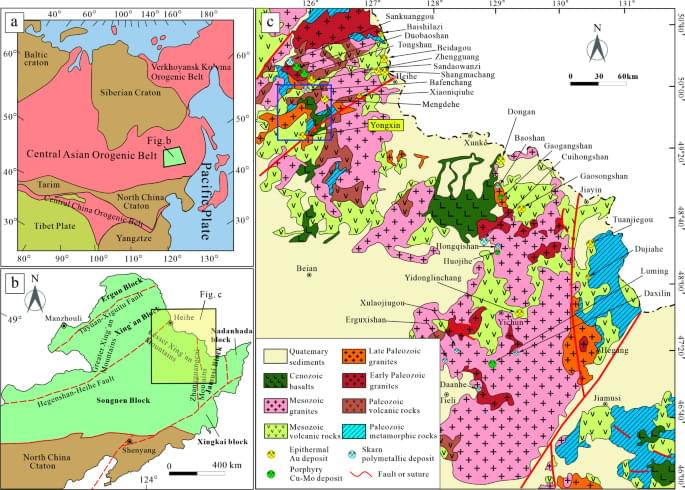
Geophysical exploration techniques play a pivotal role in enhancing the accuracy of mineral prospecting predictions. However, relying solely on individual methods often introduces uncertainties. This study presents a case study from the Yongxin gold deposit, where we integrated audio-frequency magnetotelluric (AMT) methods with gravimetric surveying and high-resolution magnetic profiling to overcome this challenge. Advanced three-dimensional modeling techniques were utilized to precisely delineate lithological variations and deep-seated mineralization features inherent to the area. The inversion and interpretation of cross-sectional AMT data provided insights into the subsurface structure down to a depth of 1.5 km. This enhanced data reliability was achieved through an integrated interpretation constrained by multiple datasets, enabling a more accurate inference of the deeper geological framework. Furthermore, by amalgamating various datasets, we uncovered characteristics of deep mineralization, the three-dimensional configuration of mineralization-related rock masses, and the spatial orientation of known ore deposits. This holistic approach facilitated a comprehensive understanding of the deeper geological formations. A detailed analysis of ore-controlling structures and exploration markers led to the development of a tailored geological-geophysical model for mineral exploration within the study area, serving as a valuable reference for future deep exploration efforts.
(Note China found over $80 billion worth of gold with the help of new mineral prospecting technological advances)
Scientific Reports -Sci Rep 15, 7258 (2025). https://doi.org/10.1038/s41598-025-92108-3